Showing posts with label Genetics. Show all posts

Genetically Italian Iron Age Balkans

February 8, 2022

The Anthrogenica member who made the genetic distance maps showing that Ancient Greeks and Romans were identical to Modern Italians did the same thing with Iron Age (pre-Slavic) Balkan samples, confirming that they were also genetically similar, with "Croatians" in the north being more Northern Italian-like and "Bulgarians" in the south being more Southern Italian (and Greek)-like. This is indigenous Southeastern European ancestry combining Neolithic Farmers and Bronze Age Indo-Europeans, which is clearly the same ancestry that's still in Italy today.

Iron Age Croatia:


Iron Age Bulgaria:


North and South Steppe/Caucasus Ancestry

January 28, 2022

Indo-European languages originated somewhere in the Russian Steppe/Caucasus Mountains area, and studies like Sarno et al. (2017) have suggested that some of them were spread to Europe (especially the Balkans and Italy) through a southern route by a population that was different than the Yamnaya who went north.

A recent study found that in the Steppe/Caucasus zone during the Bronze Age there were two distinct populations: a Northern one (which the authors call "Steppe") and a Southern one (which they call "Caucasus"). Both had CHG/Iran-related ancestry and similar mtDNA, but "Steppe" was mixed with EHG/ANE and had mainly Y-chromosome haplogroup R, whereas "Caucasus" mostly lacked EHG and was mainly haplogroup J.

It's clear that Italy and the Balkans received more of the Southern kind of ancestry, which could have brought with it languages like Greek, Albanian, Illyrian, Thracian, Messapian and maybe others too. (It would also likely be the source of the Anatolian and Armenian branches of IE).


Based on PCA and ADMIXTURE plots we observe two distinct genetic clusters: one falls with previously published ancient individuals from the West Eurasian steppe (hence termed 'Steppe'), and the second clusters with present-day southern Caucasian populations and ancient BA individuals from today's Armenia (henceforth called 'Caucasus'), while a few individuals take on intermediate positions between the two. The stark distinction seen in our temporal transect is also visible in the Y-chromosome haplogroup distribution, with R1/R1b1 and Q1a2 types in the Steppe and L, J, and G2 types in the Caucasus cluster (Fig. 3a, Supplementary Data 1, Supplementary Note 4). In contrast, the mitochondrial haplogroup distribution is more diverse and similar in both groups (Fig. 3b, Supplementary Data 1).

[...]

Our fitted qpGraph model recapitulates the genetic separation between the Caucasus and Steppe groups with the Eneolithic steppe individuals deriving more than 60% of ancestry from EHG and the remainder from a CHG-related basal lineage, whereas the Maykop group received about 86.4% from CHG, 9.6% Anatolian farming related ancestry, and 4% from EHG. The Yamnaya individuals from the Caucasus derived the majority of their ancestry from Eneolithic steppe individuals, but also received about 16% from Globular Amphora-related farmers (Fig. 5, Supplementary Note 6).

[...]

The insight that the Caucasus mountains served as a corridor for the spread of CHG ancestry north but also for subtle later gene-flow from the south allows speculations on the postulated homelands of Proto-Indo-European (PIE) languages and documented gene-flows that could have carried a consecutive spread of both across West Eurasia. This also opens up the possibility of a homeland of PIE south of the Caucasus, and could offer a parsimonious explanation for an early branching off of Anatolian languages, as shown on many PIE tree topologies. Geographically conceivable are also Armenian and Greek, for which genetic data support an eastern influence from Anatolia or the southern Caucasus, and an Indo-Iranian offshoot to the east. However, latest ancient DNA results from South Asia suggest an LMBA spread via the steppe belt. Irrespective of the early branching pattern, the spread of some or all of the PIE branches would have been possible via the North Pontic/Caucasus region and from there, along with pastoralist expansions, to the heart of Europe. This scenario finds support from the well attested and widely documented 'steppe ancestry' in European populations and the postulate of increasingly patrilinear societies in the wake of these expansions.

The two clusters are represented in the PCA, and the dotted lines show trajectories of admixture: the pink one between Western European Farmers and the Northern Steppe/Caucasus cluster, and the brown one between Eastern European Farmers and the Southern Steppe/Caucasus cluster. All Italians (and Balkan peoples) are on those clines and plot between the two dotted lines, near the bottom.


Wang et al. "Ancient human genome-wide data from a 3000-year interval in the Caucasus corresponds with eco-geographic regions". Nat Commun, 2019.

Pre-Roman Population Structure

October 14, 2021

There's a new study on Etruscans that makes a ridiculous claim about Modern Italians. Because the Etruscans were West Mediterranean (Iberian-like) and Imperial Romans were shifted toward the East Mediterranean, the authors stupidly assume that Modern Italians must be a ~50/50 mix of Etruscans and slaves/barbarians from the Roman Empire, with a North-to-South cline going from Western Europe to the Near East/Levant. But that ignores the entire Pre-Roman demographic history of Italy and Europe, and contradicts the findings of Antonio et al. (2019) that Roman Republicans already resembled Modern Italians, and that foreigners disappeared after Rome fell.

As five other new studies show, population structure in Italy is much more ancient. Modern Italians, like other Europeans, are actually in a cline from Sardinian-like Anatolian Neolithic (AN) Farmers, with varying Western Hunter-Gatherer (WHG) admixture, to the Bronze Age "Steppe" — a mix of divergent components including Caucasus Hunter-Gatherer (CHG) and Iranian Neolithic (IN) from the "Middle East", and Eastern Hunter-Gatherer (EHG) and Ancient North Eurasian (ANE) from "Northeast Asia". The reason Italians (especially in the South) appear closer to the "Levant" is that they have higher AN and CHG/IN, and lower WHG and EHG/ANE, than most other Europeans, because they were more affected by early farmers and then by migrations that brought Indo-European languages and later Ancient Greek culture from the Balkans in Southeastern Europe.

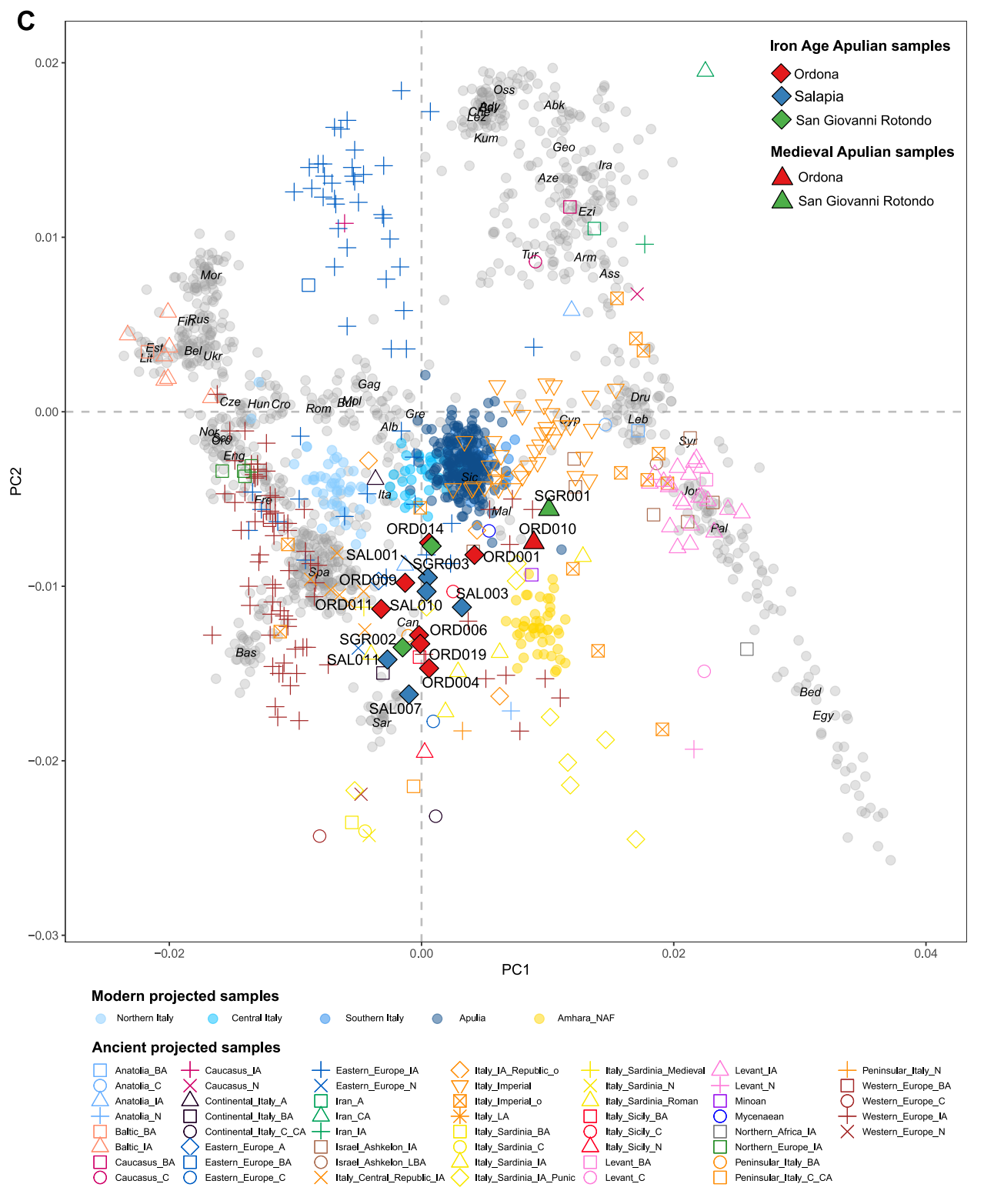
As you can see in the PCA of the first study, Iron Age Eastern Europeans (dark blue plus signs) were very "diverse", with a few still mostly CHG/IN and some way over in France. About 10 of them already cluster with Modern Italians and Southern Europeans. The cline away from AN/WHG is very obvious, going from bottom to top, with samples of Iron Age Apulians (IAA) from Southern Italy moving over time toward the broad "Steppe" zone and up to where Italians and other Europeans are today:


In order to shed light on this and to provide a genetic picture of Iron Age Southern Italy, we collected and sequenced human remains from three archaeological sites geographically located in Northern Apulia (the area historically inhabited by Daunians) and radiocarbon dated between 1157 and 275 calBCE. We find that Iron Age Apulian samples are still distant from the genetic variability of modern-day Apulians, they show a remarkable genetic heterogeneity, even though a few kilometers and centuries separate them, and they are well inserted into the Iron Age Pan-Mediterranean genetic landscape. Our study provides for the first time a window on the genetic make-up of pre-imperial Southern Italy, whose increasing connectivity within the Mediterranean landscape, would have contributed to laying the foundation for modern genetic variability. In this light, the genetic profile of Daunians may be compatible with an autochthonous origin, with plausible contributions from the Balkan peninsula.

[...]

To explore the genetic make-up of the IAA population, we performed a PCA projecting the ancient individuals onto the genetic variation of modern Eurasian samples (Figure 1C, Data S2 and Data S3). Our samples are largely scattered between modern peninsular Italians and Sardinians, and, in contrast to what was generally described for other European Iron Age populations (e.g., Northern_Europe_IA, Western_Europe_IA and Levant_IA in Figure 1C), they are still clearly distant from the genetic variability of modern-day inhabitants of Apulia. The downward shift of Iron Age Apulians from the present-day ones is further confirmed by the significantly negative f4(Modern Apulians, IAA; X, Mbuti), where X is a Neolithic/Chalcolithic/Copper Age population (Figure 2A, Data S4). Within the remarkable heterogeneity reported by the PCA, which does not mirror the archaeological sites, the two medieval individuals are shifted towards modern Middle Eastern and Caucasus populations (ORD010 and SGR001), while the others are stretched along the PC2. This pattern partially mirrors the chronological date with the most recent being more similar to present-day Southern Europeans, and is further strengthened when considering the PC3 distribution (Figure S2). Three samples located at the bottom of the PCA (ORD004, ORD019, SAL007) and one (SAL010) falling in the middle did not include modern Apulians among the top 25 results of an f3 outgroup analysis (Figure S3). All of them showed an affinity to Copper and Bronze Age Italians as well as the Aegean and the Mediterranean worlds (including Minoans, Greece, Croatians, and Gibraltar). A similar distribution is mirrored in the Multi-Dimensional scaling (MDS) built from the f3 outgroup measures, where the oldest IAA individual (SAL001; 1235 - 1048 calBCE (95.4%)) lies farthest from the modern samples, while the medieval ones (ORD010: 1078 - 1156 cal CE (95.4%) and SGR001: 670 - 774 cal CE (95.4%)) are the closest (Figure S4).

[...]

The geographic location of Apulia, a narrow peninsula stretching out in the sea at the South of Italy, has made this region an important Mediterranean crossroads connecting Western Europe, the Balkans, the Aegean, and Levant worlds. This is reflected in the PCA where IAA individuals are closely related to other Iron Age populations from the Mediterranean and surrounding areas (e.g., Montenegro, Bulgaria and Sardinia) (Figure 1C and Figure S4).

[...]

In order to shed light onto the genetic composition of the IAA individuals, we modelled them as a combination of the main ancestries documented across Western Europe at that time: Western Hunter-Gatherers (WHG), Anatolian Neolithic (AN), Steppe-related and, interchangeably, Caucasus Hunter-Gatherers (CHG) or Iranian Neolithic (IN) using the qpWave/qpAdm framework (Figure 2B, Figure S5A, STAR Methods). Broadly, the contributions of such ancestries to the genetic variability of ancient European populations vary according to their geographical positions: in particular, northernmost locations received higher proportions of WHG, Steppe-related ancestry and, consequently, CHG ancestries, while Southern European groups carried variable Iranian Neolithic or CHG traces. In view of this, we observed that while the IAA individuals could generally be modelled as a two-way admixture between AN and Steppe (0.63±0.08 and 0.37±0.08, respectively), the alternative model AN + CHG/IN could also fit for a subset of them, particularly in case of the samples ORD004, ORD010 and SAL010 with higher or comparable p-values (Figure S5A, first row with two sources). When three or four sources were tested, the presence of WHG ancestry in the majority of our individuals emerges, which, together with AN, Steppe and CHG/IN, forms a supported model for IAA samples (Figure 2B, Figure S5A and Data S5). Notably, for the individuals stretching downwards in the PCA (ORD004, ORD019, SGR002 and the Medieval ORD010) a three-way admixture involving AN, Steppe and CHG/IN is generally preferable.

[...]

We also investigated whether the PCA scattering was due to varying African or Levantine contributions with f4(Rome Republican, IAA, Levant_N/YRI, Mbuti) and tried the same on Medieval ancient Apulians (ORD010 and SGR001). However, none of the tested ancient Apulians shows a significant excess of YRI ancestry when compared to the contemporary Roman Republicans, even though ORD014, SAL007 and SAL011 show negative f4 values with a Z-score between 2 and 3 (Figure S8B).

The second study shows that the descendants of those Iron Age Balkan peoples (blue squares) in a Serbian sample dated to a later period (but before they were changed by Slavic migrations) all cluster with Modern Italians, forming the same kind of cline as in Italy from Iron Age Slovenia and Croatia in the North to Iron Age Bulgaria and Aegean in the South. This represents the original Pre-Roman ancestry of Southeastern Europe (including most of Italy).

Individuals from the first cluster fall on an area of the PCA delimited by the "Balkan Iron Age cline" (Figure 1A). Consistent with this, we model the ancestry of this Balkans Iron Age Cluster as predominantly deriving from Iron Age (IA) groups from nearby areas in the Balkans, with 67% Aegean Bronze Age-related ancestry and the remainder Slovenia Iron Age-related ancestry (Figure 2; Supplementary section 12.1). A local origin is supported by a high frequency of Ychromosome lineage E-V13, which has been hypothesized to have experienced a Bronze-to-Iron Age expansion in the Balkans and is found in its highest frequencies in the present-day Balkans. We interpret this cluster as the descendants of local Balkan Iron Age populations living at Viminacium, where they represented an abundant ancestry group during the Early Imperial and later periods (~47% of sampled individuals from the 1-550 CE).


The third study looks back even farther, showing that population structure already existed in the Neolithic, with many Balkan and Italian farmers being more AN and less WHG, and that it kept increasing in the Bronze Age, with Sicilians starting to shift toward CHG/IN long before the Roman Empire and even before the Greek settlements of Magna Graecia. Other Italians were also starting to shift (in slightly different directions) toward their current positions.

It is globally accepted that this [Neolithic farming] demic diffusion followed both a Mediterranean route (following the Mediterranean coasts, including Italy) and a continental route (Balkan route reaching Central and Western Europe through the Danubian valley), with the terminal fringes of this migration admixing again.

[...]

However, with the increase of ancient samples examined, subtle differences between Central-West and Central-East Europe started to emerge, with samples from Western and Eastern Europe forming two distinct clusters in the PCA (Fig. 2C) (Olalde et al. 2015; Rivollat et al. 2020; Marcus et al. 2020; Saupe et al. 2021). F4 statistics and related method (qpAdm) showed that this separation is possibly due to different amounts of ancestry related to WHG. It may be possible that the populations spreading through Central and Mediterranean routes mixed differently with residing hunter-gatherer populations, with the former witnessing a higher number of admixture events, in line with some archaeological evidence suggesting a sparser mesolithic hunter-gatherer population in Southern Italy, although new archaeological surveys are needed (Mussi 2006; Martini 2019).


The Bronze Age Aegean civilizations, mainly represented by Minoans and Mycenaeans, also harboured up to a quarter of their ancestry ultimately connected with ancient populations from Caucasus and Iran. Nonetheless, only the Mycenaean individuals also showed the EHG-related component (Lazaridis et al. 2017). For this reason, at least in the Minoans, the three-way split ancestral contribution is not completely fulfilled and raises other issues about who brought the Caucasus/Iran-related component into Europe.

[...]

The work from Antonio and colleagues examined the genetic transitions experienced by Central Italians which, during the Iron Age, would have given origin to the founders of the Roman civilization (Antonio et al. 2019). While they detected the suggestive presence of a small amount of the Caucasus/Iran-related component as early as the Neolithic period, they observed an increase of that component during the Bronze and Iron Age (between~4800 and 2850 ya), possibly due to increased trade-driven mobility.

[...]

The Steppe ancestry started appearing in Sicily around 4150 ya, during the Early Bronze Age, as demonstrated by qpAdm modelling on autosomal genetic variation with two notable outliers carrying up to 20% and 40% of this genetic component (Sicily_EBA8561 and Sicily_EBA11443, (Fernandes et al. 2020). Starting from the Middle Bronze Age (3750–3450 ya), Sicilian samples show a considerable shift in the PCA towards Minoans and Mycenaeans (Fig. 3A, Minoans and Mycenaeans are grouped in the Balkan area in green) and can be modelled with the Iranian-related component in a percentage around 15% (Fernandes et al. 2020). This data opens up the fascinating possibility that this mysterious ancestry must have reached Southern Italy before the occupation of the southern coastal areas of Italy (Magna Graecia). Conversely, ancient Sardinians showed a higher degree of genetic continuity from the Neolithic to the Bronze Age, with almost all individuals showing similar proportions of Anatolian Neolithic and WHG ancestries.

[...]

Multiple Iron Age populations characterized by different languages and cultures lived in Italy but, genetically speaking, they started to approximate the modern Italians (Aneli et al. 2021; Antonio et al. 2019).


The fourth study focuses on the same process in new samples from Northern and Central Italy (previously published samples are the circles with black borders). It shows again the AN/WHG structure in Neolithic Europe, but the Bronze/Iron Age Italian cline this time is shifted slightly away from the Balkan kind of Steppe ancestry toward the kind with more EHG/ANE that likely came across the Alps from Central Europe.

The human remains are from one necropolis (Necropoli di Gattolino; hereafter, "Gattolino") and three cave sites located in Northeastern (Grottina dei Covoloni del Broion: "Broion") and Central Italy (Grotta La Sassa: "La Sassa" and Grotta Regina Margherita: "Regina Margherita"; Figures 1A and S1).

[...]

A separation within the EN [European Neolithic] cluster (Figure 2A) clearly differentiates Anatolian and Eastern Europe N (right) from Western Europe N, defined as samples west of Germany (left, toward western hunter-gatherer [WHG]; Data S1D). A similar separation has already been reported and interpreted as a difference in WHG proportion of these samples. We note that most of our Chalcolithic individuals fall on the right side of the cluster (Anatolia and Eastern Europe).

[...]

Our analyses show the expected signature of peri- and post-BA movements from Steppe-related populations across Italy: absent in Italian individuals from the N and Chalcolithic, emerging in the Early BA (Italian Bell Beaker [I2478: 2195–1940 calBCE], Italian Remedello [RISE486: 2134–1773 calBCE], and Broion [BRC010: 1952–1752 calBCE (95.4%)]) and increasing through time in the individuals from Broion and Regina Margherita (GCP003: 1626–1497 calBCE [95.4%]). These samples confirm the date of arrival in Northern Italy to at least 2000 BCE and its presence in Central Italy by 4 centuries later, although denser sampling strategies are needed to assess the dynamics of this spread. Our qpAdm results suggest that the Steppe-related ancestry component could have arrived through Late N/Bell Beaker groups from Central Europe, though what remains unknown due to small sample size and limited geographical and chronological distribution is whether there were multiple Steppe population sources and the exact timing and diffusion of this ancestry component through the Italian Peninsula. The R1b subtype found in BA Broion is a lineage found in both ancient Sicilian samples and Italian Bell Beakers. Together with the autosomal affinity of North and Central Italian BA groups with Late N Germany, the Ychr data point to a possibly Northern-, transalpine-, and potentially Bell-Beaker-associated source of the Italian Steppe-related ancestry.


The fifth study has admixture profiles for several Modern Italian groups: Sardinians, Northerners, 3 Southern samples, and "Aspromonte" (old Greek-speaking communities in the South), showing that the same pan-Italian (and pan-European) components used to model the ancient samples are also the best fits for modelling the modern ones, with the levels of each in different parts of Italy matching the clines and positions of populations in all the PCAs above.

Ancient genetic heritage of Southern Italian populations.


Since present-day patterns of genetic variation reflect both local dynamics of differentiation and the ancestral population history, in order to provide a temporal overview on the ancestral genetic legacy of analyzed Southern Italian groups we finally compared the genetic landscape defined by modern populations with a large panel of ancient DNA samples extracted from the literature and timewise spanning from the Mesolithic to the Iron Age (Suppl. Table S7).

Consistently with previous results, the PCA performed by projecting ancient samples onto the modern genetic variation reveals specific patterns of population relationships (Suppl. Figure S8). In fact, all the Southern Italian groups, besides showing a general high affinity with Anatolian and European Neolithic farmers, cluster also closely with the Chalcolithic and Bronze Age samples from Anatolian and Aegean (Minoan and Mycenaean) populations. Differences in affinity patterns were formally tested with the outgroup-f3 statistic measuring the extent of shared drift between modern Italian groups and the main ancient genetic components represented by Western European Hunter-Gatherers (WHG), Eastern European Hunter-Gatherers (EHG), Caucasian HunterGatherers (CHG), Anatolian Neolithic farmers (AN) and Pontic-Steppe Yamnaya (EMBA). Overall Sardinia shows the highest levels of shared drift with samples of Neolithic-related ancestry compared to Northern and Southern Italy. Both Sardinians and Northern Italians show higher affinity to WHG than Southern Italians, who instead appear more affected by CHG-related groups. On the other hand, Yamnaya Steppe and EHG share more affinity to North Italy than to both Southern Italians and Sardinians (Suppl. Figure S9). In addition, qpGraph-based phylogenies consistently recapitulate the observed genetic patterns, with Sardinians showing a good fit to a two-way mixture model between populations representing Early European Farmers and West European Hunter-Gatherers (Suppl. Figure S10a), and North Italy instead achieving a successful fit to a graph model with an additional admixture event from an EHG-related lineage (Suppl. Figure S10b). Interestingly, when fitting present-day Southern Italian populations into the tested qpGraph models we find them compatible with an additional contribute that, differently from Northern Italy, does not originate from an EHG-related source but instead from a CHG-related lineage (Suppl. Figure S10c). This fits to the data in the sense that there are no f-statistics more than |Z| > 3 different between model and expectation.

Finally, to better characterize the ancestral composition of Southern Italian populations, we inferred their mixture proportions with respect to a four-population model of admixture including all the above-mentioned WHG, Neolithic, CHG/Iran_N and Steppe-related main sources, using qpAdm. All Italian populations were successfully modeled as characterized by a relatively high amount of Anatolian Neolithic ancestry, with the major contribution observed in Sardinians (Fig. 4, Suppl. Table S8). The remaining ancestries were assigned to a lower WHG contribution and to differential influences of Steppe_EMBA and CHG/Iran_N in the profiles of Northern and Southern Italians, respectively (Fig. 4, Suppl. Table S8). In fact, while Steppe ancestry is greater in North Italy (~ 27%), the Iran_N/CHG-related source is more present in South Italy with the highest values (~ 29%) observed in the populations from the Aspromonte area.


Finally, even the Etruscan study itself has a PCA showing Copper-Bronze Age Sicilians (pink triangles) creeping up to where Modern Sicilians and Southern Italians are. They don't veer left to first become like Etruscans so that they can later "mix with slaves" and do a U-turn toward the Levant. They were always Balkan-like, because Iberian-like people were not the only (or even the original) inhabitants of Italy.


So the alleged cline of Italians from Etruscans to Levantines is an illusion created by coincidental PCA positions and bad choices of reference populations for modelling. Italians are on the same Farmer-to-Steppe cline as all other Europeans. It's just that because they're geographically and genetically between Southwestern and Southeastern Europe, they're increasingly shifted toward AN/CHG/IN (peaking in the South), whereas the rest of Europe (including, somewhat, Northern Italy and the Northern Balkans) is shifted increasingly more toward WHG/EHG/ANE. And it's been that way since at least the Neolithic, up through the Bronze and Iron Age, way before the slaves and barbarians of the Roman Empire, who had almost no impact on the pre-existing population structure.

---------------
Posth et al. "The origin and legacy of the Etruscans through a 2000-year archeogenomic time transect". Sci Adv, 2021.

Aneli et al. "The genetic origin of Daunians and the Pan-Mediterranean southern Italian Iron Age context". bioRxiv, 2021.

Olalde et al. "Cosmopolitanism at the Roman Danubian Frontier, Slavic Migrations, and the Genomic Formation of Modern Balkan Peoples". bioRxiv, 2021.

Aneli et al. "Through 40,000 years of human presence in Southern Europe: the Italian case study". Hum Genet, 2021.

Saupe et al. "Ancient genomes reveal structural shifts after the arrival of Steppe-related ancestry in the Italian Peninsula". Curr Biol, 2021.

Sarno et al. "Genetic history of Calabrian Greeks reveals ancient events and long term isolation in the Aspromonte area of Southern Italy". Sci Rep, 2021.

Ancient-to-Modern Genetic Distances

October 8, 2020

Someone at Anthrogenica made these genetic distance maps that visualize how Modern West Eurasians are related to samples of Ancient Greeks and Ancient Romans, with redder coloring indicating more genetic affinity. The Ancients are all closest to Modern Southern Europeans — mostly Italians from all over, but often also Greeks, Iberians, South French and Balkan peoples. (Note: The "Imperial Romans" sample includes some foreigners from the Eastern Mediterranean, who later disappeared).

Minoan Greeks:


Mycenaean Greeks:


Iron Age Romans:


Proto-Villanovan
Villanovan


Etrsucan
Latin


Imperial Romans:


Late Antiquity Romans:


Medieval Romans:


Related: Genetically Italian Iron Age Balkans

Misleading Genetic Distance Claim

July 22, 2020

Raveane et al. (2019) show that genes mirror geography, but then they make a misleading claim implying that genetic distances (Fst) within Italy are as great as those "across the whole of Europe". To Nordicists who wrongly believe that only their corner of Europe is "fully European" and the others are "mixed", that kind of distance perpetuates the myth of racial differences between Northern and Southern Italians.

But we already know that all Italians cluster between Spaniards and Greeks, which would make "across Southern Europe" a more accurate statement. So what exactly are the authors talking about?

They base their claim on the finding that the median Fst between all of their Italian clusters is 0.0044, which is about the same as the median Fst between all of the European clusters (excluding outlier Finns), and higher than within any of the other countries examined (0.0001 to 0.002). They say that they got similar results after also excluding outlier Sardinians and Basques, but don't show the data.

However, they're still including the Northern Italian clusters from the small regions bordering France, Austria and Slovenia that have many outliers as well, which increases the genetic distances. If you just compare typical Northern Italians (from Piedmont, Lombardy and Veneto) to deep Southern Italians (from Puglia, Basilicata, Calabria and Sicily), Fst between them ranges from 0.001 to 0.0054, with a median of just 0.0024, and an average of 0.0029.

That's not too much higher than the maximum distances within the other examined countries, and it's a lot lower than truly cross-Europe Fst, which ranges from 0.005 to 0.011 between Iberia and Eastern Europe (med. 0.008, avg. 0.0077), and from 0.004 to 0.008 between Greece and Northern Europe (med. 0.005, avg. 0.0055).

It also happens to be the same as the Fst between Southwest (Spain) and Southeast (Greece) Europe (0.002 to 0.003, med. 0.003, avg. 0.0029), which is itself lower than the Fst between Northwest (Britain) and Northeast (Baltic) Europe (0.003 to 0.007, med. 0.005, avg. 0.0049).

[NOTE: The highest in their data is 0.02 between Finns and Basques, both of which I excluded from all the above calculations, along with other outliers like Orcadians and Mordovians.]

So even though genetic distances in Italy are somewhat high for a single country, they're not as extreme as implied, and they don't represent any kind of "racial" or other significant difference, but merely a normal cline that's entirely within Southern Europe and likely related to the ancient spread of Indo-European languages.

Genes and Geography (Italy vs. Britain)

January 16, 2020

All else being equal, genes mirror geography in Europe. We've already seen this by comparing Italians to Germans, and now we can do another similar comparison. A new study that has even better geographical coverage than Sazzini et al. (2016) shows the samples clustering to form an almost perfect map of Italy, while another new study shows the same thing in the British Isles.

[NOTE: For the samples in gray, "NWEur" is actually Southern French, "WEur" are Spanish and Portuguese, and "SEEur" is Greeks.]


Raveane et al. "Population structure of modern-day Italians reveals patterns of ancient and archaic ancestries in Southern Europe". Sci Adv, 2019.


Gilbert et al. "The genetic landscape of Scotland and the Isles". PNAS, 2019.

Related: Misleading Genetic Distance Claim

Pigmentation Through Roman History

December 6, 2019

The recent study on Ancient Roman DNA gives frequencies over time for some alleles of functional importance (eye and skin color). We know that Mesolithic hunters had blue eyes and dark skin while Neolithic farmers had brown eyes and light skin, which combined and adapted to make the European phenotypes of today.

But contrary to what Nordicists claim about Romans going from "Northern European" to "Middle Eastern", blue eyes and light skin (and also lactase persistence) have increased steadily since at least the Iron Age, and today they show the same levels as other Modern Europeans (Spanish, British or Finnish).

Ancient Roman DNA

November 28, 2019

We've already seen that modern Italians are genetically close to ancient Mycenaean Greeks, and now we finally have Ancient Roman DNA, which shows the same genetic closeness, refuting Nordicist fantasies about an original "Northern European" stock becoming "orientalized". The Romans (Latin and Etruscan) were all Southern European, similar to modern Italians from North to South. There were foreigners during the empire, but they weren't very exotic and didn't have much of an impact.

Most of the samples are from cemeteries in and around the city of Rome, so on one hand they're not representative of the whole country, but on the other, Rome was the biggest, most traveled-to city in all of Italy, so if there wasn't much diversity or mixing going on there, that means there would have been even less in other cities and (especially) in the small towns and rural areas that made up most of the country.

As in all of Europe, there were major changes between the Mesolithic and Iron Age, but from then on, the samples all have the same 4 main components: Western Hunter-Gatherer, Anatolian Neolithic (farmers), Iran Neolithic and Steppe Eneolithic (the last two arriving mostly with Indo-Europeans), plus very low levels of Morocco Hunter-Gatherer. Even the "diverse" imperial samples have those same components, just in slightly different proportions, so the foreigners were not that foreign.


Iron Age & Republic (dark blue)


Most of these early Latin and Etruscan samples cluster between Northern Italians and Spaniards, and a few others cluster with Northern Italians, Central Italians, Southern Italians and off toward Sardinians. So the original, pre-empire Romans were heterogeneous but fully Southern European, just like modern Italians.

By 900 BCE at the latest [before the founding of Rome], the inhabitants of central Italy had begun to approximate the genetics of modern Mediterranean populations. [...] The Iron Age individuals exhibit highly variable ancestries, hinting at multiple sources of migration into the region during this period (Figs. 2A and 3B). [...] Together these results suggest substantial genetic heterogeneity within the Etruscan (n = 3 individuals) and Latin (n = 6) groups. [...] In contrast to prehistoric individuals, the Iron Age individuals genetically resemble modern European and Mediterranean individuals, and display diverse ancestries....

Imperial Rome (teal)


At this time there appears a "tail" toward the Near East, reflecting migrants to Rome from the Eastern Mediterranean. However, most of them cluster no farther than Cyprus, which seems to confirm that "Middle Eastern" migrants to Rome were of predominantly Greek ancestry.

During the Imperial period (n = 48 individuals), the most prominent trend is an ancestry shift toward the eastern Mediterranean and with very few individuals of primarily western European ancestry (Fig. 3C). The distribution of Imperial Romans in PCA largely overlaps with modern Mediterranean and Near Eastern populations, such as Greek, Maltese, Cypriot, and Syrian (Figs. 2A and 3C).

Late Antiquity (green)


Here the "tail" to the Middle East disappears and the samples shift back westward. After the capital of the empire moved east and Rome was sacked, the population declined to almost nothing, and the city would have been repopulated by Italians from other parts of the country, and possibly other Europeans too.

The average ancestry of the Late Antique individuals (n = 24) shifts away from the Near East and toward modern central European populations in PCA (Fig. 3D). [...] This ancestry shift is also reflected in ChromoPainter results by the drastic shrinkage of the Near Eastern cluster (C4), maintenance of the two Mediterranean clusters (C5 and C6), and marked expansion of the European cluster (C7) (Fig. 4C).

This shift may have arisen from reduced contacts with the eastern Mediterranean, increased gene flow from Europe, or both, facilitated by a drastic reduction in Rome's population in this period to less than 100,000 individuals, due to conflicts and epidemics (1, 3).


Medieval & Early Modern (yellow)


Here the samples are back to being similar to the Iron Age samples, and they're identical to modern Italians from North to South, except for a few outliers tending toward Spain and France. The latter may be related to the Holy Roman Empire and Norman conquests.

In the Medieval and early modern periods (n = 28 individuals), we observe an ancestry shift toward central and northern Europe in PCA (Fig. 3E), as well as a further increase in the European cluster (C7) and loss of the Near Eastern and eastern Mediterranean clusters (C4 and C5) in ChromoPainter (Fig. 4C). The Medieval population is roughly centered on modern-day central Italians (Fig. 3F).

[...]

This shift is consistent with the growing ties between Medieval Rome and mainland Europe. Rome was incorporated into the Holy Roman Empire (3), which spanned much of central and western Europe. The Normans expanded from northern France to a number of regions, including Sicily and the southern portion of the Italian Peninsula (and even sacked the city of Rome in 1084), where they established the Kingdom of Sicily (3, 36).

Recap


  • By the time Rome was founded, its people (Latins and Etruscans) were already genetically Mediterranean, overlapping with modern Southern Europeans from Spain to Sicily.
  • The empire brought migrants to Rome from the Eastern Mediterranean, but they were mostly of Greek ancestry and not that different than the Romans.
  • When the western half of the empire fell, the migrants disappeared as Rome's population declined drastically. The city was later repopulated by Italians and other Europeans.
  • By the Middle Ages, the inhabitants of Rome were back to resembling Iron Age people and identical to modern Italians from North to South, with a few outliers tending toward Western and Central Europe.

---------------
Antonio et al. "Ancient Rome: A genetic crossroads of Europe and the Mediterranean". Science, 2019.

Related: Pigmentation Through Roman History, Ancient-to-Modern Genetic Distances

Mycenaeans and Italians

January 15, 2018

We don't have Ancient Roman DNA yet, but now we have the next closest thing: Ancient Mycenaean Greek DNA. This new study shows that Mycenaeans, like their Peloponnesean descendants, are genetically similar to modern Italians (and other Southern Europeans) because both are similar mixes of Neolithic farmers and Indo-Europeans, and also because of Ancient Greek settlements in Southern Italy.

We estimated the fixation index, FST, of Bronze Age populations with present-day West Eurasians, finding that Mycenaeans were least differentiated from populations from Greece, Cyprus, Albania, and Italy (Fig. 2), part of a general pattern in which Bronze Age populations broadly resembled present-day inhabitants from the same region (Extended Data Fig. 7). [...] Other proposed migrations, such as settlement by Egyptian or Phoenician colonists, are not discernible in our data, as there is no measurable Levantine or African influence in the Minoans and Mycenaeans, thus rejecting the hypothesis that the cultures of the Aegean were seeded by migrants from the old civilizations of these regions.

[...]

The Mycenaeans settled all of mainland Greece up to Thessaly, and throughout the Aegean islands. There is evidence of extensive Mycenaean acculturation in Western Anatolia, Italy and Cyprus and trading relations with Egypt and the Near East. The Mycenaeans were literate and used for accounting purposes a syllabic script, Linear B, written in an early form of the Greek. They introduced this script into Crete after they occupied the island.

Lazaridis et al. "Genetic origins of the Minoans and Mycenaeans". Nature, 2017.

Related: Ancient Roman DNA, Ancient-to-Modern Genetic Distances

Complex Spread of Indo-European Languages

June 22, 2017

In this recent post, I talked about how ancestry clines in Italy could be due to the way Indo-European languages spread, and a new study suggests the same thing. Italy and the Balkans, especially the southern parts, differ from the rest of Europe by having a lot of the Caucasus Hunter-Gatherer (CHG) component of Yamnaya, but not much of the Eastern Hunter-Gatherer (EHG) component. The authors conclude that Italic, Greek and Balkan branches of Indo-European may have spread directly from the Caucasus through Anatolia and not via the Russian Steppe.

The most recent literature demonstrated significant impact of Caucasus-related ancestry in the Central European Late-Neolithic and Bronze-Age through the migrations of Yamnaya/Pontic-Steppe herders. Accordingly, our results confirm that Caucasus-related admixture via Yamnaya is present in Eastern and Central-Western European clusters (i.e. Continental Europe; Supplementary Table S8, Supplementary Information). However, among our Mediterranean groups, evidence of Yamnaya (and EHG) introgression seems to be present at a lesser extent and was detected mainly in Balkan-related groups (Supplementary Table S8, Supplementary Information), which in turn display traces of admixture with Eastern Europe (Fig. 4, Supplementary Fig. S2). In addition, outgroup-f3 values for Late Neolithic/Bronze Age samples (especially Yamnaya) appear lower in all our newly analysed Mediterranean populations (Supplementary Fig. S9). These results suggest that the genetic history of Southern Italian and Balkan populations may have been, at least in part, independent from that of Eastern and Central Europe, involving specific migratory events that carried Caucasian and Levantine genetic contributes along the Mediterranean shores (see Supplementary Information). This picture may bring important implications for our understanding of the cultural history of Europe, and in particular for the diffusion of Indo-European languages. The Steppe in the Early Bronze Age has been supported as a source of at least some Indo-European languages entering North-Central Europe at that time. In southern Mediterranean Europe, however, our results suggest lower impacts. Any significant Steppe/northern component may have arrived in the south Balkan mainland and southern Italy only later, by which time Indo-European languages of the Italic, Greek and various Balkan branches had already established themselves there. This would suggest that a Bronze Age Steppe source may be not highly consistent with all branches of the Indo-European family (see also Broushaki et al.).

[...]

Summing it up, our analyses show that a Caucasus-related ancestry is observed in both Southern Italian and Southern Balkan populations. Nevertheless, these populations do not seem to reveal such significant evidence of Bronze-Age Yamanya-like introgressions, which have been interpreted as the most probable vectors of CHG-like ancestry in Central-Eastern and Northern Europe and were also linked with the demographic diffusion of some Indo-European languages. These results may suggest that Caucasus-related ancestry reached our Mediterranean populations through migratory events at least partly independent from those postulated for Central Europe, most likely through Anatolia. If so, the spread of Indo-European languages in Europe may be envisaged as a more complex multi-way phenomenon, rather than the one-way result of a single diffusion process.

Sarno et al. "Ancient and recent admixture layers in Sicily and Southern Italy trace multiple migration routes along the Mediterranean". Scientific Reports, 2017.

Related: North and South Steppe/Caucasus Ancestry

Genetically Southern European

May 31, 2017

Genetic studies on Italians often say that Northerners are "closer" to Central and Northern Europeans while Southerners are "closer" to Middle Easterners and North Africans. Technically that's true because of simple geography, but it's misleading because it makes it seem like they cluster with those distant populations, which is false. All Italians cluster with other populations from Southern Europe.

This new study is mainly about Peloponnesean Greeks and how they haven't changed much since ancient times, but they also happen to be the group of Greeks who are genetically closest to Southern Italians. In addition to 5 Italian samples from all over the country, the study also has a large sample of Spaniards (including Andalusians from the south), who are genetically closest to Northern Italians.

Confirming many other studies, this PCA plot shows that the Italian samples — Lombards (labeled "Italians"), Venetians, Tuscans (including "TSI"), and Sicilians — cluster in a North-to-South cline between the Spanish and Greek samples, i.e. Southwestern and Southeastern Europe on the map. (Sardinians, as always, are outliers because of their almost purely Neolithic farmer ancestry.)


In these plots, with the Peloponnesean Greeks (in red) acting as a proxy for the southernmost Italians (and therefore all Italians and Southern Europeans in general), we can see that they're genetically distinct from all non-European populations of Western Eurasia, North Africa and beyond.


Supplementary Figure 2: Comparisons of Peloponneseans with non-European populations. PCA analysis of Peloponneseans and A. Near East. B. Caucasus. C. North Africa. D. East Africa. E. Arabia. F. West Siberia populations.


Stamatoyannopoulos et al. "Genetics of the peloponnesean populations and the theory of extinction of the medieval peloponnesean Greeks". Eur J Hum Genet, 2017.

Much Better Population Structure

April 16, 2017

This new study confirms the results of previous studies by Di Gaetano et al. (2012) and Fiorito et al. (2016) but has much better geographical coverage of samples, with 737 individuals from 20 locations in 15 different regions being tested, making the earlier genetic "gap" between North-Central and Southern Italians disappear, filled in by an intermediate Central Italian cluster, creating a continuous cline of variation down the peninsula (with Sardinians as outliers) that mirrors geography.


The four new Italian samples from this study (N_ITA, C_ITA, S_ITA and SARD) cluster right on top of older Italian samples from Bergamo, Tuscany, Abruzzo, Sicily and Sardinia used in earlier studies, which are barely visible underneath, showing that the results are consistent. Northern Italians once again cluster with Spaniards, and there's a small Greek sample this time, but it's not from the areas closest to Southern Italians, clustering more with the Central Italians instead.


The study also for the first time includes a formal admixture test that models the ancestry of Italians by inferring admixture events using all of the Western Eurasian samples. The results are very interesting in light of the ancient DNA evidence that has come out in the last couple years.

When top 1% of most significant f3 values were retained according to computed Z-scores, 85% of tested population trios actually involved Italian clusters (Supplementary Table S2). In addition to the pattern described in the main text, the SARD sample seemed to have played a major role as source of admixture for most of the examined populations, especially Italian ones, rather than as recipient of migratory processes. In fact, the most significant f3 scores for trios including SARD indicated peninsular Italians as plausible results of admixture between SARD and populations from Iran, Caucasus and Russia. This scenario could be interpreted as further evidence that Sardinians retain high proportions of a putative ancestral genomic background that was considerably widespread across Europe at least until the Neolithic and that has been subsequently erased or masked in most of present-day European populations.

It's known that Sardinians are almost identical to Early European Farmers from the Neolithic, and that the Indo-Europeans who spread their languages all across Europe in the Bronze Age were a mix of Eastern Hunter-Gatherers from the Russian Steppe and either Caucasus Hunter-Gatherers or Chalcolithic Iranians (who are very similar).

So it looks like Italians resemble other Europeans in being a mix of early European farmers and later Indo-European invaders. The farmer ancestry (which is ultimately from Anatolia) has an expected southeast to northwest cline in Europe, but surprisingly not within Italy. According to the study's estimates, it's about the same amount in the North as it is in the South. The two regions actually differ in their Indo-European related ancestries, caused by inverse clines of the "Caucasus/Iran" and "Russian Steppe" components.

The purple component was predominant in Southern European groups and equally distributed along the peninsula (average frequency of 46%), almost reaching fixation in Sardinians (85%) plausibly due to their long-term isolation especially to Post-Neolithic processes. [...] The green component was considerably represented in samples from Caucasus and Middle East, being also evident in some Southern European populations (e.g. Greeks) and, especially, in Southern Italy (28%), progressively decreasing towards the northern part of the peninsula (12%). [...] The red component characterized most of Central and Eastern European populations, being reduced in Sardinia (7.4%) and showing a decreasing north-south gradient in peninsular Italy (from 39% in N_ITA to 20% in S_ITA).

This difference could be explained by the fact that Ancient Italy was home to a variety of Indo-European speakers: Italic languages spread everywhere, Celtic languages were spoken in the North, and Greek and Illyrian languages in the South. It's likely that some of these arrived via southern route through the Balkans while others took a northern route over the Alps, and the people who brought them thus had different levels of "Caucasus" and "Russian" ancestry.

---------------
Sazzini et al. "Complex interplay between neutral and adaptive evolution shaped differential genomic background and disease susceptibility along the Italian peninsula". Scientific Reports, 2016.

Related: Complex Spread of Indo-European Languages

More Italian Population Structure

August 10, 2016

This new study is a follow-up to Di Gaetano et al. (2012) by the same team. It increases the number of SNPs, improves the sample selection criteria, and incorporates some newer methods, but it has a lot of the same problems. The main findings are that genetic variation in Italy is clinal going from the Western to the Eastern Mediterranean (with Sardinians as outliers) and that all Italians are made up of the same ancestral components, in different proportions, related to Paleolithic, Neolithic and Bronze Age settlements of Europe (with minor recent Lombard/Norman and Moorish admixture).

We hypothesize two simple historical scenarios leading to the observed genetic variability across Italy: (a) continuous ancient gene flow amplified by isolation-by-distance in recent times; (b) different ancestral origins of the main Italian macroareas whose distinguishability has been attenuated by genetic exchange in recent times.

Monmonier's algorithm revealed no evidence of the presence of genetic barriers across the peninsula. Instead, results from the Mantel test provide evidence of a correlation between genetics and geographical distance. The observed higher average length of the segments with shared IBD within regions compared with those shared between regions (Supplementary Table S2B) suggests recent isolation-by-distance across the wide range of latitude of the Italian peninsula. Moreover, a North to South gradient of increasing ancestral Ne was inferred for the three main macroareas (Northern, Central and Southern), coinciding with increased heterozygosity in Southern Italy. A similar trend was previously described for the rate of inbreeding and genome-wide similarity across Central Europe, and could be interpreted as a signature of the 'Out of Africa' migration during Palaeolithic expansions from refugia after the ice age and of ancient South-to-North migratory waves that occurred at the times of European colonization by Neolithic farmers. The ancestry and IBD analyses provided evidence of admixture in Italy with three major ancestries detected, most represented in Northern Europeans, Southern Europeans and Middle Eastern, respectively (with a small percentage of a North African component found in South Italy and Sardinia), with different prevalence across the peninsula. None of these components is fixed in any population, meaning that there is a poor fit with a strict admixture model, as assumed by the algorithm used, and supporting a process of continuous gene flow in multiple directions (migratory waves to and from Italy). According to previous studies on the Y chromosome and mtDNA, the Middle Eastern ancestry in Southern Italians most likely originated at the time of the Greek colonization and, with a smaller percentage, of the subsequent Arabic domination, whereas in Central-Northern Italy it is possibly because of the admixture of the indigenous residents with Middle Eastern populations spreading from the Caucasus to Central Europe. Our results agree with previously published reports describing a possible maritime route of colonization across Europe, including Italy, although we cannot exclude the occurrence of more recent demographic events leading to a similar scenario. Finally, the homogenous ancestral effective population size across Italian regions could be interpreted as reflecting common genetic origins, taking also into account previous considerations, although the same results might also occur in comparing populations without common origins.

Our study supports the notion that genetic variability across Italy is likely to represent continuous gene flow leading to differences in the proportion of ancestry from different sources, along with genetic exchange among neighbouring populations (eg, Northern Italian with European countries, Southern Italian with Middle Eastern and North African ones). Previous studies, analysing uniparental markers, found Y-chromosome genetic discontinuity across Italy. This contrasts with a general lack of structure for mitochondrial DNA, and with a higher homogeneity for maternal than paternal genetic contributions, suggesting different demographic and historical dynamics for females and males in Italy.

One issue is that the samples are still unevenly distributed, with a big gap between North-Center and South — which is reflected in the PCAs — and almost nothing from the eastern part of the country. (Note: the genetic gap between Aosta Valley and its very close neighbor regions is due to some of it being ethnically French).


Principal component analysis based on the coancestry matrix including Sardinians (b) and excluding Sardinians (c); x and y axes were inverted to emphasize similarity to the geographical map of Italy.

This time they do include a few Iberians for comparison, and that's who Northern Italians cluster with. But besides a few Cypriots, there are still no Greeks, which Paschou et al. (2014) and many other studies show Southern Italians clustering with. Sardinians, as always, are the closest to Ötzi the Iceman.


Fiorito et al. "The Italian genome reflects the history of Europe and the Mediterranean basin". Eur J Hum Genet, 2016.

Related: Much Better Population Structure

Italian Clustering vs. German Clustering

September 14, 2015

Some people with a Nordicist agenda will use the fact that Northern Italians are a little bit closer than Southern Italians to Northern Europeans as evidence supporting the myth of racial differences between Northern and Southern Italy resulting from Germanic and Arab/African invasions. But there's no reason to expect all Italians to form a tight cluster. Genetic distance is largely a product of geographic distance, and Italy is long and curved, stretching from the Western Alps in the North to the Eastern Mediterranean in the South. So it's normal that Italians would be spread out in a broad cluster that mimics the shape of the country. Tian et al. (2009), which sampled Lombards, Tuscans, Southern Italians and Sardinians, noted exactly this pattern:

To further explore the relationship among European population groups and examine population substructure, PCA was performed using the genotype results from a set of ~300,000 autosomal SNPs that was common to each of the populations examined. For most individuals with self-reported ethnic identities, there was a general correspondence with the geographical location of origin (Figure 1A). For example, the relationship of Italian groups and the subjects from the island country of Sardinia shows a striking resemblance to maps of Europe. In addition, genotypes from the same or related population groups typed in different laboratories showed similar PCA results (for example, north Italian and Tuscan groups genotyped as part of HGDP overlapped with Italian American subjects).

The same thing can be seen in other large countries, like Germany for example. Below is a detail of Figure S2 from Nelis et al. (2009). The Germans are spread out over an even greater area than the Italians, with Northern Germans (from Schleswig-Holstein) tending to the right and Southern Germans (from Bavaria) tending to the left, similar to the pattern observed with the Northern Italians (from Piedmont) and Southern Italians (from Puglia):


The distance between the Northern and Southern locations in each country is about 430 miles (690 km), and accordingly, the median values of PCs for the corresponding sample sets are about the same genetic distance:


In addition, Germany has East-West differences that seem to be even more prominent. The cities of Munich and Dresden are only 223 miles (359 km) apart, yet according to Heath et al. (2008), their populations form two distinct genetic clusters connecting Eastern and Western Europeans, just like on the map:


All of this is ultimately related to the clinal distribution of Mesolithic hunter-gatherer and Neolithic farmer ancestry, which shifts Northern and Eastern Europeans slightly toward Siberia, and Southern and Western Europeans slightly toward the Middle East, and can also have an effect within nations. Indeed, even smaller and less populous Germanic nations have noticeable population structure that follows the same pattern seen in Italy, Germany and Europe as a whole.

Lao et al. (2013) observed it in the Netherlands:

We detected a subtle but clearly noticeable genomic population substructure in the Dutch population, allowing differentiation of a north-eastern, central-western, central-northern and a southern group. Furthermore, we observed a statistically significant southeast to northwest cline in the distribution of genomic diversity across the Netherlands, similar to earlier findings from across Europe. [...] This genetic diversity cline is traditionally explained by several major prehistoric demographic events in Europe: the first colonization of Europe by anatomically modern humans together with a postglacial re-expansion from the southern European refugee areas in Palaeolithic times, and the introduction of the Neolithic agricultural lifestyle by people from the Near East.

And Humphreys et al. (2011) observed it in Sweden:

In a comparison of extended homozygous segments, we detected a clear divide between southern and northern Sweden with small differences between the southern counties and considerably more segments in northern Sweden. [...] The first principal component showed the presence of a north-south genetic gradient that was mainly driven by each northern county being different from other counties. Systematic variation was present in the south of Sweden although to a markedly smaller degree than in the north of Sweden. [...] The overall North-South axis of variation is consistent with previous studies that have shown axes of variation on a European scale that closely line up with geographical axes.

Related: Genes and Geography (Italy vs. Britain)

Overestimated Admixture in Brisighelli (2012)

September 8, 2014

This study tries to quantify individual ancestry in Italians by using a small panel of autosomal markers that are known to produce errors and overestimate admixture compared with using the full SNP data set, and as a result it comes up with estimates of Sub-Saharan African admixture in Italy and elsewhere in Europe that are much higher than in any other study:

A panel of 52 AIMs was genotyped in 435 Italian individuals in order to estimate the proportion of ancestry from a three-way differentiation: sub-Saharan Africa, Europe and Asia. Structure analyses allowed us to infer membership proportions in population samples, and these proportions can be graphically displayed, as in Figure 2. This analysis indicated that Italians have a basal proportion of sub-Saharan ancestry that is higher (9.2%, on average) than other central or northern European populations (1.5%, on average). The amount of African ancestry in Italians is however more comparable to (but slightly higher than) the average in other Mediterranean countries (7.1%).

The authors go on to say that Sub-Saharan African admixture in Italy is also evident in uniparental markers, but they should've been suspicious of their high AIM-based estimate when they found only 1.2% mtDNA haplogroup L and no A, B or E(xE3b) Y-DNA, which leads to an admixture estimate (0.6%) that's 15 times lower.

They also should've been puzzled by other bizarre results in their structure analysis, like African admixture appearing higher in Northern and Central Italy than in Southern Italy, with an equally high amount in Britain and Japan, and a very high Asian component in Central and Southern Italians that other Europeans don't have:

52 AIMs

Indeed, when we look at many of the same and similar populations tested using 291,184 SNPs in Lazaridis et al. (2014), we can see that the pattern is totally different and fits much better with the uniparental data and known reality. Italians only have a drop (<1%) of African admixture, which is highest in the south, while the British and Japanese don't have any at all, and Asian admixture is expectedly higher in Northern and Eastern Europe than it is in Southern Europe:

291,184 SNPs

These two very different results highlight the importance of using all genome-wide data when estimating individual ancestry and admixture proportions.

---------------
Brisighelli et al. "Uniparental Markers of Contemporary Italian Population Reveals Details on Its Pre-Roman Heritage". PLoS One, 2012.

Mediterranean Sea as Genetic Barrier

June 16, 2014

This new study confirms that the Mediterranean Sea has acted as a strong barrier to gene flow through geographic isolation following initial settlements. Samples from (Northern) Italy, Tuscany, Sicily and Sardinia are closest to other Southern Europeans from Iberia, the Balkans and Greece, who are in turn closest to the Neolithic migrants that spread farming throughout Europe, represented here by the Cappadocian sample from Anatolia. But there hasn't been any significant admixture from the Middle East or North Africa into Southern Europe since then.

Genes Mirror Geography Across the Mediterranean Basin


We first used principal components analysis (PCA) to visualize the genotypic distances between studied populations. Populations on the southern and northern coasts of the Mediterranean appear to be separated by the geographic barrier of the Mediterranean Sea. The role of the Mediterranean Sea as a barrier for gene flow among populations was also supported by our analysis using the BARRIER software, which implements Monmonier's maximum difference algorithm. In accordance with this finding...the PCA distribution of the populations closely resembles the geographic map of the countries circling the Mediterranean Sea. On this PCA "map" of populations, the east coast of the Mediterranean Sea is appropriately occupied by the Palestinians and the Lebanese Druze. Yemenites and Bedouins branch out from the Mediterranean populations and are closer to the populations of the Near East.

[...]

Seljuk Turks settled in Anatolia in the 12th century AD; however, the Anatolian Cappadocians we included in this study belong to the population that have kept the religion and the language of the pre-Seljuk Cappadocians and, therefore, most likely carry the genetic makeup of the ancient Anatolians. The only important gene flows from Near East to Europe must have occurred in prehistoric times and, as genetic evidence suggests, the most prominent migrations should have occurred during the Neolithic.

[...]

Although the Southeastern Mediterranean islands seem to have acted as a bridge from Anatolia to Southern Europe, the relatively small degree of gene flow between the African and the European coasts shows that the Mediterranean Sea also had a barrier function as also suggested with studies of mtDNA polymorphisms. Thus, the Mediterranean seems to have facilitated the migrations of Neolithic farmers along its Southern European coast but it mostly acted as an isolating factor between its European and African coasts.


Paschou et al. "Maritime route of colonization of Europe". PNAS, 2014.

Related: Moors Expelled from Sicily and Southern Italy