Showing posts with label Ancient Rome. Show all posts

Pre-Roman Population Structure

October 14, 2021

There's a new study on Etruscans that makes a ridiculous claim about Modern Italians. Because the Etruscans were West Mediterranean (Iberian-like) and Imperial Romans were shifted toward the East Mediterranean, the authors stupidly assume that Modern Italians must be a ~50/50 mix of Etruscans and slaves/barbarians from the Roman Empire, with a North-to-South cline going from Western Europe to the Near East/Levant. But that ignores the entire Pre-Roman demographic history of Italy and Europe, and contradicts the findings of Antonio et al. (2019) that Roman Republicans already resembled Modern Italians, and that foreigners disappeared after Rome fell.

As five other new studies show, population structure in Italy is much more ancient. Modern Italians, like other Europeans, are actually in a cline from Sardinian-like Anatolian Neolithic (AN) Farmers, with varying Western Hunter-Gatherer (WHG) admixture, to the Bronze Age "Steppe" — a mix of divergent components including Caucasus Hunter-Gatherer (CHG) and Iranian Neolithic (IN) from the "Middle East", and Eastern Hunter-Gatherer (EHG) and Ancient North Eurasian (ANE) from "Northeast Asia". The reason Italians (especially in the South) appear closer to the "Levant" is that they have higher AN and CHG/IN, and lower WHG and EHG/ANE, than most other Europeans, because they were more affected by early farmers and then by migrations that brought Indo-European languages and later Ancient Greek culture from the Balkans in Southeastern Europe.

As you can see in the PCA of the first study, Iron Age Eastern Europeans (dark blue plus signs) were very "diverse", with a few still mostly CHG/IN and some way over in France. About 10 of them already cluster with Modern Italians and Southern Europeans. The cline away from AN/WHG is very obvious, going from bottom to top, with samples of Iron Age Apulians (IAA) from Southern Italy moving over time toward the broad "Steppe" zone and up to where Italians and other Europeans are today:
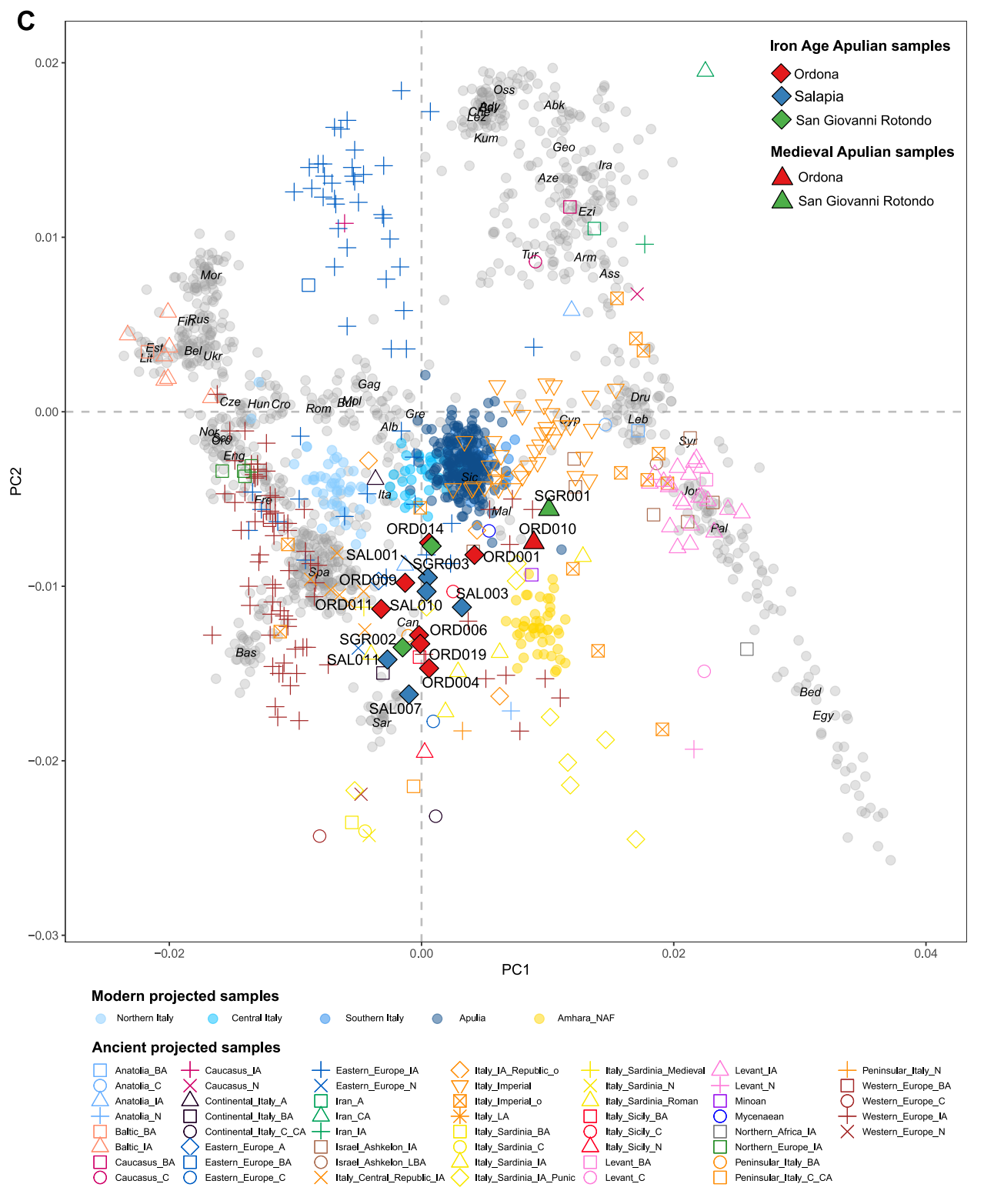

In order to shed light on this and to provide a genetic picture of Iron Age Southern Italy, we collected and sequenced human remains from three archaeological sites geographically located in Northern Apulia (the area historically inhabited by Daunians) and radiocarbon dated between 1157 and 275 calBCE. We find that Iron Age Apulian samples are still distant from the genetic variability of modern-day Apulians, they show a remarkable genetic heterogeneity, even though a few kilometers and centuries separate them, and they are well inserted into the Iron Age Pan-Mediterranean genetic landscape. Our study provides for the first time a window on the genetic make-up of pre-imperial Southern Italy, whose increasing connectivity within the Mediterranean landscape, would have contributed to laying the foundation for modern genetic variability. In this light, the genetic profile of Daunians may be compatible with an autochthonous origin, with plausible contributions from the Balkan peninsula.

[...]

To explore the genetic make-up of the IAA population, we performed a PCA projecting the ancient individuals onto the genetic variation of modern Eurasian samples (Figure 1C, Data S2 and Data S3). Our samples are largely scattered between modern peninsular Italians and Sardinians, and, in contrast to what was generally described for other European Iron Age populations (e.g., Northern_Europe_IA, Western_Europe_IA and Levant_IA in Figure 1C), they are still clearly distant from the genetic variability of modern-day inhabitants of Apulia. The downward shift of Iron Age Apulians from the present-day ones is further confirmed by the significantly negative f4(Modern Apulians, IAA; X, Mbuti), where X is a Neolithic/Chalcolithic/Copper Age population (Figure 2A, Data S4). Within the remarkable heterogeneity reported by the PCA, which does not mirror the archaeological sites, the two medieval individuals are shifted towards modern Middle Eastern and Caucasus populations (ORD010 and SGR001), while the others are stretched along the PC2. This pattern partially mirrors the chronological date with the most recent being more similar to present-day Southern Europeans, and is further strengthened when considering the PC3 distribution (Figure S2). Three samples located at the bottom of the PCA (ORD004, ORD019, SAL007) and one (SAL010) falling in the middle did not include modern Apulians among the top 25 results of an f3 outgroup analysis (Figure S3). All of them showed an affinity to Copper and Bronze Age Italians as well as the Aegean and the Mediterranean worlds (including Minoans, Greece, Croatians, and Gibraltar). A similar distribution is mirrored in the Multi-Dimensional scaling (MDS) built from the f3 outgroup measures, where the oldest IAA individual (SAL001; 1235 - 1048 calBCE (95.4%)) lies farthest from the modern samples, while the medieval ones (ORD010: 1078 - 1156 cal CE (95.4%) and SGR001: 670 - 774 cal CE (95.4%)) are the closest (Figure S4).

[...]

The geographic location of Apulia, a narrow peninsula stretching out in the sea at the South of Italy, has made this region an important Mediterranean crossroads connecting Western Europe, the Balkans, the Aegean, and Levant worlds. This is reflected in the PCA where IAA individuals are closely related to other Iron Age populations from the Mediterranean and surrounding areas (e.g., Montenegro, Bulgaria and Sardinia) (Figure 1C and Figure S4).

[...]

In order to shed light onto the genetic composition of the IAA individuals, we modelled them as a combination of the main ancestries documented across Western Europe at that time: Western Hunter-Gatherers (WHG), Anatolian Neolithic (AN), Steppe-related and, interchangeably, Caucasus Hunter-Gatherers (CHG) or Iranian Neolithic (IN) using the qpWave/qpAdm framework (Figure 2B, Figure S5A, STAR Methods). Broadly, the contributions of such ancestries to the genetic variability of ancient European populations vary according to their geographical positions: in particular, northernmost locations received higher proportions of WHG, Steppe-related ancestry and, consequently, CHG ancestries, while Southern European groups carried variable Iranian Neolithic or CHG traces. In view of this, we observed that while the IAA individuals could generally be modelled as a two-way admixture between AN and Steppe (0.63±0.08 and 0.37±0.08, respectively), the alternative model AN + CHG/IN could also fit for a subset of them, particularly in case of the samples ORD004, ORD010 and SAL010 with higher or comparable p-values (Figure S5A, first row with two sources). When three or four sources were tested, the presence of WHG ancestry in the majority of our individuals emerges, which, together with AN, Steppe and CHG/IN, forms a supported model for IAA samples (Figure 2B, Figure S5A and Data S5). Notably, for the individuals stretching downwards in the PCA (ORD004, ORD019, SGR002 and the Medieval ORD010) a three-way admixture involving AN, Steppe and CHG/IN is generally preferable.

[...]

We also investigated whether the PCA scattering was due to varying African or Levantine contributions with f4(Rome Republican, IAA, Levant_N/YRI, Mbuti) and tried the same on Medieval ancient Apulians (ORD010 and SGR001). However, none of the tested ancient Apulians shows a significant excess of YRI ancestry when compared to the contemporary Roman Republicans, even though ORD014, SAL007 and SAL011 show negative f4 values with a Z-score between 2 and 3 (Figure S8B).

The second study shows that the descendants of those Iron Age Balkan peoples (blue squares) in a Serbian sample dated to a later period (but before they were changed by Slavic migrations) all cluster with Modern Italians, forming the same kind of cline as in Italy from Iron Age Slovenia and Croatia in the North to Iron Age Bulgaria and Aegean in the South. This represents the original Pre-Roman ancestry of Southeastern Europe (including most of Italy).

Individuals from the first cluster fall on an area of the PCA delimited by the "Balkan Iron Age cline" (Figure 1A). Consistent with this, we model the ancestry of this Balkans Iron Age Cluster as predominantly deriving from Iron Age (IA) groups from nearby areas in the Balkans, with 67% Aegean Bronze Age-related ancestry and the remainder Slovenia Iron Age-related ancestry (Figure 2; Supplementary section 12.1). A local origin is supported by a high frequency of Ychromosome lineage E-V13, which has been hypothesized to have experienced a Bronze-to-Iron Age expansion in the Balkans and is found in its highest frequencies in the present-day Balkans. We interpret this cluster as the descendants of local Balkan Iron Age populations living at Viminacium, where they represented an abundant ancestry group during the Early Imperial and later periods (~47% of sampled individuals from the 1-550 CE).


The third study looks back even farther, showing that population structure already existed in the Neolithic, with many Balkan and Italian farmers being more AN and less WHG, and that it kept increasing in the Bronze Age, with Sicilians starting to shift toward CHG/IN long before the Roman Empire and even before the Greek settlements of Magna Graecia. Other Italians were also starting to shift (in slightly different directions) toward their current positions.

It is globally accepted that this [Neolithic farming] demic diffusion followed both a Mediterranean route (following the Mediterranean coasts, including Italy) and a continental route (Balkan route reaching Central and Western Europe through the Danubian valley), with the terminal fringes of this migration admixing again.

[...]

However, with the increase of ancient samples examined, subtle differences between Central-West and Central-East Europe started to emerge, with samples from Western and Eastern Europe forming two distinct clusters in the PCA (Fig. 2C) (Olalde et al. 2015; Rivollat et al. 2020; Marcus et al. 2020; Saupe et al. 2021). F4 statistics and related method (qpAdm) showed that this separation is possibly due to different amounts of ancestry related to WHG. It may be possible that the populations spreading through Central and Mediterranean routes mixed differently with residing hunter-gatherer populations, with the former witnessing a higher number of admixture events, in line with some archaeological evidence suggesting a sparser mesolithic hunter-gatherer population in Southern Italy, although new archaeological surveys are needed (Mussi 2006; Martini 2019).


The Bronze Age Aegean civilizations, mainly represented by Minoans and Mycenaeans, also harboured up to a quarter of their ancestry ultimately connected with ancient populations from Caucasus and Iran. Nonetheless, only the Mycenaean individuals also showed the EHG-related component (Lazaridis et al. 2017). For this reason, at least in the Minoans, the three-way split ancestral contribution is not completely fulfilled and raises other issues about who brought the Caucasus/Iran-related component into Europe.

[...]

The work from Antonio and colleagues examined the genetic transitions experienced by Central Italians which, during the Iron Age, would have given origin to the founders of the Roman civilization (Antonio et al. 2019). While they detected the suggestive presence of a small amount of the Caucasus/Iran-related component as early as the Neolithic period, they observed an increase of that component during the Bronze and Iron Age (between~4800 and 2850 ya), possibly due to increased trade-driven mobility.

[...]

The Steppe ancestry started appearing in Sicily around 4150 ya, during the Early Bronze Age, as demonstrated by qpAdm modelling on autosomal genetic variation with two notable outliers carrying up to 20% and 40% of this genetic component (Sicily_EBA8561 and Sicily_EBA11443, (Fernandes et al. 2020). Starting from the Middle Bronze Age (3750–3450 ya), Sicilian samples show a considerable shift in the PCA towards Minoans and Mycenaeans (Fig. 3A, Minoans and Mycenaeans are grouped in the Balkan area in green) and can be modelled with the Iranian-related component in a percentage around 15% (Fernandes et al. 2020). This data opens up the fascinating possibility that this mysterious ancestry must have reached Southern Italy before the occupation of the southern coastal areas of Italy (Magna Graecia). Conversely, ancient Sardinians showed a higher degree of genetic continuity from the Neolithic to the Bronze Age, with almost all individuals showing similar proportions of Anatolian Neolithic and WHG ancestries.

[...]

Multiple Iron Age populations characterized by different languages and cultures lived in Italy but, genetically speaking, they started to approximate the modern Italians (Aneli et al. 2021; Antonio et al. 2019).


The fourth study focuses on the same process in new samples from Northern and Central Italy (previously published samples are the circles with black borders). It shows again the AN/WHG structure in Neolithic Europe, but the Bronze/Iron Age Italian cline this time is shifted slightly away from the Balkan kind of Steppe ancestry toward the kind with more EHG/ANE that likely came across the Alps from Central Europe.

The human remains are from one necropolis (Necropoli di Gattolino; hereafter, "Gattolino") and three cave sites located in Northeastern (Grottina dei Covoloni del Broion: "Broion") and Central Italy (Grotta La Sassa: "La Sassa" and Grotta Regina Margherita: "Regina Margherita"; Figures 1A and S1).

[...]

A separation within the EN [European Neolithic] cluster (Figure 2A) clearly differentiates Anatolian and Eastern Europe N (right) from Western Europe N, defined as samples west of Germany (left, toward western hunter-gatherer [WHG]; Data S1D). A similar separation has already been reported and interpreted as a difference in WHG proportion of these samples. We note that most of our Chalcolithic individuals fall on the right side of the cluster (Anatolia and Eastern Europe).

[...]

Our analyses show the expected signature of peri- and post-BA movements from Steppe-related populations across Italy: absent in Italian individuals from the N and Chalcolithic, emerging in the Early BA (Italian Bell Beaker [I2478: 2195–1940 calBCE], Italian Remedello [RISE486: 2134–1773 calBCE], and Broion [BRC010: 1952–1752 calBCE (95.4%)]) and increasing through time in the individuals from Broion and Regina Margherita (GCP003: 1626–1497 calBCE [95.4%]). These samples confirm the date of arrival in Northern Italy to at least 2000 BCE and its presence in Central Italy by 4 centuries later, although denser sampling strategies are needed to assess the dynamics of this spread. Our qpAdm results suggest that the Steppe-related ancestry component could have arrived through Late N/Bell Beaker groups from Central Europe, though what remains unknown due to small sample size and limited geographical and chronological distribution is whether there were multiple Steppe population sources and the exact timing and diffusion of this ancestry component through the Italian Peninsula. The R1b subtype found in BA Broion is a lineage found in both ancient Sicilian samples and Italian Bell Beakers. Together with the autosomal affinity of North and Central Italian BA groups with Late N Germany, the Ychr data point to a possibly Northern-, transalpine-, and potentially Bell-Beaker-associated source of the Italian Steppe-related ancestry.


The fifth study has admixture profiles for several Modern Italian groups: Sardinians, Northerners, 3 Southern samples, and "Aspromonte" (old Greek-speaking communities in the South), showing that the same pan-Italian (and pan-European) components used to model the ancient samples are also the best fits for modelling the modern ones, with the levels of each in different parts of Italy matching the clines and positions of populations in all the PCAs above.

Ancient genetic heritage of Southern Italian populations.


Since present-day patterns of genetic variation reflect both local dynamics of differentiation and the ancestral population history, in order to provide a temporal overview on the ancestral genetic legacy of analyzed Southern Italian groups we finally compared the genetic landscape defined by modern populations with a large panel of ancient DNA samples extracted from the literature and timewise spanning from the Mesolithic to the Iron Age (Suppl. Table S7).

Consistently with previous results, the PCA performed by projecting ancient samples onto the modern genetic variation reveals specific patterns of population relationships (Suppl. Figure S8). In fact, all the Southern Italian groups, besides showing a general high affinity with Anatolian and European Neolithic farmers, cluster also closely with the Chalcolithic and Bronze Age samples from Anatolian and Aegean (Minoan and Mycenaean) populations. Differences in affinity patterns were formally tested with the outgroup-f3 statistic measuring the extent of shared drift between modern Italian groups and the main ancient genetic components represented by Western European Hunter-Gatherers (WHG), Eastern European Hunter-Gatherers (EHG), Caucasian HunterGatherers (CHG), Anatolian Neolithic farmers (AN) and Pontic-Steppe Yamnaya (EMBA). Overall Sardinia shows the highest levels of shared drift with samples of Neolithic-related ancestry compared to Northern and Southern Italy. Both Sardinians and Northern Italians show higher affinity to WHG than Southern Italians, who instead appear more affected by CHG-related groups. On the other hand, Yamnaya Steppe and EHG share more affinity to North Italy than to both Southern Italians and Sardinians (Suppl. Figure S9). In addition, qpGraph-based phylogenies consistently recapitulate the observed genetic patterns, with Sardinians showing a good fit to a two-way mixture model between populations representing Early European Farmers and West European Hunter-Gatherers (Suppl. Figure S10a), and North Italy instead achieving a successful fit to a graph model with an additional admixture event from an EHG-related lineage (Suppl. Figure S10b). Interestingly, when fitting present-day Southern Italian populations into the tested qpGraph models we find them compatible with an additional contribute that, differently from Northern Italy, does not originate from an EHG-related source but instead from a CHG-related lineage (Suppl. Figure S10c). This fits to the data in the sense that there are no f-statistics more than |Z| > 3 different between model and expectation.

Finally, to better characterize the ancestral composition of Southern Italian populations, we inferred their mixture proportions with respect to a four-population model of admixture including all the above-mentioned WHG, Neolithic, CHG/Iran_N and Steppe-related main sources, using qpAdm. All Italian populations were successfully modeled as characterized by a relatively high amount of Anatolian Neolithic ancestry, with the major contribution observed in Sardinians (Fig. 4, Suppl. Table S8). The remaining ancestries were assigned to a lower WHG contribution and to differential influences of Steppe_EMBA and CHG/Iran_N in the profiles of Northern and Southern Italians, respectively (Fig. 4, Suppl. Table S8). In fact, while Steppe ancestry is greater in North Italy (~ 27%), the Iran_N/CHG-related source is more present in South Italy with the highest values (~ 29%) observed in the populations from the Aspromonte area.


Finally, even the Etruscan study itself has a PCA showing Copper-Bronze Age Sicilians (pink triangles) creeping up to where Modern Sicilians and Southern Italians are. They don't veer left to first become like Etruscans so that they can later "mix with slaves" and do a U-turn toward the Levant. They were always Balkan-like, because Iberian-like people were not the only (or even the original) inhabitants of Italy.


So the alleged cline of Italians from Etruscans to Levantines is an illusion created by coincidental PCA positions and bad choices of reference populations for modelling. Italians are on the same Farmer-to-Steppe cline as all other Europeans. It's just that because they're geographically and genetically between Southwestern and Southeastern Europe, they're increasingly shifted toward AN/CHG/IN (peaking in the South), whereas the rest of Europe (including, somewhat, Northern Italy and the Northern Balkans) is shifted increasingly more toward WHG/EHG/ANE. And it's been that way since at least the Neolithic, up through the Bronze and Iron Age, way before the slaves and barbarians of the Roman Empire, who had almost no impact on the pre-existing population structure.

---------------
Posth et al. "The origin and legacy of the Etruscans through a 2000-year archeogenomic time transect". Sci Adv, 2021.

Aneli et al. "The genetic origin of Daunians and the Pan-Mediterranean southern Italian Iron Age context". bioRxiv, 2021.

Olalde et al. "Cosmopolitanism at the Roman Danubian Frontier, Slavic Migrations, and the Genomic Formation of Modern Balkan Peoples". bioRxiv, 2021.

Aneli et al. "Through 40,000 years of human presence in Southern Europe: the Italian case study". Hum Genet, 2021.

Saupe et al. "Ancient genomes reveal structural shifts after the arrival of Steppe-related ancestry in the Italian Peninsula". Curr Biol, 2021.

Sarno et al. "Genetic history of Calabrian Greeks reveals ancient events and long term isolation in the Aspromonte area of Southern Italy". Sci Rep, 2021.

Ancient-to-Modern Genetic Distances

October 8, 2020

Someone at Anthrogenica made these genetic distance maps that visualize how Modern West Eurasians are related to samples of Ancient Greeks and Ancient Romans, with redder coloring indicating more genetic affinity. The Ancients are all closest to Modern Southern Europeans — mostly Italians from all over, but often also Greeks, Iberians, South French and Balkan peoples. (Note: The "Imperial Romans" sample includes some foreigners from the Eastern Mediterranean, who later disappeared).

Minoan Greeks:


Mycenaean Greeks:


Iron Age Romans:


Proto-Villanovan
Villanovan


Etrsucan
Latin


Imperial Romans:


Late Antiquity Romans:


Medieval Romans:


Related: Genetically Italian Iron Age Balkans

Italy Is Over 2000 Years Old

April 8, 2020

People with an agenda to divide Italy who say that it's "not a real country" because it "didn't even exist until 1861" don't know their history. Italy was first unified by the Ancient Romans, and then it was divided by foreign powers after Rome fell. The movement for national unity was actually a reunification movement that went back to the Renaissance and was supported by many prominent Italians.

Italy was unified by Rome in the third century BC. For 700 years, it was a de facto territorial extension of the capital of the Roman Republic and Empire, and for a long time experienced a privileged status and was not converted into a province.

After the fall of the Western Roman Empire, Italy remained united under the Ostrogothic Kingdom and later disputed between the Kingdom of the Lombards and the Byzantine (Eastern Roman) Empire. Following conquest by the Frankish Empire, the title of King of Italy merged with the office of Holy Roman Emperor. However, the emperor was an absentee German-speaking foreigner who had little concern for the governance of Italy as a state; as a result, Italy gradually developed into a system of city-states. Southern Italy, however, was governed by the long-lasting Kingdom of Sicily or Kingdom of Naples, which had been established by the Normans. Central Italy was governed by the Pope as a temporal kingdom known as the Papal States.

This situation persisted through the Renaissance but began to deteriorate with the rise of modern nation-states in the early modern period. Italy, including the Papal States, then became the site of proxy wars between the major powers, notably the Holy Roman Empire (including Austria), Spain, and France.

Harbingers of national unity appeared in the treaty of the Italic League, in 1454, and the 15th-century foreign policy of Cosimo De Medici and Lorenzo De Medici. Leading Renaissance Italian writers Dante, Petrarch, Boccaccio, Machiavelli and Guicciardini expressed opposition to foreign domination. Petrarch stated that the "ancient valour in Italian hearts is not yet dead" in Italia Mia. Machiavelli later quoted four verses from Italia Mia in The Prince, which looked forward to a political leader who would unite Italy "to free her from the barbarians".

The Peace of Westphalia in 1648 formally ended the rule of the Holy Roman Emperors in Italy. However, the Spanish branch of the Hapsburg dynasty, another branch of which provided the Emperors, continued to rule most of Italy down to the War of the Spanish Succession (1701–14).

A sense of Italian national identity was reflected in Gian Rinaldo Carli's Della Patria degli Italiani, written in 1764. It told how a stranger entered a café in Milan and puzzled its occupants by saying that he was neither a foreigner nor a Milanese. "'Then what are you?' they asked. 'I am an Italian,' he explained."


Roman Italy at the death of Augustus (14 A.D.)

Pigmentation Through Roman History

December 6, 2019

The recent study on Ancient Roman DNA gives frequencies over time for some alleles of functional importance (eye and skin color). We know that Mesolithic hunters had blue eyes and dark skin while Neolithic farmers had brown eyes and light skin, which combined and adapted to make the European phenotypes of today.

But contrary to what Nordicists claim about Romans going from "Northern European" to "Middle Eastern", blue eyes and light skin (and also lactase persistence) have increased steadily since at least the Iron Age, and today they show the same levels as other Modern Europeans (Spanish, British or Finnish).

Ancient Roman DNA

November 28, 2019

We've already seen that modern Italians are genetically close to ancient Mycenaean Greeks, and now we finally have Ancient Roman DNA, which shows the same genetic closeness, refuting Nordicist fantasies about an original "Northern European" stock becoming "orientalized". The Romans (Latin and Etruscan) were all Southern European, similar to modern Italians from North to South. There were foreigners during the empire, but they weren't very exotic and didn't have much of an impact.

Most of the samples are from cemeteries in and around the city of Rome, so on one hand they're not representative of the whole country, but on the other, Rome was the biggest, most traveled-to city in all of Italy, so if there wasn't much diversity or mixing going on there, that means there would have been even less in other cities and (especially) in the small towns and rural areas that made up most of the country.

As in all of Europe, there were major changes between the Mesolithic and Iron Age, but from then on, the samples all have the same 4 main components: Western Hunter-Gatherer, Anatolian Neolithic (farmers), Iran Neolithic and Steppe Eneolithic (the last two arriving mostly with Indo-Europeans), plus very low levels of Morocco Hunter-Gatherer. Even the "diverse" imperial samples have those same components, just in slightly different proportions, so the foreigners were not that foreign.


Iron Age & Republic (dark blue)


Most of these early Latin and Etruscan samples cluster between Northern Italians and Spaniards, and a few others cluster with Northern Italians, Central Italians, Southern Italians and off toward Sardinians. So the original, pre-empire Romans were heterogeneous but fully Southern European, just like modern Italians.

By 900 BCE at the latest [before the founding of Rome], the inhabitants of central Italy had begun to approximate the genetics of modern Mediterranean populations. [...] The Iron Age individuals exhibit highly variable ancestries, hinting at multiple sources of migration into the region during this period (Figs. 2A and 3B). [...] Together these results suggest substantial genetic heterogeneity within the Etruscan (n = 3 individuals) and Latin (n = 6) groups. [...] In contrast to prehistoric individuals, the Iron Age individuals genetically resemble modern European and Mediterranean individuals, and display diverse ancestries....

Imperial Rome (teal)


At this time there appears a "tail" toward the Near East, reflecting migrants to Rome from the Eastern Mediterranean. However, most of them cluster no farther than Cyprus, which seems to confirm that "Middle Eastern" migrants to Rome were of predominantly Greek ancestry.

During the Imperial period (n = 48 individuals), the most prominent trend is an ancestry shift toward the eastern Mediterranean and with very few individuals of primarily western European ancestry (Fig. 3C). The distribution of Imperial Romans in PCA largely overlaps with modern Mediterranean and Near Eastern populations, such as Greek, Maltese, Cypriot, and Syrian (Figs. 2A and 3C).

Late Antiquity (green)


Here the "tail" to the Middle East disappears and the samples shift back westward. After the capital of the empire moved east and Rome was sacked, the population declined to almost nothing, and the city would have been repopulated by Italians from other parts of the country, and possibly other Europeans too.

The average ancestry of the Late Antique individuals (n = 24) shifts away from the Near East and toward modern central European populations in PCA (Fig. 3D). [...] This ancestry shift is also reflected in ChromoPainter results by the drastic shrinkage of the Near Eastern cluster (C4), maintenance of the two Mediterranean clusters (C5 and C6), and marked expansion of the European cluster (C7) (Fig. 4C).

This shift may have arisen from reduced contacts with the eastern Mediterranean, increased gene flow from Europe, or both, facilitated by a drastic reduction in Rome's population in this period to less than 100,000 individuals, due to conflicts and epidemics (1, 3).


Medieval & Early Modern (yellow)


Here the samples are back to being similar to the Iron Age samples, and they're identical to modern Italians from North to South, except for a few outliers tending toward Spain and France. The latter may be related to the Holy Roman Empire and Norman conquests.

In the Medieval and early modern periods (n = 28 individuals), we observe an ancestry shift toward central and northern Europe in PCA (Fig. 3E), as well as a further increase in the European cluster (C7) and loss of the Near Eastern and eastern Mediterranean clusters (C4 and C5) in ChromoPainter (Fig. 4C). The Medieval population is roughly centered on modern-day central Italians (Fig. 3F).

[...]

This shift is consistent with the growing ties between Medieval Rome and mainland Europe. Rome was incorporated into the Holy Roman Empire (3), which spanned much of central and western Europe. The Normans expanded from northern France to a number of regions, including Sicily and the southern portion of the Italian Peninsula (and even sacked the city of Rome in 1084), where they established the Kingdom of Sicily (3, 36).

Recap


  • By the time Rome was founded, its people (Latins and Etruscans) were already genetically Mediterranean, overlapping with modern Southern Europeans from Spain to Sicily.
  • The empire brought migrants to Rome from the Eastern Mediterranean, but they were mostly of Greek ancestry and not that different than the Romans.
  • When the western half of the empire fell, the migrants disappeared as Rome's population declined drastically. The city was later repopulated by Italians and other Europeans.
  • By the Middle Ages, the inhabitants of Rome were back to resembling Iron Age people and identical to modern Italians from North to South, with a few outliers tending toward Western and Central Europe.

---------------
Antonio et al. "Ancient Rome: A genetic crossroads of Europe and the Mediterranean". Science, 2019.

Related: Pigmentation Through Roman History, Ancient-to-Modern Genetic Distances

Mycenaeans and Italians

January 15, 2018

We don't have Ancient Roman DNA yet, but now we have the next closest thing: Ancient Mycenaean Greek DNA. This new study shows that Mycenaeans, like their Peloponnesean descendants, are genetically similar to modern Italians (and other Southern Europeans) because both are similar mixes of Neolithic farmers and Indo-Europeans, and also because of Ancient Greek settlements in Southern Italy.

We estimated the fixation index, FST, of Bronze Age populations with present-day West Eurasians, finding that Mycenaeans were least differentiated from populations from Greece, Cyprus, Albania, and Italy (Fig. 2), part of a general pattern in which Bronze Age populations broadly resembled present-day inhabitants from the same region (Extended Data Fig. 7). [...] Other proposed migrations, such as settlement by Egyptian or Phoenician colonists, are not discernible in our data, as there is no measurable Levantine or African influence in the Minoans and Mycenaeans, thus rejecting the hypothesis that the cultures of the Aegean were seeded by migrants from the old civilizations of these regions.

[...]

The Mycenaeans settled all of mainland Greece up to Thessaly, and throughout the Aegean islands. There is evidence of extensive Mycenaean acculturation in Western Anatolia, Italy and Cyprus and trading relations with Egypt and the Near East. The Mycenaeans were literate and used for accounting purposes a syllabic script, Linear B, written in an early form of the Greek. They introduced this script into Crete after they occupied the island.

Lazaridis et al. "Genetic origins of the Minoans and Mycenaeans". Nature, 2017.

Related: Ancient Roman DNA, Ancient-to-Modern Genetic Distances

Reconstruction of a Herculaneum Resident

July 11, 2017


The exploded skull of a man who died in the catastrophic eruption of Mount Vesuvius nearly 2,000 years ago has been pieced together, giving scientists a unique opportunity to capture the ancient face using 3D imaging.

It is the first real-life reconstruction of the features of a victim of the volcanic disaster who lived in the ill-fated seaside town of Herculaneum.

The appearance is that of a typical southern European who may have been wealthy and educated because he was 50 years old when he died — an unusual milestone for the time.

He was one of 350 casualties discovered frozen in time, buried under volcanic ash in Herculaneum.

Every single resident perished instantly when the southern Italian town was hit by a 500° centigrade pyroclastic hot surge in AD 79.

[...]

The excavation of Pompeii, the industrial hub of the region, and Herculaneum, a small beach resort, has given unparalleled insight into Roman life.

"This is the beginning of what we're hoping will be an on-going project to reveal the faces of the ancient Roman inhabitants of Herculaneum and Pompeii", said Italian 3D graphic designer Gianfranco Quaranta who is leading the initiative as part of the Association for Research and Education in Art, Archaeology and Architecture (AREA3).

Janet Tappin Coelho and Phoebe Weston. "EXCLUSIVE: Scientists piece together the exploded skull of a 50-year-old man, who died in 500°C heat from the Mount Vesuvius eruption 2,000 years ago, to reveal his face for the first time". DailyMail.com – Science & Tech, 06:14 EDT, 21 June 2017.

Biochemistry of Skeletons from Ancient Rome

February 26, 2016

A new scientific study, and an older one it references, confirm that there were very few foreigners in Ancient Rome by chemically analyzing skeletons from three non-elite imperial-era cemeteries. The data show that non-locals were in the minority, and most came from other parts of Italy or nearby provinces in Southern/Central Europe. Only 1 individual definitely came from outside of Europe (North Africa), and another 2 possibly did, but results are inconclusive. Note that non-European "Romans" have been discovered as far away as the British Isles.


In order to assess migration to Rome within an updated contextual framework, strontium isotope analysis was performed on 105 individuals from two cemeteries associated with Imperial Rome—Casal Bertone and Castellaccio Europarco—and oxygen and carbon isotope analyses were performed on a subset of 55 individuals. Statistical analysis and comparisons with expected local ranges found several outliers who likely immigrated to Rome from elsewhere.

[...]

Who immigrated to Rome?


Of the nonlocal sample (n = 4), there are three adult males and one adolescent of unknown sex. Two of the males fall in the Middle Adult category (35-50) and one into the Older Adult category (50+), while the Adolescent is between 11-15 years old. The other four individuals whose isotope ratios were different from local Roman expectations, although not statistically conclusive, include two Older Children (7-12 years old), one probably male older Adolescent (11-15 years old), and one older Adolescent female (16-20 years old).

[...]

It is also impossible to answer from the present data whether these individuals were voluntary or compulsory migrants. The status of slave was multifaceted and mutable during the Empire [130], and there is no indication in the archaeological information from Casal Bertone and Castellaccio Europarco that any specific individual was a slave. There is, however, no evidence from isotopes that individuals buried in the mausoleum at Casal Bertone were nonlocal, whereas the necropoleis at Casal Bertone and Castellaccio Europarco both produced skeletons with nonlocal isotope ratios. Burial in a necropolis was customary for the lower classes, while burial in a mausoleum cost more [77]. These isotope data may be showing a form of economic, status-related migration, with more lower class individuals and possibly slaves moving to Rome compared to wealthier individuals. Additional testing would be needed, though, to confirm this hypothesis.

[...]

Where did immigrants come from?


Because migrants often came to Rome in diasporic waves resulting from slavery, attempting to identify a general geographic origin can be instructive. The combination of strontium and oxygen isotope analyses is particularly useful for this in western Europe, although only general predictions of homeland can be made. Oxygen isotopes on the continent vary roughly east-to-west, while strontium isotopes are higher in the older rock of mountains such as the Alps and lower in the younger rock of volcanic areas like most of peninsular Italy. From the perspective of Rome, oxygen isotope ratios will decrease as one moves into the Apennine range running along the spine of Italy, and strontium isotope ratios will increase to the north and decrease to the south.

The four individuals with clearly anomalous isotope ratios—T15, ET38, T24, and T36—fall into three distinct strontium and oxygen isotope combinations. T15 and ET38 have oxygen isotope ratios within range of Rome, but strontium isotope ratios that are significantly higher, suggesting a possible origin in a place with older geology, such as the Alps or one of the islands in the Tyrrhenian Sea. As people arrived at Rome from all over the Empire, however, there are numerous locations in which these individuals could have been born.

Individual T24 has low strontium and low oxygen isotope ratios compared to Rome, suggesting an origin somewhere with a cool, wet climate and basalt or limestone substrate, such as the Apennines. Individual T36 has high oxygen and low strontium isotope ratios, suggesting an origin in a region of limestone or basalt with a hotter, drier climate than Rome, such as North Africa. For these individuals, however, a dietary explanation for the anomalous strontium isotope ratios, while much less likely owing to the concomitant δ18O values, cannot be completely ruled out. As Rome imported significant amounts of grain from north Africa during the Empire, and as human strontium isotope ratios from Egypt and the Nile Valley have been shown to be lower than those in Rome (around 0.707 to 0.708) [131], it is not impossible that T24 and T36 were consuming a significant amount of imported grain as children. Still, as shown further below, the dietary explanation is less likely than is an origin elsewhere.

The four additional individuals whose isotopes may indicate they were immigrants—T8, T70, T39, and ET76—fall into the categories above. T8 and ET76 have higher-than-expected strontium isotope ratios, showing up as outliers in the box plot in Fig 3. They may have arrived at Rome from a region of older geology such as northern Italy. Individuals T70 and T39, while not statistical outliers in the oxygen isotope box plot in Fig 5, are nevertheless 0.6-0.7‰ higher than the next closest local, suggesting they may also be immigrants. They could have arrived at Rome from a drier climate like North Africa. These four individuals highlight the challenge of identifying immigrants to Rome from a vast geographical expanse.

Finally, the fact that there is a large spread in both the strontium and oxygen isotope data compared to results obtained from other archaeological populations could indicate that people were arriving at Rome from places not too far removed, in a form of centripetal migration, as Prowse and colleagues [76] suggest for Portus. Both the strontium and the oxygen isotope ratios from Rome are diverse, and it is not unreasonable to assume that these may reflect the diversity of the population as well. It is also possible that even more individuals are essentially isotopically invisible migrants, if they came to Rome from homelands with similar strontium and/or oxygen isotope values. Further isotopic and DNA work will be necessary to better understand origins and homelands from skeletal remains.

Killgrove and Montgomery. "All Roads Lead to Rome: Exploring Human Migration to the Eternal City through Biochemistry of Skeletons from Two Imperial-Era Cemeteries (1st-3rd c AD)". PLOS One, 2016.

Oxygen stable isotope ratios (δ18O) have been determined in carbonate in paired first and third molar teeth from individuals (N = 61) who lived in the town of Portus Romae ("Portus") and who were buried in the necropolis of Isola Sacra (First to Third centuries AD) near Rome, Italy. We compare these analyses with data for deciduous teeth of modern Roman children. Approximately one-third of the archaeological sample has first molar (M1) values outside the modern range, implying a large rate of population turnover at that time, consistent with historical data. Delta 18Oap values suggest that a group within the sample migrated to the area before the third molar (M3) crown had completely formed (i.e., between 10 and 17.5 years of age). This is the first quantitative assessment of population mobility in Classical antiquity. This study demonstrates that migration was not limited to predominantly single adult males, as suggested by historical sources, but rather a complex phenomenon involving families. We hypothesize that migrants most likely came from higher elevations to the East and North of Rome. One individual with a higher δ18O value may have come (as a child) from an area isotopically similar to North Africa.

[...]

Origins of the immigrants to Imperial Rome


There are several possible origins for the outsiders (at birth) buried in the cemetery of Isola Sacra who must have come from regions where δ18O of local precipitation is lower than in Rome by up to 2.6%. One possible region of origin is the Roman Imperial provinces lying to the North of the Italian landmass. In general, the δ18O of modern precipitation decreases northward, reaching values up to 3% less than found in Rome (Bowen and Wilkinson, 2002; Longinelli and Selmo, 2003), within the geographic range of the Roman Empire of 100 CE. Isotope ratios of average annual precipitation to the North of Italy would generally be lower than the values required to account for the outsiders’ values. Furthermore, seasonal variation in δ18O of precipitation in these more northern regions is larger than in Rome because the range between winter and summer temperature increases as average annual temperature decreases, and because δ18O varies linearly with temperature. Thus, an individual whose M1 teeth happened to mineralize through the winter months while consuming water largely derived from precipitation would display significantly lower δ18Oap values than "local" Romans.

As another possible locus for the outsiders, we note that δ18O values of modern meteoric water vary continuously to values up to 4% lower than those encountered in Rome at distances as close as 100 km in the foothills and heights of the Apennine Mountains (Longinelli and Selmo, 2003). Derivation of the outsiders principally from this region seems to be the most likely scenario. Other possible regions of origin of the outsiders might be the Iberian Peninsula or Greece, both of which were under Roman control at this time. Rain falling in these regions also displays δ18O values lower than those corresponding to the outsiders’ inferred drinking water, although coastal regions in both these provinces might have included such values.

The continuous gradation of δ18Oap between local and outsider δ18Oap values suggests that these individuals came from locations at gradually farther distances and gradually higher elevations than Rome. If the outsiders were from as far away as southern Gaul (where δ18O of rain is about 2% lighter than in Rome), we would expect to see a cluster of analyses at discretely lower δ18Oap values, rather than the continuum that we actually observe. However, we can not exclude the possibility that some of the outsiders came from further away to the north.

[...]

Conclusions


The δ18Oap values show that approximately one-third of the individuals in our sample were not born in the region around Rome, but migrated to this area from regions where local drinking water has somewhat lower δ18Oap values. It has further been shown that a significant minority of the sample as a whole were individuals who migrated as children, so that migration to Portus was not a predominantly single adult male activity. Migrants to Portus were families, most obviously as children accompanying the parents.

The data support historical demographic estimates of high mortality rates in the Roman urban region, and the consequent need for high rates of population replacement to maintain the size of the Roman population in this era. Although such isotopic data suggest a method of quantitative assessment of this steady population replacement, a detailed numerical estimate is beyond the scope of this paper. The individuals with low δ18Oap values could have been from as close as 100 km to Rome, in the hills surrounding the Apennine Mountains. It is also possible that they came from the transalpine provinces of the Roman Empire much further to the north, where low δ18Oap precipitation falls even at low elevations. However, due to the observed scatter of the δ18Oap data around the "local" Roman range, we conclude that this latter explanation seems less likely. Only one individual was found to have a conspicuously high δ18Oap value; the observed value is consistent with an origin in a region with higher δ18Oap in drinking water, like the Nile Delta, although it is impossible to exclude possible origins in southern Italy. Further Sr isotopic analyses of these teeth might help to resolve this issue. Analyses of δ18Oap in bones of these same people may also show further evidence of population movement during adulthood.

Prowse et al. "Isotopic Evidence for Age-Related Immigration to Imperial Rome". Am J Phys Anthropol, 2007.

Italian Ancestry of Ashkenazi Jews

March 8, 2014

Genetic similarities between Italians and Ashkenazi Jews are due to the fact that about half of Jews' ancestry is European, a lot of which came from Italy when diaspora males migrated to Rome and found wives among local women who then converted to Judaism. The same process happened again to a lesser degree in other parts of Europe as Jews migrated further north, west and then east, but according to genome-wide autosomal DNA, their highest European admixture is Italian.

Overall, it seems that at least 80% of Ashkenazi maternal ancestry is due to the assimilation of mtDNAs indigenous to Europe, most likely through conversion. The phylogenetic nesting patterns suggest that the most frequent of the Ashkenazi mtDNA lineages were assimilated in Western Europe, ~2 ka or slightly earlier. Some in particular, including N1b2, M1a1b, K1a9 and perhaps even the major K1a1b1, point to a north Mediterranean source. It seems likely that the major founders were the result of the earliest and presumably most profound wave of founder effects, from the Mediterranean northwards into central Europe, and that most of the minor founders were assimilated in west/central Europe within the last 1,500 years. The sharing of rarer lineages with Eastern European populations may indicate further assimilation in some cases, but can often be explained by exchange via intermarriage in the reverse direction.

The Ashkenazim therefore resemble Jewish communities in Eastern Africa and India, and possibly also others across the Near East, Caucasus and Central Asia, which also carry a substantial fraction of maternal lineages from their 'host' communities. Despite widely differing interpretations of autosomal data, these results in fact fit well with genome-wide studies, which imply a significant European component, with particularly close relationships to Italians. As might be expected from the autosomal picture, Y-chromosome studies generally show the opposite trend to mtDNA (with a predominantly Near Eastern source) with the exception of the large fraction of European ancestry seen in Ashkenazi Levites.

Evidence for haplotype sharing with non-Ashkenazi Jews for each of the three main haplogroup K founders may imply a partial common ancestry in Mediterranean Europe for Ashkenazi and Spanish-exile Sephardic Jews, but may also, at least in part, be due to subsequent gene flow, especially into Bulgaria and Turkey, both of which witnessed substantial immigration from Ashkenazi communities in the fourteenth and fifteenth centuries. Gene flow could have been substantial in some cases—ongoing intermarriage is likely when these communities began living in closer proximity after the Spanish exile. A partial common ancestry for all European Jews—both Ashkenazi and Sephardic—is again strongly supported by the autosomal results.

Jewish communities were already spread across the Graeco-Roman and Persian world >2,000 years ago. It is thought that a substantial Jewish community was present in Rome from at least the mid-second century BCE, maintaining links to Jerusalem and numbering 30,000-50,000 by the first half of the first century CE. By the end of the first millennium CE, Ashkenazi communities were historically visible along the Rhine valley in Germany. After the wave of expulsions in Western Europe during the fifteenth century, they began to disperse once more, into Eastern Europe.

These analyses suggest that the first major wave of assimilation probably took place in Mediterranean Europe, most likely in the Italian peninsula ~2 ka, with substantial further assimilation of minor founders in west/central Europe. There is less evidence for assimilation in Eastern Europe, and almost none for a source in the North Caucasus/Chuvashia, as would be predicted by the Khazar hypothesis—rather, the results show strong genetic continuities between west and east European Ashkenazi communities, albeit with gradual clines of frequency of founders between east and west.

Costa et al. "A substantial prehistoric European ancestry amongst Ashkenazi maternal lineages". Nature Communications, 2013.

Admixture between previously diverged populations yields patterns of genetic variation that can aid in understanding migrations and natural selection. An understanding of individual admixture (IA) is also important when conducting association studies in admixed populations. However, genetic drift, in combination with shallow allele frequency differences between ancestral populations, can make admixture estimation by the usual methods challenging. We have, therefore, developed a simple but robust method for ancestry estimation using a linear model to estimate allele frequencies in the admixed individual or sample as a function of ancestral allele frequencies. The model works well because it allows for random fluctuation in the observed allele frequencies from the expected frequencies based on the admixture estimation. We present results involving 3,366 Ashkenazi Jews (AJ) who are part of the Kaiser Permanente Genetic Epidemiology Research on Adult Health and Aging (GERA) cohort and genotyped at 674,000 SNPs, and compare them to the results of identical analyses for 2,768 GERA African Americans (AA). For the analysis of the AJ, we included surrogate Middle Eastern, Italian, French, Russian, and Caucasus subgroups to represent the ancestral populations. For the African Americans, we used surrogate Africans and Northern Europeans as ancestors. For the AJ, we estimated mean ancestral proportions of 0.380, 0.305, 0.113, 0.041 and 0.148 for Middle Eastern, Italian, French, Russian and Caucasus ancestry, respectively. For the African Americans, we obtained estimated means of 0.745 and 0.248 for African and European ancestry, respectively. We also noted considerably less variation in the individual admixture proportions for the AJ (s.d. = .02 to .05) compared to the AA (s.d.= .15), consistent with an older age of admixture for the former. From the linear model regression analysis on the entire population, we also obtain estimates of goodness of fit by r2. For the analysis of AJ, the r2 was 0.977; for the analysis of the AA, the r2 was 0.994, suggesting that genetic drift has played a more prominent role in determining the AJ allele frequencies. This was confirmed by examination of the distribution of differences for the observed versus predicted allele frequencies. As compared to the African Americans, the AJ differences were significantly larger, and presented some outliers which may have been the target of selection (e.g. in the HLA region on chromosome 6p).

Banda et al. "Admixture Estimation in a Founder Population". Am Soc Hum Genet, 2013.

Two major differences among the populations in this study were the high degree of European admixture (30%-60%) among the Ashkenazi, Sephardic, Italian, and Syrian Jews and the genetic proximity of these populations to each other compared to their proximity to Iranian and Iraqi Jews. This time of a split between Middle Eastern Iraqi and Iranian Jews and European/Syrian Jews, calculated by simulation and comparison of length distributions of IBD segments, is 100–150 generations, compatible with a historical divide that is reported to have occurred more than 2500 years ago. The Middle Eastern populations were formed by Jews in the Babylonian and Persian empires who are thought to have remained geographically continuous in those locales. In contrast, the other Jewish populations were formed more recently from Jews who migrated or were expelled from Palestine and from individuals who were converted to Judaism during Hellenic-Hasmonean times, when proselytism was a common Jewish practice. During Greco-Roman times, recorded mass conversions led to 6 million people practicing Judaism in Roman times or up to 10% of the population of the Roman Empire. Thus, the genetic proximity of these European/Syrian Jewish populations, including Ashkenazi Jews, to each other and to French, Northern Italian, and Sardinian populations favors the idea of non-Semitic Mediterranean ancestry in the formation of the European/Syrian Jewish groups and is incompatible with theories that Ashkenazi Jews are for the most part the direct lineal descendants of converted Khazars or Slavs. The genetic proximity of Ashkenazi Jews to southern European populations has been observed in several other recent studies.

Atzmon et al. "Abraham's Children in the Genome Era: Major Jewish Diaspora Populations Comprise Distinct Genetic Clusters with Shared Middle Eastern Ancestry". Am J Hum Genet, 2010.

Hair Dye and Wigs in Ancient Rome

November 10, 2011

When Nordicists aren't trying to claim Ancient Romans as their own, they say that the Romans dyed their hair blonde, or wore blonde wigs made from Germanic hair, because they envied the physical and moral attributes of "superior" Northern Europeans. But that narcissistic fantasy couldn't be further from the truth. Hair coloring was indeed popular in ancient Roman society (as it also is in modern British society), but its history, functions and significance were much more complicated.

In her reference book Encyclopedia of Hair, Victoria Sherrow explains that blonde hair in Rome was linked with prostitution at first, and obtained from slaves:

In ancient Rome, blond hair was initially considered to be a symbol of a prostitute, and these women were required to bleach their hair blond or wear blond wigs. After slave girls were acquired from Scandinavia and Germany, noblewomen began to wear more wigs made from their hair, and the stigma attached to blond hair diminished. Women also began dying their hair lighter shades using infusions made from saffron flowers. Unfortunately, some dyes and bleaches caused such severe damage to the hair that people resorted to wearing wigs. People also wore false hairpieces to augment their own hair or create special effects.

Popular anthropologist Desmond Morris describes in an amusing passage how blonde hair lost its prostitution stigma, how and why it gained in popularity, and what it represented (hint: not high morals):

Roman prostitutes were carefully organized. They were licensed, taxed, and actually required by law to wear blonde hair. The third wife of the Emperor Claudius, the wild nymphomaniac Messalina, was so excited by the idea of sudden, brutal sex with strangers that she would sneak out at night clad in a whore's wig and prowl the city. So violent was her lovemaking that it is rumoured she frequently dislodged her blonde hairpiece, returning to the royal precincts in all too recognizable condition.

Other Roman ladies of fashion were soon imitating her, and the lawmakers were impotent to stem the trend. Their blonde-wig-whoring law was ruined, but the element of wickedness and abandon by now associated with blondness was to survive down the centuries, repeatedly re-surfacing as an opposing strand in contrast to the image of fair-haired virginal innocence.

Prior to that (and probably long after as well), Romans were much more likely to use dark colored dyes, often to hide gray hair and restore their natural color. Victoria Sherrow explains again:

Hair dyes were popular in ancient Rome, and historians have found more than 100 different recipes that the Romans used for bleaching or dying hair. Early Romans preferred dark hair, and at one time, blond hair was the mark of a prostitute. Light hair became fashionable after Greek culture reached Italy and the Roman legionnaires began bringing back fair-haired slaves from Gaul. Women, and some men, applied bleaching agents to their hair and then exposed it to the sun to achieve a golden or red color. Wealthier people could afford to sprinkle actual gold dust on their hair to create a blond look, as did the ancient Phoenicians. Another way to achieve a lighter shade was to cover the hair with flower pollen and the crushed petals of yellow-colored flowers. When harsh bleaching agents caused hair loss, Roman women resorted to wigs made from the hair of blond slaves.

To color gray hair, the Romans used a mixture made from ashes, boiled walnut shells, and earthworms. Another recipe for dark hair dye combined boiled walnut shells, charred eggs, leeks, leeches, and other ingredients. They also discovered that lead-coated combs dipped in vinegar would leave a dark residue on the hair. The color deepened over time as repeated use of a comb left more lead salts on the hair.

Indeed, according to archaeologist Elizabeth Bartman, Romans also imported black hair from India, while their use of blonde hair had political significance. Unlike the Indian hair, which was acquired through trade, Germanic hair became a symbol of Rome's subjugation of barbarians:

Ample literary sources document women's (as well as men's) use of wigs and hairpieces, and the extensive vocabulary they employ suggests a wide range of options. Capillamentum, corymbium, galerum and τρίχωμα are favorite, but by no means the only, terms attested. Most wigs in antiquity were made of human hair and fashioned with a level of beauty and craftsmanship largely unobtainable today. (In modern times synthetic hair has replaced natural human hair in all but the most expensive wigs.) Although no Roman wigs have survived, evidence from pharaonic Egypt attests to the high quality of ancient hairpieces. The blond hair of Germans and jet black of Indians was preferred for artificial attachments, but it is unclear whether their desirability stemmed from their color or texture. While black Indian hair, documented in a late source, was no doubt obtained through trade, the blond hair of Germans was one of the spoils of war, at least in the early Imperial period. Both Ovid and Martial refer to "captured" hair (captivos crines), making an explicit link between the commodification of hair and Roman power.

Bartman also stresses the artificiality and extravagance of popular hairstyles, which would often combine light and dark shades. This indicates an ornamental function rather than an attempt to look like a natural Northern European blonde — something that would have been looked down on:

Notwithstanding its implications of Roman conquest, a blond braid interwoven into the dark tresses of a Mediterranean crown presumably announced the fictive nature of the coiffure rather emphatically. This unabashed flaunting of artificial locks contrasts with the generally negative image of wig wearing conveyed by many of the literary sources.

...Roman female coiffures bespeak human intervention. When looking at sculptural rendering today, we frame our discussion of cultus largely in terms of the shape and construction of Roman coiffures, but we should recall that artificial color provided by dye, bleach, or powder, and the sheen acquired by gel or pomade, also advertised the hairdressers' effort. By contrast, we today favor the so-called natural look in female hairdressing; whether styled in an Afro or Princess Diana bob, contemporary women's hair professes to be close to its natural state. [...] To the ancients, however, "natural" was a term of opprobrium, suggesting a lack of civilization and social control — a state close to beasts and barbarians. So Paola Virgili and others have appropriately linked the notion of cultus, implying refinement and civilization, to the elaborate coiffures of imperial Roman women.

References


  1. Victoria Sherrow. Encyclopedia of Hair: A Cultural History. Westport, CT: Greenwood Press, 2006.
  2. Desmond Morris. The Naked Woman: A Study of the Female Body. New York: Macmillan, 2007.
  3. Elizabeth Bartman. "Hair and the Artifice of Roman Female Adornment". Am J Archaeol, 2001.

Legacy and Value of Latin

May 4, 2011

Although Latin — an Indo-European language at its height during the Roman Empire — is nobody's native tongue these days, it certainly remains a topic of conversation. The usual point of debate? Whether learning Latin is valuable for modern-day students.

"I don't think people know what they mean when they dismiss Latin as a dead language," said Paul Harvey, associate professor of classics at Penn State. "Of course it is not spoken in many places, save for the Vatican and a few classics departments. But whether a language is currently spoken is irrelevant to the continuing value of learning it and to the value of literature written in that language."

Even if you never read Virgil or Cicero in the original, explains Harvey, "Latin is the root language from which variations developed into today's modern Spanish, Portuguese, French, Italian and a few less-spoken European tongues. On a practical level, it is far easier for those with a firm foundation in Latin to learn a modern Romance language."

Whether you've studied Latin or not, most people already use it constantly, Harvey adds. The ancient Latin/Roman alphabet is the most widely used writing system in the world, and is the alphabet of English and almost all other European languages. Up to 60 percent of modern English words derive from Latin, directly or indirectly.

Latin is our foundational language
, explains Harvey, and that awareness may be a factor in the current revival of interest in Latin in our schools. One indicator is the number of students taking the AP Latin exam has doubled in the last decade. "From what I've seen and read," Harvey said, "the revival in schools — including inner city schools — has less to do with a renewed interest in the classical past than a realization that the more Latin students learn, the higher their SAT verbal and analytical scores." In fact, students of Latin had notably higher mean SAT Verbal scores than students of Spanish, French or German.

"Furthermore," Harvey notes, "there is a continuing appreciation that studying Greek and Latin — the classical languages of Western civilization — demonstrably enhances the ability to write cogently in English." The reason for this is "rather straightforward," believes Harvey: "The successful study of a highly inflected language forces students to understand better the grammar and syntax of their own native language and that, in turn, encourages clarity of expression and analytical thought."

In today's era of online chat acronyms and text-messaging abbreviations, the ability to write well in English may be an increasingly rare and valuable career asset. Future attorneys, doctors and scientists would be well advised to study Latin to get a jump on the professional jargon, says Harvey. "And students wishing to study practically any aspect of ancient, medieval, and Renaissance literature, art, music, and history are at a serious disadvantage if they do not know Latin well."

Melissa Beattie-Moss. "Probing Question: Is Latin valuable for today's students?". Research/Penn State, April 27, 2011.

Climate and the Fall of Rome

February 1, 2011

After centuries of speculation about why Rome fell, including stupid racial theories, could the explanation be, not human, but environmental? A new study suggests that climate instability played a central role in the collapse:

Climate variations have influenced the agricultural productivity, health risk, and conflict level of preindustrial societies. Discrimination between environmental and anthropogenic impacts on past civilizations, however, remains difficult because of the paucity of high-resolution palaeoclimatic evidence. Here, we present tree ring-based reconstructions of Central European summer precipitation and temperature variability over the past 2500 years. Recent warming is unprecedented, but modern hydroclimatic variations may have at times been exceeded in magnitude and duration. Wet and warm summers occurred during periods of Roman and medieval prosperity. Increased climate variability from ~AD 250 to 600 coincided with the demise of the Western Roman Empire and the turmoil of the Migration Period. Historical circumstances may challenge recent political and fiscal reluctance to mitigate projected climate change.

[...]

Exceptional climate variability is reconstructed for AD ~250-550, and coincides with some of the most severe challenges in Europe's political, social and economic history, the MP [Migration Period]. Distinct drying in the 3rd century paralleled a period of serious crisis in the WRE [Western Roman Empire] marked by barbarian invasion, political turmoil and economic dislocation in several provinces of Gaul, including Belgica, Germania superior and Rhaetia. Precipitation increased during the recovery of the WRE in the 300s under the dynasties of Constantine and Valentinian, while temperatures were below average. Precipitation surpassed early imperial levels during the demise of the WRE in the 5th century before dropping sharply in the first half of the 6th century. At the same time, falling lake levels in Europe and Africa accompanied hemispheric-scale cooling that has been linked with an explosive, near equatorial volcanic eruption in AD 536, followed by the first pandemic of Justinian plague that spread from the Eastern Mediterranean in AD 542/543. Rapid climate changes together with frequent epidemics had the overall capacity to disrupt the food production of agrarian societies.

Büntgen et al. "2500 Years of European Climate Variability and Human Susceptibility". Science, 2011.

Tenney Frank's "Orientalization" Refuted

January 17, 2011

In 1916, American historian Tenney Frank published an article called "Race Mixture in the Roman Empire", which is quoted all over the web by Nordicists. Like them, he was concerned about what he called the "race suicide" of America's "native stock", and he needed a historical parallel to help sound the alarm. So he claimed that Ancient Rome fell because of mixing with freed slaves from the East (mainly Syria, Asia Minor and Egypt) that led to a process of racial and cultural "Orientalization".

Recently, old notions about the demographic impact of Roman slavery in Italy have been completely overturned, and evidence has shown that the foreign population of Rome was very small and mostly European. But even in his own time, Frank's work was criticized by other historians who argued that the Eastern origin of the slaves could not be established, and that the sample he used was not representative.

Professor Tenney Frank, of the Johns Hopkins University, Baltimore, has approached the problem from another angle. From an elaborate statistical study of the Corpus of Latin inscriptions he concludes that Rome and the Latin West were flooded by an invasion of Greek and Oriental slaves: as these were emancipated and thus secured Roman citizenship the whole character of the citizen body was changed: on the basis of a consideration of some 13,900 sepulchral inscriptions he argues that nearly 90 per cent of the Roman-born inhabitants of the Western capital were of foreign extraction. What lay behind and constantly reacted on those economic factors which have generally been adduced to explain the decline of the Roman power was the fact that those who had built Rome had given way to a different race. "The whole of Italy as well as the Romanized portions of Gaul and Spain were during the Empire dominated in blood by the East." In this fact Tenney Frank would find an explanation of the development from the Principate to the Dominate — the triumph of absolutism, of the spread of Oriental religions, the decline in Latin literature and the growing failure in that gift for the government of men which had built up the Empire.

But the foundations on which this far-reaching theory rests are not above suspicion. The nationality of Roman slaves is but rarely expressly stated in the sepulchral inscriptions, and thus it is upon the appearance of a Greek name for slave or freedman that Tenney Frank has inferred an Oriental origin. The legitimacy of this inference has been questioned by Miss Mary Gordon in her able study of the "Nationality of Slaves under the early Roman Empire", JRS xiv, 1924. A slave was a personal chattel, and slave-dealer or slave-owner could give to the slave any name which in his unfettered choice he might select: the slave dealers with whom Romans first came in contact were Greeks and thus, as Miss Gordon says, "Greek was the original language of the slave trade and this is reflected in servile nomenclature much as the use of French on modern menus and in the names affected by dressmakers suggests the history and associations of particular trades." In fact the nomenclature of the slave in the ancient world was scarcely less arbitrary than are the modern names given to our houses, our puddings, our horses or our dogs. An attempt to determine the domicile of origin of our cats or dogs solely by the names which their owners have given them would hardly be likely to produce results of high scientific value. The outlandish names of barbarian captives reduced to slavery would naturally be changed to more familiar forms, and Latin nomenclature was singularly poor and unimaginative: the Greek names were well-known and resort to these was easy. It may be said that this reasoning is largely a priori and of little cogency. But Ettore Cicotti in a recent paper on "Motivi demografici e biologici nella rovina della civiltà antica" in Nuova Rivista Storica, Anno xiv, fasc. i-ii, has adduced an interesting historical parallel. L. Livi (La schiavitù domestica nei tempi di mezzo e nei moderni, Ricerche storiche di un antropologo, Roma, 1928) in 1928 published documents which his father copied from the State Archives of Florence. These documents record 357 sales of slaves: the transactions date from the years 1366 to 1390 — for the most part from the years 1366 to 1370. The majority of the slaves were of Tartar origin, though some were Greeks, Roumanians, etc. In these records the slave's original name is generally given and then follows the Italian name by which the slave is known. Thus the name of Lucia occurs forty-two times and represents such original names as Marchecta, Gingona, Erina, Minglacha, Saragosa, Casabai, Alterona and many others. Similarly the name of Caterina is given to slaves of Greek, Tartar, Turkish, Circassian, and Russian origin and has taken the place of such barbarous names as Coraghessan, Chrittias, Colcatalo, Tagaton, and Melich. The parallel is very instructive.

But this is not all: the sepulchral inscriptions studied by Tenney Frank extend over a period of three centuries: suppose that Rome had during the early Empire a population of some 800,000 with an annual mortality of 20 per cent: in those three centuries the deaths would number 4,800,000. Tenney Frank has examined 13,900 inscriptions and those are derived from imperial and aristocratic columbaria: here the slaves would be better off and the percentage of accomplished foreign slaves would be higher: what of the nameless dead whom no record preserved, whose bodies lay in the vast common burial pits of the slave proletariat? These 13,900 dead who left permanent memorials behind them cannot be regarded as really representative of the general servile population of the city: we are not justified in using the percentage obtained from these records and applying it as though it were applicable to the whole class of slaves and of freedmen.

In the light of this criticism Tenney Frank's statistics are vitiated, and it must be admitted that the nationality of the slaves of Rome under the early Empire remains a matter of conjecture. There must have been a far greater number derived from Western Europe than are allowed for on Tenney Frank's calculations.

Norman H. Baynes. "The Decline of the Roman Power in Western Europe. Some Modern Explanations". Journal of Roman Studies, 1943.

Legacy of the Romans in Britain

September 23, 2010

This is an excerpt from one of the articles contributed by Roman military historian Mike Ibeji to an online BBC series on ancient history.

Striving to be Roman


The Roman invasion of Britain was arguably the most significant event ever to happen to the British Isles. It affected our language, our culture, our geography, our architecture and even the way we think. Our island has a Roman name, its capital is a Roman city and for centuries (even after the Norman Conquest) the language of our religion and administration was a Roman one.

For 400 years, Rome brought a unity and order to Britain that it had never had before. Prior to the Romans, Britain was a disparate set of peoples with no sense of national identity beyond that of their local tribe. In the wake of the Roman occupation, every 'Briton' was aware of their 'Britishness'. This defined them as something different from those people who came after them, colouring their national mythology, so that the Welsh could see themselves as the true heirs of Britain, whilst the Scots and Irish were proud of the fact that they had never been conquered by Rome.

Yet perhaps Rome's most important legacy was not its roads, nor its agriculture, nor its cities, nor even its language, but the bald and simple fact that every generation of British inhabitant that followed them — be they Saxon, Norman, Renaissance English or Victorian — were striving to be Roman. Each was trying to regain the glory of that long-lost age when Britannia was part of a grand civilisation, which shaped the whole of Europe and was one unified island.

I am usually asked five questions whenever people talk to me about Roman Britain, and they find the answers profoundly surprising. People's view of Rome is of a grand, monolithic dictatorship which imposed its might upon an unwilling people, dictating how they lived, how they spoke and how they worshipped. They see the Romans as something akin to the Nazis (which is hardly surprising since the fascists tried to model themselves on Rome). The truth about Roman Britain is much more subtle and surprising, and serves to show why on the one hand their legacy has endured so long, and on the other, why their culture vanished so quickly once they departed from these shores.

Dr Mike Ibeji. "An Overview of Roman Britain". BBC History: Romans, 2001-2009.