Genetically Italian Iron Age Balkans

February 8, 2022

The Anthrogenica member who made the genetic distance maps showing that Ancient Greeks and Romans were identical to Modern Italians did the same thing with Iron Age (pre-Slavic) Balkan samples, confirming that they were also genetically similar, with "Croatians" in the north being more Northern Italian-like and "Bulgarians" in the south being more Southern Italian (and Greek)-like. This is indigenous Southeastern European ancestry combining Neolithic Farmers and Bronze Age Indo-Europeans, which is clearly the same ancestry that's still in Italy today.

Iron Age Croatia:


Iron Age Bulgaria:


North and South Steppe/Caucasus Ancestry

January 28, 2022

Indo-European languages originated somewhere in the Russian Steppe/Caucasus Mountains area, and studies like Sarno et al. (2017) have suggested that some of them were spread to Europe (especially the Balkans and Italy) through a southern route by a population that was different than the Yamnaya who went north.

A recent study found that in the Steppe/Caucasus zone during the Bronze Age there were two distinct populations: a Northern one (which the authors call "Steppe") and a Southern one (which they call "Caucasus"). Both had CHG/Iran-related ancestry and similar mtDNA, but "Steppe" was mixed with EHG/ANE and had mainly Y-chromosome haplogroup R, whereas "Caucasus" mostly lacked EHG and was mainly haplogroup J.

It's clear that Italy and the Balkans received more of the Southern kind of ancestry, which could have brought with it languages like Greek, Albanian, Illyrian, Thracian, Messapian and maybe others too. (It would also likely be the source of the Anatolian and Armenian branches of IE).


Based on PCA and ADMIXTURE plots we observe two distinct genetic clusters: one falls with previously published ancient individuals from the West Eurasian steppe (hence termed 'Steppe'), and the second clusters with present-day southern Caucasian populations and ancient BA individuals from today's Armenia (henceforth called 'Caucasus'), while a few individuals take on intermediate positions between the two. The stark distinction seen in our temporal transect is also visible in the Y-chromosome haplogroup distribution, with R1/R1b1 and Q1a2 types in the Steppe and L, J, and G2 types in the Caucasus cluster (Fig. 3a, Supplementary Data 1, Supplementary Note 4). In contrast, the mitochondrial haplogroup distribution is more diverse and similar in both groups (Fig. 3b, Supplementary Data 1).

[...]

Our fitted qpGraph model recapitulates the genetic separation between the Caucasus and Steppe groups with the Eneolithic steppe individuals deriving more than 60% of ancestry from EHG and the remainder from a CHG-related basal lineage, whereas the Maykop group received about 86.4% from CHG, 9.6% Anatolian farming related ancestry, and 4% from EHG. The Yamnaya individuals from the Caucasus derived the majority of their ancestry from Eneolithic steppe individuals, but also received about 16% from Globular Amphora-related farmers (Fig. 5, Supplementary Note 6).

[...]

The insight that the Caucasus mountains served as a corridor for the spread of CHG ancestry north but also for subtle later gene-flow from the south allows speculations on the postulated homelands of Proto-Indo-European (PIE) languages and documented gene-flows that could have carried a consecutive spread of both across West Eurasia. This also opens up the possibility of a homeland of PIE south of the Caucasus, and could offer a parsimonious explanation for an early branching off of Anatolian languages, as shown on many PIE tree topologies. Geographically conceivable are also Armenian and Greek, for which genetic data support an eastern influence from Anatolia or the southern Caucasus, and an Indo-Iranian offshoot to the east. However, latest ancient DNA results from South Asia suggest an LMBA spread via the steppe belt. Irrespective of the early branching pattern, the spread of some or all of the PIE branches would have been possible via the North Pontic/Caucasus region and from there, along with pastoralist expansions, to the heart of Europe. This scenario finds support from the well attested and widely documented 'steppe ancestry' in European populations and the postulate of increasingly patrilinear societies in the wake of these expansions.

The two clusters are represented in the PCA, and the dotted lines show trajectories of admixture: the pink one between Western European Farmers and the Northern Steppe/Caucasus cluster, and the brown one between Eastern European Farmers and the Southern Steppe/Caucasus cluster. All Italians (and Balkan peoples) are on those clines and plot between the two dotted lines, near the bottom.


Wang et al. "Ancient human genome-wide data from a 3000-year interval in the Caucasus corresponds with eco-geographic regions". Nat Commun, 2019.

Pre-Roman Population Structure

October 14, 2021

There's a new study on Etruscans that makes a ridiculous claim about Modern Italians. Because the Etruscans were West Mediterranean (Iberian-like) and Imperial Romans were shifted toward the East Mediterranean, the authors stupidly assume that Modern Italians must be a ~50/50 mix of Etruscans and slaves/barbarians from the Roman Empire, with a North-to-South cline going from Western Europe to the Near East/Levant. But that ignores the entire Pre-Roman demographic history of Italy and Europe, and contradicts the findings of Antonio et al. (2019) that Roman Republicans already resembled Modern Italians, and that foreigners disappeared after Rome fell.

As five other new studies show, population structure in Italy is much more ancient. Modern Italians, like other Europeans, are actually in a cline from Sardinian-like Anatolian Neolithic (AN) Farmers, with varying Western Hunter-Gatherer (WHG) admixture, to the Bronze Age "Steppe" — a mix of divergent components including Caucasus Hunter-Gatherer (CHG) and Iranian Neolithic (IN) from the "Middle East", and Eastern Hunter-Gatherer (EHG) and Ancient North Eurasian (ANE) from "Northeast Asia". The reason Italians (especially in the South) appear closer to the "Levant" is that they have higher AN and CHG/IN, and lower WHG and EHG/ANE, than most other Europeans, because they were more affected by early farmers and then by migrations that brought Indo-European languages and later Ancient Greek culture from the Balkans in Southeastern Europe.

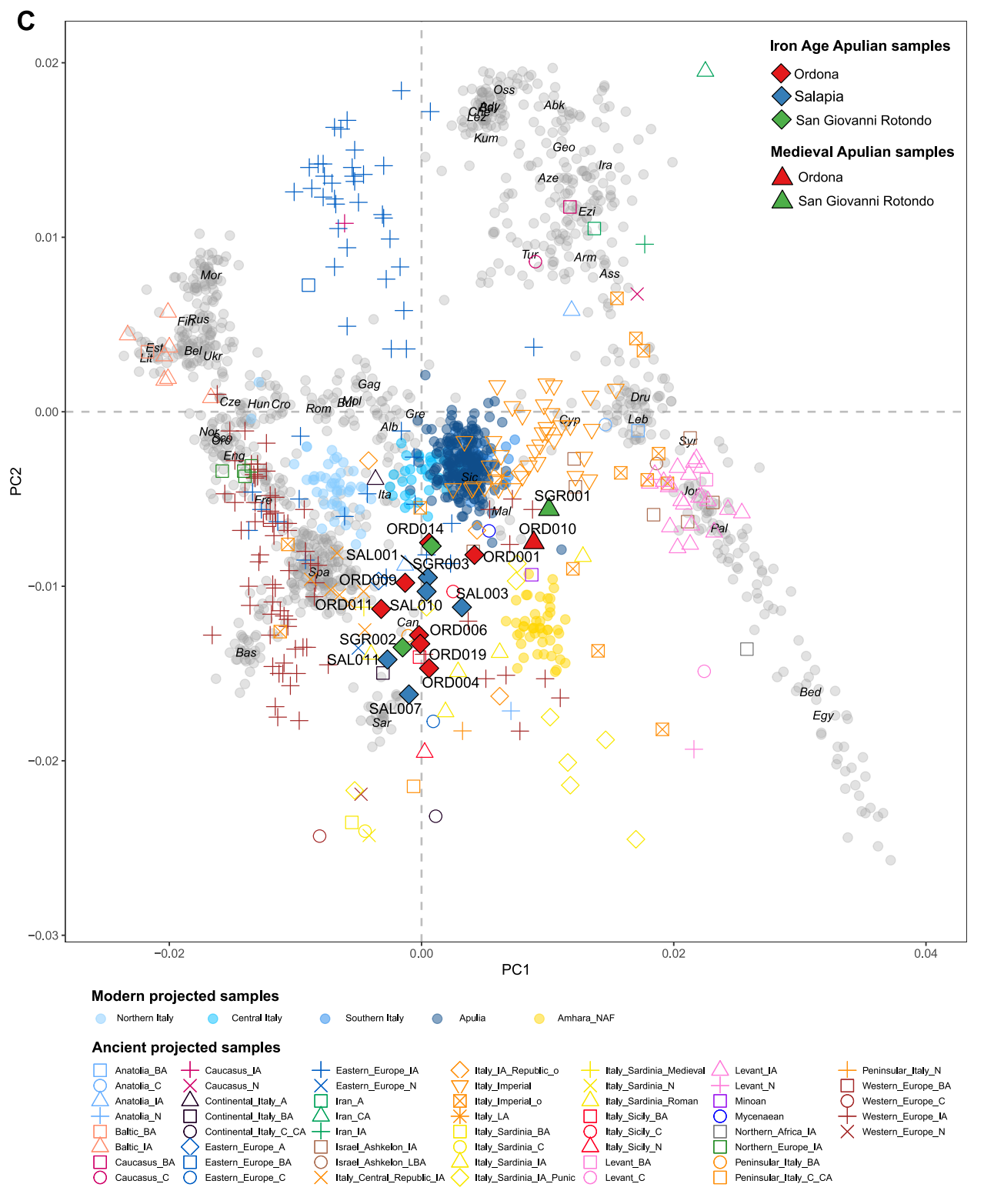
As you can see in the PCA of the first study, Iron Age Eastern Europeans (dark blue plus signs) were very "diverse", with a few still mostly CHG/IN and some way over in France. About 10 of them already cluster with Modern Italians and Southern Europeans. The cline away from AN/WHG is very obvious, going from bottom to top, with samples of Iron Age Apulians (IAA) from Southern Italy moving over time toward the broad "Steppe" zone and up to where Italians and other Europeans are today:


In order to shed light on this and to provide a genetic picture of Iron Age Southern Italy, we collected and sequenced human remains from three archaeological sites geographically located in Northern Apulia (the area historically inhabited by Daunians) and radiocarbon dated between 1157 and 275 calBCE. We find that Iron Age Apulian samples are still distant from the genetic variability of modern-day Apulians, they show a remarkable genetic heterogeneity, even though a few kilometers and centuries separate them, and they are well inserted into the Iron Age Pan-Mediterranean genetic landscape. Our study provides for the first time a window on the genetic make-up of pre-imperial Southern Italy, whose increasing connectivity within the Mediterranean landscape, would have contributed to laying the foundation for modern genetic variability. In this light, the genetic profile of Daunians may be compatible with an autochthonous origin, with plausible contributions from the Balkan peninsula.

[...]

To explore the genetic make-up of the IAA population, we performed a PCA projecting the ancient individuals onto the genetic variation of modern Eurasian samples (Figure 1C, Data S2 and Data S3). Our samples are largely scattered between modern peninsular Italians and Sardinians, and, in contrast to what was generally described for other European Iron Age populations (e.g., Northern_Europe_IA, Western_Europe_IA and Levant_IA in Figure 1C), they are still clearly distant from the genetic variability of modern-day inhabitants of Apulia. The downward shift of Iron Age Apulians from the present-day ones is further confirmed by the significantly negative f4(Modern Apulians, IAA; X, Mbuti), where X is a Neolithic/Chalcolithic/Copper Age population (Figure 2A, Data S4). Within the remarkable heterogeneity reported by the PCA, which does not mirror the archaeological sites, the two medieval individuals are shifted towards modern Middle Eastern and Caucasus populations (ORD010 and SGR001), while the others are stretched along the PC2. This pattern partially mirrors the chronological date with the most recent being more similar to present-day Southern Europeans, and is further strengthened when considering the PC3 distribution (Figure S2). Three samples located at the bottom of the PCA (ORD004, ORD019, SAL007) and one (SAL010) falling in the middle did not include modern Apulians among the top 25 results of an f3 outgroup analysis (Figure S3). All of them showed an affinity to Copper and Bronze Age Italians as well as the Aegean and the Mediterranean worlds (including Minoans, Greece, Croatians, and Gibraltar). A similar distribution is mirrored in the Multi-Dimensional scaling (MDS) built from the f3 outgroup measures, where the oldest IAA individual (SAL001; 1235 - 1048 calBCE (95.4%)) lies farthest from the modern samples, while the medieval ones (ORD010: 1078 - 1156 cal CE (95.4%) and SGR001: 670 - 774 cal CE (95.4%)) are the closest (Figure S4).

[...]

The geographic location of Apulia, a narrow peninsula stretching out in the sea at the South of Italy, has made this region an important Mediterranean crossroads connecting Western Europe, the Balkans, the Aegean, and Levant worlds. This is reflected in the PCA where IAA individuals are closely related to other Iron Age populations from the Mediterranean and surrounding areas (e.g., Montenegro, Bulgaria and Sardinia) (Figure 1C and Figure S4).

[...]

In order to shed light onto the genetic composition of the IAA individuals, we modelled them as a combination of the main ancestries documented across Western Europe at that time: Western Hunter-Gatherers (WHG), Anatolian Neolithic (AN), Steppe-related and, interchangeably, Caucasus Hunter-Gatherers (CHG) or Iranian Neolithic (IN) using the qpWave/qpAdm framework (Figure 2B, Figure S5A, STAR Methods). Broadly, the contributions of such ancestries to the genetic variability of ancient European populations vary according to their geographical positions: in particular, northernmost locations received higher proportions of WHG, Steppe-related ancestry and, consequently, CHG ancestries, while Southern European groups carried variable Iranian Neolithic or CHG traces. In view of this, we observed that while the IAA individuals could generally be modelled as a two-way admixture between AN and Steppe (0.63±0.08 and 0.37±0.08, respectively), the alternative model AN + CHG/IN could also fit for a subset of them, particularly in case of the samples ORD004, ORD010 and SAL010 with higher or comparable p-values (Figure S5A, first row with two sources). When three or four sources were tested, the presence of WHG ancestry in the majority of our individuals emerges, which, together with AN, Steppe and CHG/IN, forms a supported model for IAA samples (Figure 2B, Figure S5A and Data S5). Notably, for the individuals stretching downwards in the PCA (ORD004, ORD019, SGR002 and the Medieval ORD010) a three-way admixture involving AN, Steppe and CHG/IN is generally preferable.

[...]

We also investigated whether the PCA scattering was due to varying African or Levantine contributions with f4(Rome Republican, IAA, Levant_N/YRI, Mbuti) and tried the same on Medieval ancient Apulians (ORD010 and SGR001). However, none of the tested ancient Apulians shows a significant excess of YRI ancestry when compared to the contemporary Roman Republicans, even though ORD014, SAL007 and SAL011 show negative f4 values with a Z-score between 2 and 3 (Figure S8B).

The second study shows that the descendants of those Iron Age Balkan peoples (blue squares) in a Serbian sample dated to a later period (but before they were changed by Slavic migrations) all cluster with Modern Italians, forming the same kind of cline as in Italy from Iron Age Slovenia and Croatia in the North to Iron Age Bulgaria and Aegean in the South. This represents the original Pre-Roman ancestry of Southeastern Europe (including most of Italy).

Individuals from the first cluster fall on an area of the PCA delimited by the "Balkan Iron Age cline" (Figure 1A). Consistent with this, we model the ancestry of this Balkans Iron Age Cluster as predominantly deriving from Iron Age (IA) groups from nearby areas in the Balkans, with 67% Aegean Bronze Age-related ancestry and the remainder Slovenia Iron Age-related ancestry (Figure 2; Supplementary section 12.1). A local origin is supported by a high frequency of Ychromosome lineage E-V13, which has been hypothesized to have experienced a Bronze-to-Iron Age expansion in the Balkans and is found in its highest frequencies in the present-day Balkans. We interpret this cluster as the descendants of local Balkan Iron Age populations living at Viminacium, where they represented an abundant ancestry group during the Early Imperial and later periods (~47% of sampled individuals from the 1-550 CE).


The third study looks back even farther, showing that population structure already existed in the Neolithic, with many Balkan and Italian farmers being more AN and less WHG, and that it kept increasing in the Bronze Age, with Sicilians starting to shift toward CHG/IN long before the Roman Empire and even before the Greek settlements of Magna Graecia. Other Italians were also starting to shift (in slightly different directions) toward their current positions.

It is globally accepted that this [Neolithic farming] demic diffusion followed both a Mediterranean route (following the Mediterranean coasts, including Italy) and a continental route (Balkan route reaching Central and Western Europe through the Danubian valley), with the terminal fringes of this migration admixing again.

[...]

However, with the increase of ancient samples examined, subtle differences between Central-West and Central-East Europe started to emerge, with samples from Western and Eastern Europe forming two distinct clusters in the PCA (Fig. 2C) (Olalde et al. 2015; Rivollat et al. 2020; Marcus et al. 2020; Saupe et al. 2021). F4 statistics and related method (qpAdm) showed that this separation is possibly due to different amounts of ancestry related to WHG. It may be possible that the populations spreading through Central and Mediterranean routes mixed differently with residing hunter-gatherer populations, with the former witnessing a higher number of admixture events, in line with some archaeological evidence suggesting a sparser mesolithic hunter-gatherer population in Southern Italy, although new archaeological surveys are needed (Mussi 2006; Martini 2019).


The Bronze Age Aegean civilizations, mainly represented by Minoans and Mycenaeans, also harboured up to a quarter of their ancestry ultimately connected with ancient populations from Caucasus and Iran. Nonetheless, only the Mycenaean individuals also showed the EHG-related component (Lazaridis et al. 2017). For this reason, at least in the Minoans, the three-way split ancestral contribution is not completely fulfilled and raises other issues about who brought the Caucasus/Iran-related component into Europe.

[...]

The work from Antonio and colleagues examined the genetic transitions experienced by Central Italians which, during the Iron Age, would have given origin to the founders of the Roman civilization (Antonio et al. 2019). While they detected the suggestive presence of a small amount of the Caucasus/Iran-related component as early as the Neolithic period, they observed an increase of that component during the Bronze and Iron Age (between~4800 and 2850 ya), possibly due to increased trade-driven mobility.

[...]

The Steppe ancestry started appearing in Sicily around 4150 ya, during the Early Bronze Age, as demonstrated by qpAdm modelling on autosomal genetic variation with two notable outliers carrying up to 20% and 40% of this genetic component (Sicily_EBA8561 and Sicily_EBA11443, (Fernandes et al. 2020). Starting from the Middle Bronze Age (3750–3450 ya), Sicilian samples show a considerable shift in the PCA towards Minoans and Mycenaeans (Fig. 3A, Minoans and Mycenaeans are grouped in the Balkan area in green) and can be modelled with the Iranian-related component in a percentage around 15% (Fernandes et al. 2020). This data opens up the fascinating possibility that this mysterious ancestry must have reached Southern Italy before the occupation of the southern coastal areas of Italy (Magna Graecia). Conversely, ancient Sardinians showed a higher degree of genetic continuity from the Neolithic to the Bronze Age, with almost all individuals showing similar proportions of Anatolian Neolithic and WHG ancestries.

[...]

Multiple Iron Age populations characterized by different languages and cultures lived in Italy but, genetically speaking, they started to approximate the modern Italians (Aneli et al. 2021; Antonio et al. 2019).


The fourth study focuses on the same process in new samples from Northern and Central Italy (previously published samples are the circles with black borders). It shows again the AN/WHG structure in Neolithic Europe, but the Bronze/Iron Age Italian cline this time is shifted slightly away from the Balkan kind of Steppe ancestry toward the kind with more EHG/ANE that likely came across the Alps from Central Europe.

The human remains are from one necropolis (Necropoli di Gattolino; hereafter, "Gattolino") and three cave sites located in Northeastern (Grottina dei Covoloni del Broion: "Broion") and Central Italy (Grotta La Sassa: "La Sassa" and Grotta Regina Margherita: "Regina Margherita"; Figures 1A and S1).

[...]

A separation within the EN [European Neolithic] cluster (Figure 2A) clearly differentiates Anatolian and Eastern Europe N (right) from Western Europe N, defined as samples west of Germany (left, toward western hunter-gatherer [WHG]; Data S1D). A similar separation has already been reported and interpreted as a difference in WHG proportion of these samples. We note that most of our Chalcolithic individuals fall on the right side of the cluster (Anatolia and Eastern Europe).

[...]

Our analyses show the expected signature of peri- and post-BA movements from Steppe-related populations across Italy: absent in Italian individuals from the N and Chalcolithic, emerging in the Early BA (Italian Bell Beaker [I2478: 2195–1940 calBCE], Italian Remedello [RISE486: 2134–1773 calBCE], and Broion [BRC010: 1952–1752 calBCE (95.4%)]) and increasing through time in the individuals from Broion and Regina Margherita (GCP003: 1626–1497 calBCE [95.4%]). These samples confirm the date of arrival in Northern Italy to at least 2000 BCE and its presence in Central Italy by 4 centuries later, although denser sampling strategies are needed to assess the dynamics of this spread. Our qpAdm results suggest that the Steppe-related ancestry component could have arrived through Late N/Bell Beaker groups from Central Europe, though what remains unknown due to small sample size and limited geographical and chronological distribution is whether there were multiple Steppe population sources and the exact timing and diffusion of this ancestry component through the Italian Peninsula. The R1b subtype found in BA Broion is a lineage found in both ancient Sicilian samples and Italian Bell Beakers. Together with the autosomal affinity of North and Central Italian BA groups with Late N Germany, the Ychr data point to a possibly Northern-, transalpine-, and potentially Bell-Beaker-associated source of the Italian Steppe-related ancestry.


The fifth study has admixture profiles for several Modern Italian groups: Sardinians, Northerners, 3 Southern samples, and "Aspromonte" (old Greek-speaking communities in the South), showing that the same pan-Italian (and pan-European) components used to model the ancient samples are also the best fits for modelling the modern ones, with the levels of each in different parts of Italy matching the clines and positions of populations in all the PCAs above.

Ancient genetic heritage of Southern Italian populations.


Since present-day patterns of genetic variation reflect both local dynamics of differentiation and the ancestral population history, in order to provide a temporal overview on the ancestral genetic legacy of analyzed Southern Italian groups we finally compared the genetic landscape defined by modern populations with a large panel of ancient DNA samples extracted from the literature and timewise spanning from the Mesolithic to the Iron Age (Suppl. Table S7).

Consistently with previous results, the PCA performed by projecting ancient samples onto the modern genetic variation reveals specific patterns of population relationships (Suppl. Figure S8). In fact, all the Southern Italian groups, besides showing a general high affinity with Anatolian and European Neolithic farmers, cluster also closely with the Chalcolithic and Bronze Age samples from Anatolian and Aegean (Minoan and Mycenaean) populations. Differences in affinity patterns were formally tested with the outgroup-f3 statistic measuring the extent of shared drift between modern Italian groups and the main ancient genetic components represented by Western European Hunter-Gatherers (WHG), Eastern European Hunter-Gatherers (EHG), Caucasian HunterGatherers (CHG), Anatolian Neolithic farmers (AN) and Pontic-Steppe Yamnaya (EMBA). Overall Sardinia shows the highest levels of shared drift with samples of Neolithic-related ancestry compared to Northern and Southern Italy. Both Sardinians and Northern Italians show higher affinity to WHG than Southern Italians, who instead appear more affected by CHG-related groups. On the other hand, Yamnaya Steppe and EHG share more affinity to North Italy than to both Southern Italians and Sardinians (Suppl. Figure S9). In addition, qpGraph-based phylogenies consistently recapitulate the observed genetic patterns, with Sardinians showing a good fit to a two-way mixture model between populations representing Early European Farmers and West European Hunter-Gatherers (Suppl. Figure S10a), and North Italy instead achieving a successful fit to a graph model with an additional admixture event from an EHG-related lineage (Suppl. Figure S10b). Interestingly, when fitting present-day Southern Italian populations into the tested qpGraph models we find them compatible with an additional contribute that, differently from Northern Italy, does not originate from an EHG-related source but instead from a CHG-related lineage (Suppl. Figure S10c). This fits to the data in the sense that there are no f-statistics more than |Z| > 3 different between model and expectation.

Finally, to better characterize the ancestral composition of Southern Italian populations, we inferred their mixture proportions with respect to a four-population model of admixture including all the above-mentioned WHG, Neolithic, CHG/Iran_N and Steppe-related main sources, using qpAdm. All Italian populations were successfully modeled as characterized by a relatively high amount of Anatolian Neolithic ancestry, with the major contribution observed in Sardinians (Fig. 4, Suppl. Table S8). The remaining ancestries were assigned to a lower WHG contribution and to differential influences of Steppe_EMBA and CHG/Iran_N in the profiles of Northern and Southern Italians, respectively (Fig. 4, Suppl. Table S8). In fact, while Steppe ancestry is greater in North Italy (~ 27%), the Iran_N/CHG-related source is more present in South Italy with the highest values (~ 29%) observed in the populations from the Aspromonte area.


Finally, even the Etruscan study itself has a PCA showing Copper-Bronze Age Sicilians (pink triangles) creeping up to where Modern Sicilians and Southern Italians are. They don't veer left to first become like Etruscans so that they can later "mix with slaves" and do a U-turn toward the Levant. They were always Balkan-like, because Iberian-like people were not the only (or even the original) inhabitants of Italy.


So the alleged cline of Italians from Etruscans to Levantines is an illusion created by coincidental PCA positions and bad choices of reference populations for modelling. Italians are on the same Farmer-to-Steppe cline as all other Europeans. It's just that because they're geographically and genetically between Southwestern and Southeastern Europe, they're increasingly shifted toward AN/CHG/IN (peaking in the South), whereas the rest of Europe (including, somewhat, Northern Italy and the Northern Balkans) is shifted increasingly more toward WHG/EHG/ANE. And it's been that way since at least the Neolithic, up through the Bronze and Iron Age, way before the slaves and barbarians of the Roman Empire, who had almost no impact on the pre-existing population structure.

---------------
Posth et al. "The origin and legacy of the Etruscans through a 2000-year archeogenomic time transect". Sci Adv, 2021.

Aneli et al. "The genetic origin of Daunians and the Pan-Mediterranean southern Italian Iron Age context". bioRxiv, 2021.

Olalde et al. "Cosmopolitanism at the Roman Danubian Frontier, Slavic Migrations, and the Genomic Formation of Modern Balkan Peoples". bioRxiv, 2021.

Aneli et al. "Through 40,000 years of human presence in Southern Europe: the Italian case study". Hum Genet, 2021.

Saupe et al. "Ancient genomes reveal structural shifts after the arrival of Steppe-related ancestry in the Italian Peninsula". Curr Biol, 2021.

Sarno et al. "Genetic history of Calabrian Greeks reveals ancient events and long term isolation in the Aspromonte area of Southern Italy". Sci Rep, 2021.

Ancient-to-Modern Genetic Distances

October 8, 2020

Someone at Anthrogenica made these genetic distance maps that visualize how Modern West Eurasians are related to samples of Ancient Greeks and Ancient Romans, with redder coloring indicating more genetic affinity. The Ancients are all closest to Modern Southern Europeans — mostly Italians from all over, but often also Greeks, Iberians, South French and Balkan peoples. (Note: The "Imperial Romans" sample includes some foreigners from the Eastern Mediterranean, who later disappeared).

Minoan Greeks:


Mycenaean Greeks:


Iron Age Romans:


Proto-Villanovan
Villanovan


Etrsucan
Latin


Imperial Romans:


Late Antiquity Romans:


Medieval Romans:


Related: Genetically Italian Iron Age Balkans

Rosanne Cash's "Passing" Mother?

September 8, 2020

Rosanne Cash is the daughter of Johnny Cash and his first wife Vivian Liberto, whose parents were Thomas Liberto, a Sicilian American, and Irene Robinson from Texas. In some photos Vivian could almost be an exotic European type, like Sophia Loren, Victoria Beckham or Sarah Hyland, but most of the time she looks more ambiguous and mixed-race, like Rosie Perez or Eartha Kitt.

Ken Burns' recent documentary on Country Music talks about an incident in the 60s when a racist group in Alabama with links to the KKK questioned Vivian's whiteness, saying she looked like a "negro", but in an interview Rosanne claims that she was just very exotic looking because "her people were Italian", without even mentioning the Robinson side of the family.

Not everyone's buying it, like in this popular blog thread where many commenters believe she was black passing for white. There are the usual idiots repeating refuted lies about Sicilians being "African" and North Africans being "black", but one comment focusing on the Robinson line (if accurate) solves the case:

I dug around into her genealogy a bit out of curiosity – the commenters who stated that her parents (and maybe grandparents too) are white according to the census etc just didn’t dig far back enough. Also, regarding the census, it does have mistakes at time and people would just tell the census taker their info – so if they say so and so is from a certain place, or that they’re white then that’s what will be put down. Anyhow, Vivian’s mom was Irene Robinson. Irene’s mom was Dora Minnie, and Dora’s dad was Lafayette Robinson, born 1844. In the 1880 census he is listed as “mulatto” and by the 1910 census he is listed as “white,” so I’d assume that somewhere in that time he decided to start passing as white. His mother, Sarah, born about 1830 was also listed as “mulatto.” You can see various photos and family trees of the family on ancestry.com and one of them has Sarah’s mother listed as an unknown black slave and her father looks to be a slave owner by the name of William Shields. Sarah is listed in the 1870 census as “mulatto” and then in 1880 she is listed as “white.”

Anyway, here's a photo of Johnny Cash with Irene Robinson and Tom Liberto:


Which parent do you think Vivian gets her "exotic" looks from?

UPDATE: Genealogical research and genetic testing done on the show Finding Your Roots has confirmed that the Robinson line was mulatto passing for white.

Al Capone: From "Dark" to "Fair"

August 26, 2020

Recently I posted about how fairly light-skinned Italian criminals were often falsely stereotyped as "dark" or "swarthy" in the media. Because Al Capone is so famous, a lot of his rap sheets and wanted posters are uploaded online, and I was surprised to find that they don't all describe him the same way.

His hair is always Dark Brown or Black, and on his wanted poster it was assumed that his eyes would be Brown, but on his rap sheets they're described as either Blue, Grey or Green (his relatives have said that they were blue). But his complexion ranges from Dark all the way to Fair:


Dark
Dark Ruddy
Medium Dark


Medium Fair
Fair


Of course, this inconsistency doesn't reflect any kind of "questionable racial status" for Italians because, first of all, complexion and color (i.e. race) are two different things, and whenever a file mentions Capone's color, it's always White:


White
White
White


And second of all, this kind of thing wasn't limited to Italians and other "ethnics". I also found that criminals of Northern European descent were not always described as stereotypically Fair, but often also as Medium and even Dark:


John Dillinger:
Medium
Willie Sutton:
Medium Dark
Fred Barker:
Dark


Harvey Bailey:
Dark
Homer Van Meter:
Dark

Green Book's Made-Up Scene

August 11, 2020

The movie Green Book is "inspired by a true story" about an Italian American bouncer who takes a job driving a black pianist (Don Shirley) on a tour through the Deep South in 1962. But as always it doesn't stick closely to the facts. In one scene, Tony "Lip" Vallelonga punches a cop who accuses Italians of being part black:

PATROLMAN #1
What's this last name say?

LIP
Vallelonga.

PATROLMAN #1
'Hell kind of name is that?

LIP
Italian.

PATROLMAN #1
Oh, now I get it. That's why you driving this boy around... you half a nigger yourself.

Since that sounds more like something that would be in a dumb Spike Lee or Quentin Tarantino movie, or posted online by some Afrocentrist or Nordicist troll, I decided to check if it really happened. That scene is actually based on two separate events:

There were a lot more things that happened with the cops, and we combined two, when my father punched out a cop and that was one time they got arrested. They also got arrested when they were going 25 mph and a cop said they were doing 75. It was a shakedown and the cops were pissed my father was driving this black man.

The one where the cop is mad about a white man driving a black man around was only about that and had no violence and no mention of any name-calling:

Tony and the Mississippi policeman argue about the fact that Tony is driving a black man. The policeman calls Tony a racial slur, and Tony punches him. The camera pans to the two men in a jail cell. [...] In Shirley's own telling, Tony didn't throw blows, Shirley was not arrested, and they were driving through West Virginia.

"What happened was they stopped us and charged us for speeding in a 35 mile (per hour) zone we were going 25, okay, but they said we were going 75, and it was all pure racism," Shirley said in an interview with Astor. "They got pissed because he was white, driving me. That's what it was about. They made us turn around and come back 50 miles to McMechen, West Virginia, okay?"

The one where Tony punches the cop happened later and it was because he was called an ethnic slur for Italians, not blacks:

Did Tony Lip and Don Shirley really end up in jail due to Lip punching a police officer?

Yes. Lip became enraged at the officer for calling him a derogatory name for Italians. Lip did punch the officer and they ended up in jail, but it happened a year later, in the fall of 1963.

So there's no evidence that any cop ever made that claim. It was very likely invented by the writers and put in the movie to make a point about racism and "whiteness":

The point of the film is, to a certain extent, that because Tony is experiencing these prejudicial encounters with Don, that they slowly chip away at his conditioned hostility and he begins to view people of colour as something approaching equal. At one point, a police officer pulls over their car and seems intent on humiliating both Tony and Don, and calls Tony 'half a nigger.' To which Tony responds in the only way he knows with a swift one to the jaw. This is presented as pivotal by Farrelly, a Damascus moment where Tony experiences life as a member of the oppressed. But in actuality, Farrelly is showcasing a kind of inverse Uplift Suasion, where instead of a high achieving person of colour changing a racist mind via the sheer will of their achievement, a white person literally has to be called a 'nigger' before they begin to contemplate racial equality.

Misleading Genetic Distance Claim

July 22, 2020

Raveane et al. (2019) show that genes mirror geography, but then they make a misleading claim implying that genetic distances (Fst) within Italy are as great as those "across the whole of Europe". To Nordicists who wrongly believe that only their corner of Europe is "fully European" and the others are "mixed", that kind of distance perpetuates the myth of racial differences between Northern and Southern Italians.

But we already know that all Italians cluster between Spaniards and Greeks, which would make "across Southern Europe" a more accurate statement. So what exactly are the authors talking about?

They base their claim on the finding that the median Fst between all of their Italian clusters is 0.0044, which is about the same as the median Fst between all of the European clusters (excluding outlier Finns), and higher than within any of the other countries examined (0.0001 to 0.002). They say that they got similar results after also excluding outlier Sardinians and Basques, but don't show the data.

However, they're still including the Northern Italian clusters from the small regions bordering France, Austria and Slovenia that have many outliers as well, which increases the genetic distances. If you just compare typical Northern Italians (from Piedmont, Lombardy and Veneto) to deep Southern Italians (from Puglia, Basilicata, Calabria and Sicily), Fst between them ranges from 0.001 to 0.0054, with a median of just 0.0024, and an average of 0.0029.

That's not too much higher than the maximum distances within the other examined countries, and it's a lot lower than truly cross-Europe Fst, which ranges from 0.005 to 0.011 between Iberia and Eastern Europe (med. 0.008, avg. 0.0077), and from 0.004 to 0.008 between Greece and Northern Europe (med. 0.005, avg. 0.0055).

It also happens to be the same as the Fst between Southwest (Spain) and Southeast (Greece) Europe (0.002 to 0.003, med. 0.003, avg. 0.0029), which is itself lower than the Fst between Northwest (Britain) and Northeast (Baltic) Europe (0.003 to 0.007, med. 0.005, avg. 0.0049).

[NOTE: The highest in their data is 0.02 between Finns and Basques, both of which I excluded from all the above calculations, along with other outliers like Orcadians and Mordovians.]

So even though genetic distances in Italy are somewhat high for a single country, they're not as extreme as implied, and they don't represent any kind of "racial" or other significant difference, but merely a normal cline that's entirely within Southern Europe and likely related to the ancient spread of Indo-European languages.

"Dark" and "Swarthy" Italians Are Still Light

July 3, 2020

We've seen how olive skin is misunderstood by people to mean "tan" or "non-white", now let's look at the same thing with words like "dark" and "swarthy" used to describe the complexions of Europeans. Applied mostly (but not exclusively) to Southern Europeans, people treat them as evidence against "whiteness", but they're really just exaggerations of reality, like in this passage from White on Arrival about how Italian gangsters were portrayed in the media:

Al Capone was constantly portrayed in books, magazine articles, pulps, and movies as having a "dark" or "swarthy" complexion. When he appeared in court in 1929 in Philadelphia on charges of having concealed a weapon, the Chicago Daily News noticed that his "face, which is rather dark, assumed a dull reddish hue." No one emphasized Italians' dark features more than popular writer and former newsman Walter Burns. In his book, The One-Way Ride, Johnny Torrio was "a slight, dapper, dark young man"; gunmen John Scalise and Albert Anselmi had "dark faces"; the Genna brothers were "swarthy, black haired, black eyed, looked not unlike Arabs, and probably had in their ancestral strain a strong dash of Saracenic [North African] blood".

From these descriptions you'd probably picture really dark Saudi Arabians or maybe even mixed-race Berbers, but here's what those people actually looked like (the rare mugshot of Capone has been skillfully colorized to show his blue eyes):


Al Capone
Genna Brothers


Johnny Torrio
John Scalise and Albert Anselmi


This kind of exaggeration is similar to English ideas about the so-called "Black Irish". They're really just white people from the British Isles (not just Ireland) who have dark hair and eyes and a Mediterranean appearance — like Colin Farrell, Catherine Zeta Jones, Sean Connery, Mr. Bean, Russell Brand and many others — but old school Nordicists used to claim that part of the Celtic physiognomy was "black-tinted skin".

Benjamin Franklin was even more extreme, basically lumping all whites who weren't Anglo-Saxon into a "swarthy" group with non-whites, including some who are probably lighter than English people:

All Africa is black or tawny. Asia chiefly tawny. America (exclusive of the new Comers) wholly so. And in Europe, the Spaniards, Italians, French, Russians and Swedes, are generally of what we call a swarthy Complexion; as are the Germans also, the Saxons only excepted, who with the English, make the principal Body of White People on the Face of the Earth.

So the lesson is to not take descriptions like that literally or as meaning something "non-white". Europeans (including Southern Europeans) actually have the lightest untanned skin in the world, so even when they're "dark" or "swarthy", they're still lighter than everyone else.

Related: Al Capone: From "Dark" to "Fair"

Italy Is Over 2000 Years Old

April 8, 2020

People with an agenda to divide Italy who say that it's "not a real country" because it "didn't even exist until 1861" don't know their history. Italy was first unified by the Ancient Romans, and then it was divided by foreign powers after Rome fell. The movement for national unity was actually a reunification movement that went back to the Renaissance and was supported by many prominent Italians.

Italy was unified by Rome in the third century BC. For 700 years, it was a de facto territorial extension of the capital of the Roman Republic and Empire, and for a long time experienced a privileged status and was not converted into a province.

After the fall of the Western Roman Empire, Italy remained united under the Ostrogothic Kingdom and later disputed between the Kingdom of the Lombards and the Byzantine (Eastern Roman) Empire. Following conquest by the Frankish Empire, the title of King of Italy merged with the office of Holy Roman Emperor. However, the emperor was an absentee German-speaking foreigner who had little concern for the governance of Italy as a state; as a result, Italy gradually developed into a system of city-states. Southern Italy, however, was governed by the long-lasting Kingdom of Sicily or Kingdom of Naples, which had been established by the Normans. Central Italy was governed by the Pope as a temporal kingdom known as the Papal States.

This situation persisted through the Renaissance but began to deteriorate with the rise of modern nation-states in the early modern period. Italy, including the Papal States, then became the site of proxy wars between the major powers, notably the Holy Roman Empire (including Austria), Spain, and France.

Harbingers of national unity appeared in the treaty of the Italic League, in 1454, and the 15th-century foreign policy of Cosimo De Medici and Lorenzo De Medici. Leading Renaissance Italian writers Dante, Petrarch, Boccaccio, Machiavelli and Guicciardini expressed opposition to foreign domination. Petrarch stated that the "ancient valour in Italian hearts is not yet dead" in Italia Mia. Machiavelli later quoted four verses from Italia Mia in The Prince, which looked forward to a political leader who would unite Italy "to free her from the barbarians".

The Peace of Westphalia in 1648 formally ended the rule of the Holy Roman Emperors in Italy. However, the Spanish branch of the Hapsburg dynasty, another branch of which provided the Emperors, continued to rule most of Italy down to the War of the Spanish Succession (1701–14).

A sense of Italian national identity was reflected in Gian Rinaldo Carli's Della Patria degli Italiani, written in 1764. It told how a stranger entered a café in Milan and puzzled its occupants by saying that he was neither a foreigner nor a Milanese. "'Then what are you?' they asked. 'I am an Italian,' he explained."


Roman Italy at the death of Augustus (14 A.D.)

Genes and Geography (Italy vs. Britain)

January 16, 2020

All else being equal, genes mirror geography in Europe. We've already seen this by comparing Italians to Germans, and now we can do another similar comparison. A new study that has even better geographical coverage than Sazzini et al. (2016) shows the samples clustering to form an almost perfect map of Italy, while another new study shows the same thing in the British Isles.

[NOTE: For the samples in gray, "NWEur" is actually Southern French, "WEur" are Spanish and Portuguese, and "SEEur" is Greeks.]


Raveane et al. "Population structure of modern-day Italians reveals patterns of ancient and archaic ancestries in Southern Europe". Sci Adv, 2019.


Gilbert et al. "The genetic landscape of Scotland and the Isles". PNAS, 2019.

Related: Misleading Genetic Distance Claim

Clinal Differences in Pigmentation

December 31, 2019

People often mention the fact that Southern Italians are darker than Northern Italians like it proves something about "racial differences" in Italy, but clinal north-south or east-west differences in pigmentation (and other traits) are normal and can be seen in other European countries too, like Germany, France and the British Isles:


Italy
Germany


France
British Isles


Looking at Europe as a whole, the differences within Italy are small compared to differences between Italy and North-Central Europe:


This can also be seen within the border nation of Switzerland, between the Italian-speaking south and the German-speaking parts in the north:


Despite stereotypes of Northern Italians looking "Germanic" or "Celtic" compared to "dark" Southerners, and dumb movies claiming that they all have blond hair and blue eyes, people with that combination are only ~3-6% of the population in the North, compared to ~1-3% in the South, and red hair is <1% (~0.3-0.9) everywhere:


Blond Hair and Blue Eyes
Red Hair (per 1000 people)


You can see in the large random samples from all regions here and here that most Italians are in the medium pigmentation range. And you can see how similar they all are on average in these facial composites.

Myth of North-South Racial Differences

December 18, 2019

Many people today think that Northern and Southern Italians are racially different, but that isn't based on reality or any kind of evidence, which all shows that they're genetically and phenotypically similar. It's a myth that was shaped within Italy itself by some very ignorant people with inferiority complexes, who brought it wherever they immigrated, where it was copied by even dumber Nordicists and Afrocentrists.

From the 17th c. Northern and Western European "barbarians" started surpassing Southern Europe and denigrating Italy as backwards, so insecure Northern Italians tried to win their acceptance by separating from the Mediterranean and making Southern Italians the new barbarians:

Over the course of the seventeenth century, a radical inversion in the relations of force and cultural prestige between Italy and western Europe took place. Model to and "master" of Europe since the fourteenth century (Le Goff 2074), during the 1600s Italy was dramatically upstaged by countries to the north and west of the Alps: Holland, England, and France. What was taking place in fact was a massive shift of geopolitical and economic power away from the Mediterranean world as a whole. [...] The Italians had lorded their economic power and cultural supremacy over the rest of Europe since the fourteenth century. Italian intellectuals referred to those beyond the Alps as barbarians, using a conceit dating back to the days of Petrarch and central to the consciousness of Italian elites right through the Risorgimento. Now the tables were turning.

[...]

The tendency to denigrate contemporary Italy and the Italians had thus become commonplace in the culture of western Europe by the mid-1700s and would continue well through the next century. These accusations, repeatedly voiced by the English, French, and increasingly by the Germans as well, would have a significant impact on Italian representations of Italy in the Risorgimento. [...] One of the key aspects of the national consciousness that developed in Italy in the century before unification was the necessity of confronting its inferiority vis-à-vis western Europe, both as it was expressed in foreign denunciations and as it manifested itself in the political, economic, and cultural domains more generally.

[...]

But throughout the century before unification, and especially in the decades leading up to 1860, the dominant emphasis was nevertheless on Italy's need to rise to the economic and cultural levels attained by western Europe. The problem of political independence could itself be posed in comparative terms. [...] Notwithstanding Italian claims to parity, if not primacy, it would not be the Mediterranean models that prevailed in the making of modern Italy but rather those of western Europe. As we shall see later in this study, this pressure to conform mounted in the middle of the nineteenth century, helping to split Italy into two parts, a European north and a south that deviated from the European model. [1]

The idea of the South as "not European" came from the ignorance of Northerners — including the unified country's first Prime Minister — who had made assumptions or heard rumors about the South but never traveled there or even bothered to learn about it honestly:

There was remarkably little travel and commerce between northern and southern portions of the peninsula and almost no effort to bridge the gulf of mutual ignorance between the two. [...] Prime Minister Cavour was a great admirer of Britain, France, and northern Europe. He had never been south of Florence, where he once spent a few restless days. His ignorance of what northerners called "Lower Italy" was astonishing. He believed, for example, that the people of Naples spoke Arabic as a legacy of African invasions. No wonder Cavour was horrified to learn in May 1860 that Garibaldi and a volunteer army of one thousand Italians, mostly from the North, were planning to carry the Risorgimento south. They planned to invade Sicily, ally with peasant uprisings there, and liberate the South from the rule of Ferdinand II, the Bourbon king. [2]

This false picture of the South led to the people there being "racialized" by Northerners, but also by an elite Southerner who threw his own under the bus. Their pseudo-scientific theories, and the stereotypes and prejudices that grew out of them, then spread through the culture and around the world, lasting to this day:

The cultural and political discourses that, post-unification, proceeded to represent a binarized relation between North and South would increasingly assume racializing and racist dimensions. An entire school of intellectuals devoted to the study of the South, as a "question" or "problem" to be analyzed and solved, was launched with the publication of Pasquale Villari's Lettere Meridionali (1875) (see Teti; Schneider; Petrusewicz; and Dickie). In 1876, Constantino Nigra, in his study of glottology and dialects in the context of popular Italian poetry, claimed to have identified an "ethnic substratum" which he believed explained the difference between "superior" and "inferior" Italy (Teti 15). This "ethnic substratum" was, argued Nigra, constituted by two "distinct races": the "Italici and the Arians, the Mediterraneans and the Celts" (qtd. in Teti 16). By the 1890s, Nigra's linguistic theory was elaborated and consolidated in the writings of the influential school of positivist anthropologists known as the Meridionalisti (Southernists). The important point to note was that the Meridionalisti, who were to exert an inordinate influence in the consolidation of negative Southern stereotypes in Northern Italian politics and culture, were not exclusively Northerners. One of the most influential, and racist, Meridionalisti was in fact a Sicilian, Alfredo Niceforo. Niceforo can be seen as a super-assimilated Southerner who exemplifies the paradoxical and convoluted logic of assimilation. In writing the most vilifying and condemnatory "scientific" and "rational" accounts of Southern barbarism, savagery and backwardness, Niceforo strove to efface his own Southern status and to secure a Northern identity coextensive with civility and reason.

Drawing on the work of the positivist anthropologist and craniologist Giuseppe Sergi, who argued that the difference between Southerners and Northerners lay in the existence of two distinct races, Niceforo proceeds to name these two distinct races and to articulate their respective attributes: "Today Italy is divided into two zones, inhabited by two different races, the Arians in the North, delimited by the Tuscan border (Celts and Slavs), and the Mediterraneans in the South" (78). Niceforo invokes another racial theorist, A. Mosso, in order further to differentiate Northerners from Southerners: "The population of Northern Italy is little different from the Anglo-Saxon race" (79). As the contemporary Calabrian historian, Vito Teti, illustrates in his The Damned Race: The Origins of Anti-Southern Prejudice, the racist theories of Niceforo and fellow Meridionalisti were quickly taken up and reproduced at the levels of both popular and high culture. They continue to shape contemporary perceptions of the South.

The racial theories of the Meridionalisti supply the foundations for the anti-Southern xenophobia of such contemporary political parties as the Northern League. One of the pamphlets circulated by the Northern League in the early 1990s consisted of a map of Italy titled "The Integral Solution to All Our Problems" (see Dickie 136 for a reproduction of this map). The map shows an Italy divided by a "Liberation Canal" that neatly divides the Italian peninsula into two parts: Northern Italy is constituted by the Northern provinces of Lombardy, Piedmont and Veneto; adjacent to Northern Italy is "Southern Italy," constituted by the (Northern) provinces of Liguria, Tuscany, Umbria and Emilia-Romagna. All the provinces south of Florence are gathered under the title of the "Island of New Africa." The Island of New Africa is separated from "New Italy" by a sea-channel termed the "Liberation Canal," which effectively splits the country in half. The "Liberation Canal" is bordered by a "2 km. high protective laser barrier." This map graphically illustrates the vigor and resilience of the racist theories that have shaped the political and cultural landscape of Italy since so-called "unification." The imagining of Southern Italy as Northern Italy's "Africa," first enunciated in the nineteenth-century, finds its logical culmination in a type of spatial apartheid that finally severs the peninsula into two different nations: "New Italy" and "New Africa."

What I have offered so far is really only a synoptic mapping of the complex and entrenched history of anti-Southern racism in the Italian context. The important point that the historian Vito Teti makes in his history of anti-Southern racism is that these racist theories and prejudices were exported outside Italy and proceeded to inform the attitudes towards Southern Italians in other parts of the world, including Europe, the UK, the USA and Australia (all destinations for Southern Italian immigrants). [3]

Niceforo was an immature idiot who attempted to use things like poverty, crime, illiteracy etc. to support his racial theories — a lot like what happened with the Irish and what modern idiots like Richard Lynn are bringing back:

Alfredo Niceforo published L'Italia barbara contemporanea at the age of only twenty-two; it was to be the beginning of a distinguished academic career. Niceforo's hypothesis is that Sicily, Sardinia, and the southern mainland are stagnating at an inferior level of social evolution to the northern and central provinces. In support of his case, Niceforo invokes what he calls the "magical power" of statistical evidence in those fields (crime, education, birth rates, mortality, suicide, and the economy), which for the Italian school of positivist social anthropology were the key measures of the state of civilization of a society (Niceforo 15). For example, whereas the North is characterized by crimes of fraud, southern crime is predominantly violent, like brigandage; or, like the mafia, it is the result of an Arabic or medieval spirit of independence and rebellion against the principle of authority (Niceforo 45). Low literacy rates and the prevalence of superstitious practices, such as those surrounding the lottery, betray the "state of crass and primitive ignorance" in the population of Naples in particular (Niceforo 80).

Having set out the statistical basis of his contention, Niceforo proceeds to give a more detailed portrait of the "collective psyche" of the populations of Sardinia, Sicily, and the mainland Mezzogiorno (Niceforo 179, 184). In the Sicilian countryside, for example, he observes a "hatred for the spread of culture of a kind characteristic of societies that are not just inferior, but truly barbaric" (Niceforo 197). Outside of the cities, the Sicilian character "reminds one of the Orient and of out-and-out feudalism." In their "morbid conception of their own dignity" and their overbearing pride and love of pomp, the Sicilian aristocracy in particular present the scientific onlooker with "a stratification of the past which is still tenacious" (Niceforo 203–209). The wild lower orders of Sicily's urban population are capable of acts of "cannibalistic ferocity" and of scenes "that an African tribe would hardly have committed" (Niceforo 210–211). Sicilians in general display a love of weapons and aggression—"an essential characteristic of primitive and almost savage peoples," according to Niceforo (Niceforo 212).

L'Italia barbara contemporanea concludes that the backwardness of the South is in part determined by the fact that its population of "Mediterraneans" is a different race to the "Aryans" of the North (Niceforo 288ff). Niceforo follows Giuseppe Sergi in seeing the supposedly distinctive cranial form of Southern Italians as proof of this difference, which is the root cause of the greater individualism of the South and superior sense of social organization of the North. Niceforo maintains that Italy's hopes for the future rest on its becoming a federal state, since specific forms of government are necessary to deal with the distinct characteristics of each region. Government must be authoritarian in the South and liberal in the North (Niceforo 297). [4]

Another influential but surprising anti-Southerner was Cesare Lombroso. He was from Northern Italy, but he was Jewish, and he projected anti-Semitic racial prejudices against Jews onto Southern Italians to make himself accepted by Northerners and other Europeans:

When Lombroso discussed the relation of race to current issues of his day, he seemed less concerned with inhabitants of non-Western lands than with those of the Italian south. Like other northern Italians, Lombroso was perplexed by the so-called Southern Question, the debate about the supposed backwardness of southern Italy, including the islands of Sicily and Sardinia. Home to brigandage and criminal organizations like the Mafia and Camorra, the south seemed violent and lawless to northern observers. Lombroso offered a complex answer to the Southern Question, one that included a social critique of southern elites for monopolizing landownership and a political condemnation of the national government for failing to alleviate southern poverty, disease, and illiteracy. Despite his recognition of these environmental barriers to prosperity in the south, Lombroso nevertheless emphasized the importance of race for explaining high rates of violent crime. Having been conquered over the centuries by a number of foreign peoples — including North African Arabs — the south was inhabited by a racially mixed people, who, in Lombroso's view, shared a propensity for murder with their nonwhite ancestors.

Lombroso offered a more subtle analysis of the behavior of Jews, another group included in his chapter on race. His own Jewish ancestry partially accounts for his refusal to characterize Jewish behavior in simple biological rather than more complex sociological terms. Aware of the frightening rise during the last decades of the nineteenth century of racial anti-Semitism in northern Europe, Lombroso argued that Jewish patterns of behavior derived from the historical legacy of persecution rather than from innate racial characteristics. He contended that Jews have high arrest rates for property crimes like fraud and receiving stolen goods because legislation in most European nations traditionally forbade them to follow any professions besides peddling or commerce. As proof that atavism is not intrinsic to the Jewish character, Lombroso cites the rapid movement of Jews into important positions in politics, the army, and academia once they gained the same civil rights as their Christian compatriots. [5]

Lombroso was so self-hating and delusional that while he was claiming that Southern Italians were mostly Semitic and alien to Europe, he believed that Jews were mostly Aryan and could easily assimilate:

Though Lombroso considered the Jews to be more Aryan than Semitic, he was highly critical of some Jewish religious rites, including circumcision. While Lombroso invoked notions of racial science in his research, he ultimately held that the so-called Jewish Problem would disappear as Jews modernized and became more assimilated into European society. [6]

Lombroso and Niceforo were both motivated by embarrassment over Italy's recent military loss to an Ethiopian army, and they tried to blame it on Southern Italians:

Both Lombroso's In Calabria, 1862-1897 and Niceforo's L'Italia barbara contemporanea drew upon the new science of race to explain Italy's economic and military problems, which they attributed to the backwardness of southern Italy. Not surprisingly, Lombroso's and Niceforo's books appeared in the aftermath of Italy's startling military defeat at the hands of Abyssinian forces at Adowa. [6]

Like in the early days, today the idea of "the South" is an exaggeration needed by the North to deal with its insecurities and make it feel more Northwestern European:

The early impressions of this "other Italy" exaggerated the alien qualities of the South and reassured northern Italians of their own European affinities. Africa began below Rome. "Christ stopped at Eboli," according to one local expression. Above "lower Italy" was a Christian, European civilization; below it existed something else indeed. [...] One Italian cartoon [made by northern separatists] that circulated clandestinely in the 1990s illustrates "the complete solution to all our problems" with a map showing Italy cut in two by a wide "liberation channel" that divides the peninsula just below Florence. To the south the map shows the "Island of New Africa" and "Mafioso Realm." Each side of the channel has protective barriers two kilometers high, one side electrified, the other armed with laser sensors to keep southern migrants out of the North. The channel is filled with "terrone-eating" sharks and piranhas. North of the channel is Northern Italy and, significantly, a new "Southern Italy" below the Po Valley. Even a separate Northern Italy might need its South. [2]

References


  1. Nelson Moe. The View from Vesuvius: Italian Culture and the Southern Question. Berkeley, Los Angeles & London: The University of California Press, 2002.
  2. Don H. Doyle. Nations Divided: America, Italy, and the Southern Question. Athens & London: The University of Georgia Press, 2002.
  3. Joseph Pugliese. "Diasporic Architecture, Whiteness and the Cultural Politics of Space: In the Footsteps of the Italian Forum". Thamyris/Intersecting, No. 14, 23-50, 2007.
  4. John Dickie. Darkest Italy: The Nation and Stereotypes of the Mezzogiorno, 1860-1900. New York: St. Martin's Press, 1999.
  5. Mary Gibson and Nicole Hahn Rafter. "Editors' Introduction" to Cesare Lombroso's Criminal Man. Durham & London: Duke University Press, 2006.
  6. William Brustein. Roots of Hate: Anti-Semitism in Europe before the Holocaust. Cambridge: Cambridge University Press, 2003