Showing posts with label Phenotype. Show all posts

Rosanne Cash's "Passing" Mother?

September 8, 2020

Rosanne Cash is the daughter of Johnny Cash and his first wife Vivian Liberto, whose parents were Thomas Liberto, a Sicilian American, and Irene Robinson from Texas. In some photos Vivian could almost be an exotic European type, like Sophia Loren, Victoria Beckham or Sarah Hyland, but most of the time she looks more ambiguous and mixed-race, like Rosie Perez or Eartha Kitt.

Ken Burns' recent documentary on Country Music talks about an incident in the 60s when a racist group in Alabama with links to the KKK questioned Vivian's whiteness, saying she looked like a "negro", but in an interview Rosanne claims that she was just very exotic looking because "her people were Italian", without even mentioning the Robinson side of the family.

Not everyone's buying it, like in this popular blog thread where many commenters believe she was black passing for white. There are the usual idiots repeating refuted lies about Sicilians being "African" and North Africans being "black", but one comment focusing on the Robinson line (if accurate) solves the case:

I dug around into her genealogy a bit out of curiosity – the commenters who stated that her parents (and maybe grandparents too) are white according to the census etc just didn’t dig far back enough. Also, regarding the census, it does have mistakes at time and people would just tell the census taker their info – so if they say so and so is from a certain place, or that they’re white then that’s what will be put down. Anyhow, Vivian’s mom was Irene Robinson. Irene’s mom was Dora Minnie, and Dora’s dad was Lafayette Robinson, born 1844. In the 1880 census he is listed as “mulatto” and by the 1910 census he is listed as “white,” so I’d assume that somewhere in that time he decided to start passing as white. His mother, Sarah, born about 1830 was also listed as “mulatto.” You can see various photos and family trees of the family on ancestry.com and one of them has Sarah’s mother listed as an unknown black slave and her father looks to be a slave owner by the name of William Shields. Sarah is listed in the 1870 census as “mulatto” and then in 1880 she is listed as “white.”

Anyway, here's a photo of Johnny Cash with Irene Robinson and Tom Liberto:


Which parent do you think Vivian gets her "exotic" looks from?

UPDATE: Genealogical research and genetic testing done on the show Finding Your Roots has confirmed that the Robinson line was mulatto passing for white.

Al Capone: From "Dark" to "Fair"

August 26, 2020

Recently I posted about how fairly light-skinned Italian criminals were often falsely stereotyped as "dark" or "swarthy" in the media. Because Al Capone is so famous, a lot of his rap sheets and wanted posters are uploaded online, and I was surprised to find that they don't all describe him the same way.

His hair is always Dark Brown or Black, and on his wanted poster it was assumed that his eyes would be Brown, but on his rap sheets they're described as either Blue, Grey or Green (his relatives have said that they were blue). But his complexion ranges from Dark all the way to Fair:


Dark
Dark Ruddy
Medium Dark


Medium Fair
Fair


Of course, this inconsistency doesn't reflect any kind of "questionable racial status" for Italians because, first of all, complexion and color (i.e. race) are two different things, and whenever a file mentions Capone's color, it's always White:

White
White
White


And second of all, this kind of thing wasn't limited to Italians and other "ethnics". I also found that criminals of Northern European descent were not always described as stereotypically Fair, but often also as Medium and even Dark:


John Dillinger:
Medium
Willie Sutton:
Medium Dark
Fred Barker:
Dark


Harvey Bailey:
Dark
Homer Van Meter:
Dark

"Dark" and "Swarthy" Italians Are Still Light

July 3, 2020

We've seen how olive skin is misunderstood by people to mean "tan" or "non-white", now let's look at the same thing with words like "dark" and "swarthy" used to describe the complexions of Europeans. Applied mostly (but not exclusively) to Southern Europeans, people treat them as evidence against "whiteness", but they're really just exaggerations of reality, like in this passage from White on Arrival about how Italian gangsters were portrayed in the media:

Al Capone was constantly portrayed in books, magazine articles, pulps, and movies as having a "dark" or "swarthy" complexion. When he appeared in court in 1929 in Philadelphia on charges of having concealed a weapon, the Chicago Daily News noticed that his "face, which is rather dark, assumed a dull reddish hue." No one emphasized Italians' dark features more than popular writer and former newsman Walter Burns. In his book, The One-Way Ride, Johnny Torrio was "a slight, dapper, dark young man"; gunmen John Scalise and Albert Anselmi had "dark faces"; the Genna brothers were "swarthy, black haired, black eyed, looked not unlike Arabs, and probably had in their ancestral strain a strong dash of Saracenic [North African] blood".

From these descriptions you'd probably picture really dark Saudi Arabians or maybe even mixed-race Berbers, but here's what those people actually looked like (the rare mugshot of Capone has been skillfully colorized to show his blue eyes):


Al Capone
Genna Brothers


Johnny Torrio
John Scalise and Albert Anselmi


This kind of exaggeration is similar to English ideas about the so-called "Black Irish". They're really just white people from the British Isles (not just Ireland) who have dark hair and eyes and a Mediterranean appearance — like Colin Farrell, Catherine Zeta Jones, Sean Connery, Mr. Bean, Russell Brand and many others — but old school Nordicists used to claim that part of the Celtic physiognomy was "black-tinted skin".

Benjamin Franklin was even more extreme, basically lumping all whites who weren't Anglo-Saxon into a "swarthy" group with non-whites, including some who are probably lighter than English people:

All Africa is black or tawny. Asia chiefly tawny. America (exclusive of the new Comers) wholly so. And in Europe, the Spaniards, Italians, French, Russians and Swedes, are generally of what we call a swarthy Complexion; as are the Germans also, the Saxons only excepted, who with the English, make the principal Body of White People on the Face of the Earth.

So the lesson is to not take descriptions like that literally or as meaning something "non-white". Europeans (including Southern Europeans) actually have the lightest untanned skin in the world, so even when they're "dark" or "swarthy", they're still lighter than everyone else.

Related: Al Capone: From "Dark" to "Fair"

Clinal Differences in Pigmentation

December 31, 2019

People often mention the fact that Southern Italians are darker than Northern Italians like it proves something about "racial differences" in Italy, but clinal north-south or east-west differences in pigmentation (and other traits) are normal and can be seen in other European countries too, like Germany, France and the British Isles:


Italy
Germany


France
British Isles


Looking at Europe as a whole, the differences within Italy are small compared to differences between Italy and North-Central Europe:


This can also be seen within the border nation of Switzerland, between the Italian-speaking south and the German-speaking parts in the north:


Despite stereotypes of Northern Italians looking "Germanic" or "Celtic" compared to "dark" Southerners, and dumb movies claiming that they all have blond hair and blue eyes, people with that combination are only ~3-6% of the population in the North, compared to ~1-3% in the South, and red hair is <1% (~0.3-0.9) everywhere:


Blond Hair and Blue Eyes
Red Hair (per 1000 people)


You can see in the large random samples from all regions here and here that most Italians are in the medium pigmentation range. And you can see how similar they all are on average in these facial composites.

Pigmentation Through Roman History

December 6, 2019

The recent study on Ancient Roman DNA gives frequencies over time for some alleles of functional importance (eye and skin color). We know that Mesolithic hunters had blue eyes and dark skin while Neolithic farmers had brown eyes and light skin, which combined and adapted to make the European phenotypes of today.

But contrary to what Nordicists claim about Romans going from "Northern European" to "Middle Eastern", blue eyes and light skin (and also lactase persistence) have increased steadily since at least the Iron Age, and today they show the same levels as other Modern Europeans (Spanish, British or Finnish).

Olive Skin and Other Undertones

June 9, 2019

Many people think "olive" is a skin color like white, black or brown and refers to a separate or "mixed" ethnicity with some kind of "tan" complexion, usually in the Mediterranean region. But it's actually just one of several skin undertones that are found in all races, light and dark. The 4 undertones are: Cool (blue/pink), Neutral (yellow/beige), Olive (green/gray) and Warm (red/gold). And Southern Europe, including Italy, has the same variation as anywhere else in Europe or the world.

Here's what an untanned Italian woman would look like with each undertone:


And here are some other examples of Italians with different undertones:


You can see more, including some very tanned individuals, in these random samples of Big Brother and talent show contestants.

Italian Beauty: Anita Caprioli

April 19, 2019

Curly Hair Distribution

April 4, 2019

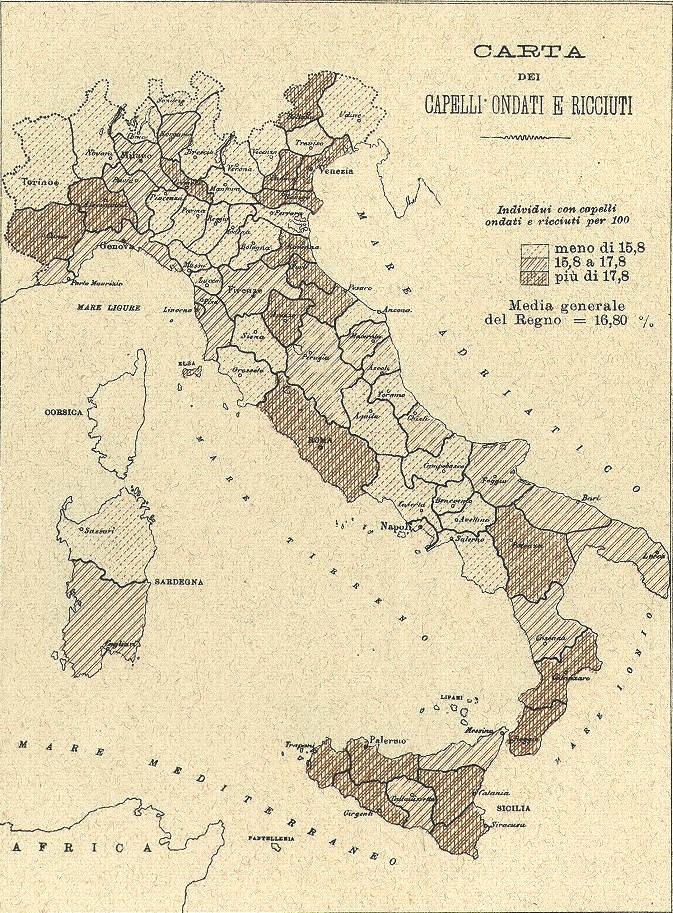
Like all Europeans, most Italians have straight or wavy hair. Curly hair in Caucasoids is a western trait that decreases as you move east toward Asia. It's most common along the Mediterranean and Atlantic shores, with an average rate of ~17% in Italy, which is a little higher in the South than in the North, but not by much.

Hair form...is of little use in distinguishing white sub-groups. Most European hair is straight or slightly wavy, although exceptional individuals in the straightest-haired groups have ringlet forms. Curly hair of this description is quite common in western Ireland and in Wales; it is also frequent in the whole of North Africa and in the western Mediterranean shorelands of Europe. Eastern Europe is predominantly straight haired, and as one approaches mongoloid territory this condition of course becomes more pronounced.

Carleton S. Coon. The Races of Europe. New York: MacMillan, 1939.


Frequency of Curly Hair in Italy
(Darker Shading = More)


Ridolfo Livi. Antropometria Militare. Roma, 1896-1905.

Convex and Concave Noses

March 24, 2019

Thin, high-rooted convex noses, which are common in Dinaric and Mediterranean types, exist at a frequency of ~15% in Italy. Wide, low-rooted concave noses, which are common in Alpine types, exist at a frequency of ~19%. The former are slightly more frequent in the North, and the latter slightly more in the South, which matches the distribution of sub-racial types throughout the country. The remaining ~66% of noses are straight or almost straight.


Frequency of Nasal Convexity
(Lighter Shading = More)
Frequency of Nasal Concavity
(Darker Shading = More)


Ridolfo Livi. Antropometria Militare. Roma, 1896-1905.

European Hair Texture

November 4, 2017

William Z. Ripley was a little confused about the racial make-up of Europeans because early anthropology was pretty basic, but he collected some useful data, like in this world map of hair texture showing Italians to resemble other Europeans:

What shall we say of the European races, the third of our intermediate types? Here also all individual variations occur, seemingly in utter defiance of any law. The Italian is as apt to be straight-haired as the Norwegian; in either nation the curly variety seems to occur sporadically. Yet common observation, to say nothing of microscopical examination, would naturally class the population of Europe among the fine-textured, wavy-haired races of the earth. One never sees the wiry form so familiar in the American Indian, or the frizzle of the full-blooded negro.


William Z. Ripley. "The Racial Geography of Europe. XII.—The Aryan Question". Popular Science Monthly, Vol 52, Jan 1898.

Related: Curly Hair Distribution

Reconstruction of a Herculaneum Resident

July 11, 2017


The exploded skull of a man who died in the catastrophic eruption of Mount Vesuvius nearly 2,000 years ago has been pieced together, giving scientists a unique opportunity to capture the ancient face using 3D imaging.

It is the first real-life reconstruction of the features of a victim of the volcanic disaster who lived in the ill-fated seaside town of Herculaneum.

The appearance is that of a typical southern European who may have been wealthy and educated because he was 50 years old when he died — an unusual milestone for the time.

He was one of 350 casualties discovered frozen in time, buried under volcanic ash in Herculaneum.

Every single resident perished instantly when the southern Italian town was hit by a 500° centigrade pyroclastic hot surge in AD 79.

[...]

The excavation of Pompeii, the industrial hub of the region, and Herculaneum, a small beach resort, has given unparalleled insight into Roman life.

"This is the beginning of what we're hoping will be an on-going project to reveal the faces of the ancient Roman inhabitants of Herculaneum and Pompeii", said Italian 3D graphic designer Gianfranco Quaranta who is leading the initiative as part of the Association for Research and Education in Art, Archaeology and Architecture (AREA3).

Janet Tappin Coelho and Phoebe Weston. "EXCLUSIVE: Scientists piece together the exploded skull of a 50-year-old man, who died in 500°C heat from the Mount Vesuvius eruption 2,000 years ago, to reveal his face for the first time". DailyMail.com – Science & Tech, 06:14 EDT, 21 June 2017.

Italian Beauty: Adua Del Vesco

May 1, 2017

Stage name of Rosalinda Cannavò, an actress from Messina, Sicily.