Raveane et al. (2019) show that genes mirror geography, but then they make a misleading claim implying that genetic distances (Fst) within Italy are as great as those "across the whole of Europe". To Nordicists who wrongly believe that only their corner of Europe is "fully European" and the others are "mixed", that kind of distance perpetuates the myth of racial differences between Northern and Southern Italians.
But we already know that all Italians cluster between Spaniards and Greeks, which would make "across Southern Europe" a more accurate statement. So what exactly are the authors talking about?
They base their claim on the finding that the median Fst between all of their Italian clusters is 0.0044, which is about the same as the median Fst between all of the European clusters (excluding outlier Finns), and higher than within any of the other countries examined (0.0001 to 0.002). They say that they got similar results after also excluding outlier Sardinians and Basques, but don't show the data.
However, they're still including the Northern Italian clusters from the small regions bordering France, Austria and Slovenia that have many outliers as well, which increases the genetic distances. If you just compare typical Northern Italians (from Piedmont, Lombardy and Veneto) to deep Southern Italians (from Puglia, Basilicata, Calabria and Sicily), Fst between them ranges from 0.001 to 0.0054, with a median of just 0.0024, and an average of 0.0029.
That's not too much higher than the maximum distances within the other examined countries, and it's a lot lower than truly cross-Europe Fst, which ranges from 0.005 to 0.011 between Iberia and Eastern Europe (med. 0.008, avg. 0.0077), and from 0.004 to 0.008 between Greece and Northern Europe (med. 0.005, avg. 0.0055).
It also happens to be the same as the Fst between Southwest (Spain) and Southeast (Greece) Europe (0.002 to 0.003, med. 0.003, avg. 0.0029), which is itself lower than the Fst between Northwest (Britain) and Northeast (Baltic) Europe (0.003 to 0.007, med. 0.005, avg. 0.0049).
[NOTE: The highest in their data is 0.02 between Finns and Basques, both of which I excluded from all the above calculations, along with other outliers like Orcadians and Mordovians.]
So even though genetic distances in Italy are somewhat high for a single country, they're not as extreme as implied, and they don't represent any kind of "racial" or other significant difference, but merely a normal cline that's entirely within Southern Europe and likely related to the ancient spread of Indo-European languages.
Showing posts with label Geography. Show all posts
Showing posts with label Geography. Show all posts

Italy Is Over 2000 Years Old
April 8, 2020
People with an agenda to divide Italy who say that it's "not a real country" because it "didn't even exist until 1861" don't know their history. Italy was first unified by the Ancient Romans, and then it was divided by foreign powers after Rome fell. The movement for national unity was actually a reunification movement that went back to the Renaissance and was supported by many prominent Italians.
Italy was unified by Rome in the third century BC. For 700 years, it was a de facto territorial extension of the capital of the Roman Republic and Empire, and for a long time experienced a privileged status and was not converted into a province.
After the fall of the Western Roman Empire, Italy remained united under the Ostrogothic Kingdom and later disputed between the Kingdom of the Lombards and the Byzantine (Eastern Roman) Empire. Following conquest by the Frankish Empire, the title of King of Italy merged with the office of Holy Roman Emperor. However, the emperor was an absentee German-speaking foreigner who had little concern for the governance of Italy as a state; as a result, Italy gradually developed into a system of city-states. Southern Italy, however, was governed by the long-lasting Kingdom of Sicily or Kingdom of Naples, which had been established by the Normans. Central Italy was governed by the Pope as a temporal kingdom known as the Papal States.
This situation persisted through the Renaissance but began to deteriorate with the rise of modern nation-states in the early modern period. Italy, including the Papal States, then became the site of proxy wars between the major powers, notably the Holy Roman Empire (including Austria), Spain, and France.
Harbingers of national unity appeared in the treaty of the Italic League, in 1454, and the 15th-century foreign policy of Cosimo De Medici and Lorenzo De Medici. Leading Renaissance Italian writers Dante, Petrarch, Boccaccio, Machiavelli and Guicciardini expressed opposition to foreign domination. Petrarch stated that the "ancient valour in Italian hearts is not yet dead" in Italia Mia. Machiavelli later quoted four verses from Italia Mia in The Prince, which looked forward to a political leader who would unite Italy "to free her from the barbarians".
The Peace of Westphalia in 1648 formally ended the rule of the Holy Roman Emperors in Italy. However, the Spanish branch of the Hapsburg dynasty, another branch of which provided the Emperors, continued to rule most of Italy down to the War of the Spanish Succession (1701–14).
A sense of Italian national identity was reflected in Gian Rinaldo Carli's Della Patria degli Italiani, written in 1764. It told how a stranger entered a café in Milan and puzzled its occupants by saying that he was neither a foreigner nor a Milanese. "'Then what are you?' they asked. 'I am an Italian,' he explained."
|

Genes and Geography (Italy vs. Britain)
January 16, 2020
All else being equal, genes mirror geography in Europe. We've already seen this by comparing Italians to Germans, and now we can do another similar comparison. A new study that has even better geographical coverage than Sazzini et al. (2016) shows the samples clustering to form an almost perfect map of Italy, while another new study shows the same thing in the British Isles.
[NOTE: For the samples in gray, "NWEur" is actually Southern French, "WEur" are Spanish and Portuguese, and "SEEur" is Greeks.]

Raveane et al. "Population structure of modern-day Italians reveals patterns of ancient and archaic ancestries in Southern Europe". Sci Adv, 2019.

Gilbert et al. "The genetic landscape of Scotland and the Isles". PNAS, 2019.
[NOTE: For the samples in gray, "NWEur" is actually Southern French, "WEur" are Spanish and Portuguese, and "SEEur" is Greeks.]

Raveane et al. "Population structure of modern-day Italians reveals patterns of ancient and archaic ancestries in Southern Europe". Sci Adv, 2019.

Gilbert et al. "The genetic landscape of Scotland and the Isles". PNAS, 2019.
Clinal Differences in Pigmentation
December 31, 2019
People often mention the fact that Southern Italians are darker than Northern Italians like it proves something about "racial differences" in Italy, but clinal north-south or east-west differences in pigmentation (and other traits) are normal and can be seen in other European countries too, like Germany, France and the British Isles:
Looking at Europe as a whole, the differences within Italy are small compared to differences between Italy and North-Central Europe:

This can also be seen within the border nation of Switzerland, between the Italian-speaking south and the German-speaking parts in the north:

Despite stereotypes of Northern Italians looking "Germanic" or "Celtic" compared to "dark" Southerners, and dumb movies claiming that they all have blond hair and blue eyes, people with that combination are only ~3-6% of the population in the North, compared to ~1-3% in the South, and red hair is <1% (~0.3-0.9) everywhere:
You can see in the large random samples from all regions here and here that most Italians are in the medium pigmentation range. And you can see how similar they all are on average in these facial composites.
|
|


|
|


Looking at Europe as a whole, the differences within Italy are small compared to differences between Italy and North-Central Europe:

This can also be seen within the border nation of Switzerland, between the Italian-speaking south and the German-speaking parts in the north:

Despite stereotypes of Northern Italians looking "Germanic" or "Celtic" compared to "dark" Southerners, and dumb movies claiming that they all have blond hair and blue eyes, people with that combination are only ~3-6% of the population in the North, compared to ~1-3% in the South, and red hair is <1% (~0.3-0.9) everywhere:
|
|


You can see in the large random samples from all regions here and here that most Italians are in the medium pigmentation range. And you can see how similar they all are on average in these facial composites.
Curly Hair Distribution
April 4, 2019
Like all Europeans, most Italians have straight or wavy hair. Curly hair in Caucasoids is a western trait that decreases as you move east toward Asia. It's most common along the Mediterranean and Atlantic shores, with an average rate of ~17% in Italy, which is a little higher in the South than in the North, but not by much.
Carleton S. Coon. The Races of Europe. New York: MacMillan, 1939.
Ridolfo Livi. Antropometria Militare. Roma, 1896-1905.
Hair form...is of little use in distinguishing white sub-groups. Most European hair is straight or slightly wavy, although exceptional individuals in the straightest-haired groups have ringlet forms. Curly hair of this description is quite common in western Ireland and in Wales; it is also frequent in the whole of North Africa and in the western Mediterranean shorelands of Europe. Eastern Europe is predominantly straight haired, and as one approaches mongoloid territory this condition of course becomes more pronounced.
Carleton S. Coon. The Races of Europe. New York: MacMillan, 1939.
|
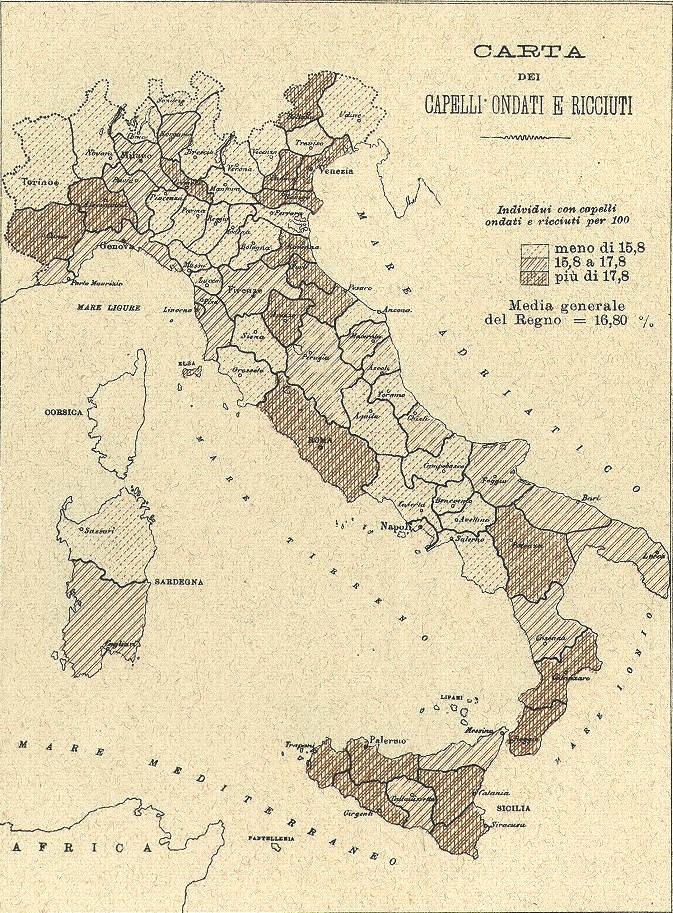
Ridolfo Livi. Antropometria Militare. Roma, 1896-1905.
Convex and Concave Noses
March 24, 2019
Thin, high-rooted convex noses, which are common in Dinaric and Mediterranean types, exist at a frequency of ~15% in Italy. Wide, low-rooted concave noses, which are common in Alpine types, exist at a frequency of ~19%. The former are slightly more frequent in the North, and the latter slightly more in the South, which matches the distribution of sub-racial types throughout the country. The remaining ~66% of noses are straight or almost straight.
Ridolfo Livi. Antropometria Militare. Roma, 1896-1905.
|
|


Ridolfo Livi. Antropometria Militare. Roma, 1896-1905.
European Hair Texture
November 4, 2017
William Z. Ripley was a little confused about the racial make-up of Europeans because early anthropology was pretty basic, but he collected some useful data, like in this world map of hair texture showing Italians to resemble other Europeans:

William Z. Ripley. "The Racial Geography of Europe. XII.—The Aryan Question". Popular Science Monthly, Vol 52, Jan 1898.
What shall we say of the European races, the third of our intermediate types? Here also all individual variations occur, seemingly in utter defiance of any law. The Italian is as apt to be straight-haired as the Norwegian; in either nation the curly variety seems to occur sporadically. Yet common observation, to say nothing of microscopical examination, would naturally class the population of Europe among the fine-textured, wavy-haired races of the earth. One never sees the wiry form so familiar in the American Indian, or the frizzle of the full-blooded negro.

William Z. Ripley. "The Racial Geography of Europe. XII.—The Aryan Question". Popular Science Monthly, Vol 52, Jan 1898.
Italian Clustering vs. German Clustering
September 14, 2015
Some people with a Nordicist agenda will use the fact that Northern Italians are a little bit closer than Southern Italians to Northern Europeans as evidence supporting the myth of racial differences between Northern and Southern Italy resulting from Germanic and Arab/African invasions. But there's no reason to expect all Italians to form a tight cluster. Genetic distance is largely a product of geographic distance, and Italy is long and curved, stretching from the Western Alps in the North to the Eastern Mediterranean in the South. So it's normal that Italians would be spread out in a broad cluster that mimics the shape of the country. Tian et al. (2009), which sampled Lombards, Tuscans, Southern Italians and Sardinians, noted exactly this pattern:
The same thing can be seen in other large countries, like Germany for example. Below is a detail of Figure S2 from Nelis et al. (2009). The Germans are spread out over an even greater area than the Italians, with Northern Germans (from Schleswig-Holstein) tending to the right and Southern Germans (from Bavaria) tending to the left, similar to the pattern observed with the Northern Italians (from Piedmont) and Southern Italians (from Puglia):

The distance between the Northern and Southern locations in each country is about 430 miles (690 km), and accordingly, the median values of PCs for the corresponding sample sets are about the same genetic distance:

In addition, Germany has East-West differences that seem to be even more prominent. The cities of Munich and Dresden are only 223 miles (359 km) apart, yet according to Heath et al. (2008), their populations form two distinct genetic clusters connecting Eastern and Western Europeans, just like on the map:


All of this is ultimately related to the clinal distribution of Mesolithic hunter-gatherer and Neolithic farmer ancestry, which shifts Northern and Eastern Europeans slightly toward Siberia, and Southern and Western Europeans slightly toward the Middle East, and can also have an effect within nations. Indeed, even smaller and less populous Germanic nations have noticeable population structure that follows the same pattern seen in Italy, Germany and Europe as a whole.
Lao et al. (2013) observed it in the Netherlands:
And Humphreys et al. (2011) observed it in Sweden:
To further explore the relationship among European population groups and examine population substructure, PCA was performed using the genotype results from a set of ~300,000 autosomal SNPs that was common to each of the populations examined. For most individuals with self-reported ethnic identities, there was a general correspondence with the geographical location of origin (Figure 1A). For example, the relationship of Italian groups and the subjects from the island country of Sardinia shows a striking resemblance to maps of Europe. In addition, genotypes from the same or related population groups typed in different laboratories showed similar PCA results (for example, north Italian and Tuscan groups genotyped as part of HGDP overlapped with Italian American subjects).
The same thing can be seen in other large countries, like Germany for example. Below is a detail of Figure S2 from Nelis et al. (2009). The Germans are spread out over an even greater area than the Italians, with Northern Germans (from Schleswig-Holstein) tending to the right and Southern Germans (from Bavaria) tending to the left, similar to the pattern observed with the Northern Italians (from Piedmont) and Southern Italians (from Puglia):

The distance between the Northern and Southern locations in each country is about 430 miles (690 km), and accordingly, the median values of PCs for the corresponding sample sets are about the same genetic distance:
In addition, Germany has East-West differences that seem to be even more prominent. The cities of Munich and Dresden are only 223 miles (359 km) apart, yet according to Heath et al. (2008), their populations form two distinct genetic clusters connecting Eastern and Western Europeans, just like on the map:


All of this is ultimately related to the clinal distribution of Mesolithic hunter-gatherer and Neolithic farmer ancestry, which shifts Northern and Eastern Europeans slightly toward Siberia, and Southern and Western Europeans slightly toward the Middle East, and can also have an effect within nations. Indeed, even smaller and less populous Germanic nations have noticeable population structure that follows the same pattern seen in Italy, Germany and Europe as a whole.
Lao et al. (2013) observed it in the Netherlands:
We detected a subtle but clearly noticeable genomic population substructure in the Dutch population, allowing differentiation of a north-eastern, central-western, central-northern and a southern group. Furthermore, we observed a statistically significant southeast to northwest cline in the distribution of genomic diversity across the Netherlands, similar to earlier findings from across Europe. [...] This genetic diversity cline is traditionally explained by several major prehistoric demographic events in Europe: the first colonization of Europe by anatomically modern humans together with a postglacial re-expansion from the southern European refugee areas in Palaeolithic times, and the introduction of the Neolithic agricultural lifestyle by people from the Near East.
And Humphreys et al. (2011) observed it in Sweden:
In a comparison of extended homozygous segments, we detected a clear divide between southern and northern Sweden with small differences between the southern counties and considerably more segments in northern Sweden. [...] The first principal component showed the presence of a north-south genetic gradient that was mainly driven by each northern county being different from other counties. Systematic variation was present in the south of Sweden although to a markedly smaller degree than in the north of Sweden. [...] The overall North-South axis of variation is consistent with previous studies that have shown axes of variation on a European scale that closely line up with geographical axes.
Geological Origins of Italy
December 11, 2014
Italy broke off of the French Alps 30 million years ago, emerged from the sea 5-10 million years ago when it collided with the Adriatic Plate, and might end up joining the Balkan Peninsula in 50-70 million years.
"Italy's Mystery Mountains". PBS International, 2014.
"Italy's Mystery Mountains". PBS International, 2014.
Mediterranean Sea as Genetic Barrier
June 16, 2014
This new study confirms that the Mediterranean Sea has acted as a strong barrier to gene flow through geographic isolation following initial settlements. Samples from (Northern) Italy, Tuscany, Sicily and Sardinia are closest to other Southern Europeans from Iberia, the Balkans and Greece, who are in turn closest to the Neolithic migrants that spread farming throughout Europe, represented here by the Cappadocian sample from Anatolia. But there hasn't been any significant admixture from the Middle East or North Africa into Southern Europe since then.


Paschou et al. "Maritime route of colonization of Europe". PNAS, 2014.
Genes Mirror Geography Across the Mediterranean Basin
We first used principal components analysis (PCA) to visualize the genotypic distances between studied populations. Populations on the southern and northern coasts of the Mediterranean appear to be separated by the geographic barrier of the Mediterranean Sea. The role of the Mediterranean Sea as a barrier for gene flow among populations was also supported by our analysis using the BARRIER software, which implements Monmonier's maximum difference algorithm. In accordance with this finding...the PCA distribution of the populations closely resembles the geographic map of the countries circling the Mediterranean Sea. On this PCA "map" of populations, the east coast of the Mediterranean Sea is appropriately occupied by the Palestinians and the Lebanese Druze. Yemenites and Bedouins branch out from the Mediterranean populations and are closer to the populations of the Near East.
[...]
Seljuk Turks settled in Anatolia in the 12th century AD; however, the Anatolian Cappadocians we included in this study belong to the population that have kept the religion and the language of the pre-Seljuk Cappadocians and, therefore, most likely carry the genetic makeup of the ancient Anatolians. The only important gene flows from Near East to Europe must have occurred in prehistoric times and, as genetic evidence suggests, the most prominent migrations should have occurred during the Neolithic.
[...]
Although the Southeastern Mediterranean islands seem to have acted as a bridge from Anatolia to Southern Europe, the relatively small degree of gene flow between the African and the European coasts shows that the Mediterranean Sea also had a barrier function as also suggested with studies of mtDNA polymorphisms. Thus, the Mediterranean seems to have facilitated the migrations of Neolithic farmers along its Southern European coast but it mostly acted as an isolating factor between its European and African coasts.


Paschou et al. "Maritime route of colonization of Europe". PNAS, 2014.
World Wonders Project: Italy
June 7, 2012
This is part of a new Google project to bring UNESCO World Heritage Sites to life and make them available to people across the globe. So far there are 21 Italian sites listed from all over the country (you can learn about the rest at the World Heritage Centre's website). Click on the names below to explore each site further.
Under the rule of the House of Este, the city of Ferrara attracted great artists and scholars of the Italian Renaissance, and the city itself expanded according to Renaissance ideals of urban design.

The Cinque Terre along northern Italy's Riviera is a series of villages that have been rather amazingly carved into a steep terraced-vineyard coastline.

Florence was Europe's most prosperous city at the end of the 13th century, and over the next two centuries it became its cultural capital as well, attracting the greatest artists of the Renaissance.

The Piazza del Duomo (Cathedral Square), located in the center of Pisa in Tuscany, Italy, is home to a group of exceptional marble monuments, dating from the Middle Ages.

The towers of San Gimignano bear unique testimony to the power struggle that raged between opposing political factions in Italy in the Middle Ages.

With medieval architectural landmarks, masterful art and innovative town planning, the Italian city of Siena has been one of Europe's most influential urban centers.

In the 15th century, the city of Urbino attracted the greatest artists of Italy's High Renaissance, and the city itself became an embodiment of the Renaissance spirit.

Extraordinarily evocative of the Middle Ages, the Santi Quattro Coronati Cloister in Rome is a splendid example of cosmatesque architecture of the 13th century.

The round Temple of Hercules in Rome, Italy, is a remnant of a Greek sanctuary that dates back to the second century B.C.

The Temple of Portunus in Rome, Italy, is one of the most intact examples of an ancient Roman Temple because it was converted to a church in medieval times.

The ruins of Villa Adriana (Hadrian's Villa) near Tivoli, Italy, once an opulent estate, date from the 2nd century A.D.

The Villa d'Este in Tivoli, Italy, is an outstanding exemplar of 16th-century Renaissance garden design and architecture, which would be imitated for centuries to come.

The 18th century Royal Palace at Caserta, in Naples, Italy, and its park, together with the Aqueduct of Vanvitelli and the nearby complex at Leucio served as a royal enclave and as an industrial town.

An ideal Mediterranean landscape, Costiera Amalfitana (Amalfi Coast) features diverse natural beauty and historic coastal settlements.

Founded by the Greeks in the 7th century B.C., the city of Naples bears the impression of the diverse powers that controlled it up to the unification of Italy in the 19th century.

The eruption of Mount Vesuvius in the 1st century A.D. buried the towns of Pompei, Herculaneum and Oplontis (modern-day Torre Annunziata), which were unearthed centuries later.

Built by Frederick II in the 13th century in southeast Italy, the Castel del Monte is a visually arresting octagonal castle, showcasing varied architectural styles.

The rupestrian churches of Puglia and Matera, Italy, are among some of the most outstanding examples of rock-hewn buildings in the Mediterranean region.

Alberobello is home to a dense concentration of trulli, limestone cottages with cone-shaped roofs built between the mid-15th and late-18th centuries.

Su Nuraxi di Barumini is a complex of unique defensive stone structures called nuraghi, dating from circa 1500–800 B.C., found only on Sardinia.

After a 1693 earthquake in the region of Val di Noto in Sicily, urban planners and architects masterfully rebuilt eight towns in a regional Baroque style, using innovative techniques.

Ferrara, City of the Renaissance, and its Po Delta
Under the rule of the House of Este, the city of Ferrara attracted great artists and scholars of the Italian Renaissance, and the city itself expanded according to Renaissance ideals of urban design.

Cinque Terre
The Cinque Terre along northern Italy's Riviera is a series of villages that have been rather amazingly carved into a steep terraced-vineyard coastline.

Historic Center of Florence
Florence was Europe's most prosperous city at the end of the 13th century, and over the next two centuries it became its cultural capital as well, attracting the greatest artists of the Renaissance.

Piazza del Duomo, Pisa
The Piazza del Duomo (Cathedral Square), located in the center of Pisa in Tuscany, Italy, is home to a group of exceptional marble monuments, dating from the Middle Ages.

Historic Center of San Gimignano
The towers of San Gimignano bear unique testimony to the power struggle that raged between opposing political factions in Italy in the Middle Ages.

Historic Center of Siena
With medieval architectural landmarks, masterful art and innovative town planning, the Italian city of Siena has been one of Europe's most influential urban centers.

Historic Center of Urbino
In the 15th century, the city of Urbino attracted the greatest artists of Italy's High Renaissance, and the city itself became an embodiment of the Renaissance spirit.

Santi Quattro Coronati Cloister
Extraordinarily evocative of the Middle Ages, the Santi Quattro Coronati Cloister in Rome is a splendid example of cosmatesque architecture of the 13th century.

Temple of Hercules
The round Temple of Hercules in Rome, Italy, is a remnant of a Greek sanctuary that dates back to the second century B.C.

Temple of Portunus
The Temple of Portunus in Rome, Italy, is one of the most intact examples of an ancient Roman Temple because it was converted to a church in medieval times.

Villa Adriana, Tivoli
The ruins of Villa Adriana (Hadrian's Villa) near Tivoli, Italy, once an opulent estate, date from the 2nd century A.D.

Villa d'Este, Tivoli
The Villa d'Este in Tivoli, Italy, is an outstanding exemplar of 16th-century Renaissance garden design and architecture, which would be imitated for centuries to come.

18th Century Royal Palace at Caserta
The 18th century Royal Palace at Caserta, in Naples, Italy, and its park, together with the Aqueduct of Vanvitelli and the nearby complex at Leucio served as a royal enclave and as an industrial town.

Costiera Amalfitana
An ideal Mediterranean landscape, Costiera Amalfitana (Amalfi Coast) features diverse natural beauty and historic coastal settlements.

Historic Center of Naples
Founded by the Greeks in the 7th century B.C., the city of Naples bears the impression of the diverse powers that controlled it up to the unification of Italy in the 19th century.

Archaeological Areas of Pompei
The eruption of Mount Vesuvius in the 1st century A.D. buried the towns of Pompei, Herculaneum and Oplontis (modern-day Torre Annunziata), which were unearthed centuries later.

Castel del Monte in Andria
Built by Frederick II in the 13th century in southeast Italy, the Castel del Monte is a visually arresting octagonal castle, showcasing varied architectural styles.

Rupestrian Churches of Puglia and the City of Matera
The rupestrian churches of Puglia and Matera, Italy, are among some of the most outstanding examples of rock-hewn buildings in the Mediterranean region.

The Trulli of Alberobello
Alberobello is home to a dense concentration of trulli, limestone cottages with cone-shaped roofs built between the mid-15th and late-18th centuries.

Su Nuraxi di Barumini
Su Nuraxi di Barumini is a complex of unique defensive stone structures called nuraghi, dating from circa 1500–800 B.C., found only on Sardinia.

Late Baroque Towns of the Val di Noto
After a 1693 earthquake in the region of Val di Noto in Sicily, urban planners and architects masterfully rebuilt eight towns in a regional Baroque style, using innovative techniques.

Resources and Industry in the North
December 30, 2011
In a recent post I showed how Italian geography favors the North when it comes to farming, trade and industry. The latter is a primary source of wealth in the modern world, and even though Southern Europe's coal reserves are small and of poor quality, Northern Italy has been able to compensate with hydroelectric power because of its geographical features and natural resources.
Concha Betrán. "Natural Resources, Electrification and Economic Growth from the End of the Nineteenth Century until World War II". Revista de Historia Económica, 2005.
The objective of this article is to analyse the importance of one of the new energy sources, electricity, since the end of the nineteenth century until 1945, from the point of view of natural resource endowments. Not all countries had good or equivalent endowments of coal, the energy-producing mineral of the nineteenth century, and for this reason not all of them had the same opportunities to use it, given that the transport cost was very high due to its weight in relation to its caloric power. Electricity reduced the dependence on coal resources as it could be produced not only from coal but also from water.
[...]
The accessible coal endowments available...are presented in Table 1, both in the form of total coal reserves and coal reserves per capita in each country. Well endowed in coal were Canada and the US in North America and Germany, the UK, Austria and — in an intermediate position — France in Europe. The Northern European countries Denmark and Sweden and the Southern European countries Italy, Greece and Portugal all had poor coal endowments. Looking at coal quality, Spain and especially Italy lacked good quality coal; as for the cost of extraction, this was particularly high in France and Spain, due to the characteristics of its seams.
[...]
Natural resources also had effects on the type of electricity being produced in these countries when electricity eventually arrived. [...] The situation was worst in Italy because of the scarcity of coal and its low caloric power. As a result, coal had to be imported. For that reason, electricity was generated by hydraulic power, once the problem of long distance transmission was solved by means of the alternating current. The most important hydraulic resources were concentrated in the Alps and the Po Valley, between the Alps and the Apennines in the North of the country. The regions endowed with the most important sources of waterpower were the Piedmont and Lombardy, the Po Valley (Adda, Adige, Ticino, Tevere, etc.), the Venetia region and that of Umbria.
[...]
We have calculated the proportion of hydroelectricity and thermoelectricity in the total electricity production of each country. As shown in Figure 1, at the top of the countries using hydroelectricity were Canada, Italy and Spain. Hydroelectricity accounted for over 80 per cent of their electricity production. At the bottom, using less than 60 per cent, as already commented, were the coal intensive countries, i.e. the UK, the USA, and France, although, France had a lesser proportion of thermoelectricity.
[...]
The degree of electrification advanced substantially from the end of the nineteenth century until WWII, the height of the process being 1925, after WWI, when real electricity prices fell considerably. The behaviour of the relative prices electricity-coal, coupled with the new technical opportunities for electrification in the manufacturing sector where electricity competed with steam, produced important possibilities for economic growth. There was also a relationship between the accumulation of physical capital and electrification process and the increase in labour productivity, manufacturing and income per capita, especially in the countries that were badly endowed with coal deposits, but enjoyed better opportunities for the production of electricity.
Concha Betrán. "Natural Resources, Electrification and Economic Growth from the End of the Nineteenth Century until World War II". Revista de Historia Económica, 2005.
Geography and North-South Disparities
November 19, 2011
Books like Guns, Germs, and Steel and The Botany of Desire, and discoveries like the impact of infectious disease on IQ and climate shifts on the fall of Rome, have shown what a huge role geography and environment play in shaping development and the course of history. Stanford economist Thomas Sowell describes this phenomenon at work in modern Italy, showing how socioeconomic and other disparities between North and South that are often attributed to behavioral or biological factors actually have deep roots in the lay of the land.
Thomas Sowell. Ethnic America: A History. New York: Basic Books, 1981.
Arable land is both scarce and scattered in southern Italy, leading to many isolated settlements — contributing in turn to the linguistic and other cultural differences. Moreover, there are very few long navigable rivers to facilitate trade and communication. Such modern means of travel or communication as broadcasting, railroads, and airlines were of course not yet in existence, or were not yet significant in southern Italy, when the massive immigration to America was taking place. Even in the middle of the twentieth century, however, geographical isolation was still extreme in some southern Italians villages.
[...]
The climate and terrain of southern Italy contributed to its poverty. While the temperatures are relatively mild, rainfall is both low and concentrated in only a few months. The growing season is dry — "drought may endure for six months or more." When the rains finally come, they are torrential, causing erosion. The dryness during the growing season in turn limits the use of fertilizers. The impermeability of much of the hilly soil facilitates rapid water runoff when it does rain, and the deforestation of southern Italy's once heavily wooded areas adds to both erosion and the collection of water in stagnant pools, breeding malaria. Italy has been the most malarial country in Europe, and southern Italy more so than the rest of the country. In addition to the direct suffering and death caused by malaria, disease also exacted an economic toll. Because the most fertile lowlands were also the most malarial, peasants and agricultural workers lived up on hillsides in order to be away from the malaria-bearing mosquitoes at night, when they bite. This in turn meant that much of the day was spent going to and from home and work — often miles apart — instead of actually working.
While much of southern Italy is hilly and mountainous, the highlands are at just the wrong height for agricultural purposes. They are too high and rugged to be good cropland and too low to collect snow, which would melt and give a slow, steady runoff of water during the spring. In addition to lacking these advantages common in some other European countries, Italy also does not have its sod broken up by nature through successive freezes and thaws during the winter. The southern Italian farmer must perform the vital function of breaking up the soil entirely by his own efforts and that of his animals pulling the plow.
Italy's natural deficiencies are both agricultural and industrial. About three quarters of the land area of Italy consists of mountains and hills. Only about half of the land is arable, and most of that is in northern Italy. In the south, the mountains "reach so close to the sea that arable land is limited to mountain villages, high plateaus, or coastal plains" — the latter being generally "very narrow." Italy is also lacking in both the quantity and quality of coal and iron ore needed for producing iron and steel — a mainstay of modern industry.
History has added to the problems created by nature. Southern Italy was long a battleground for contending empires and dynasties, which fought back and forth across the Italian peninsula for centuries, going back at least as far as the Roman Empire. For two centuries during the Middle Ages, invasions were "frequent and almost annual." At various times, southern Italy was conquered by a variety of foreigners, including the Lombards, the Arabs, and the Normans. Massacres, pillage, rape, and enslavement were the common fate of the population.
[...]
Northern Italy has been better treated by both nature and man. The rain falls in the spring and summer, when it is needed for agriculture. It has "several rivers, whose waters are kept at a relatively steady level by melting Alpine snows," and those "provide considerable water and power for agriculture and industry." In addition, northern Italy has "a system of irrigation that has been nowhere excelled and rarely approached" — at least during the era of massive immigration to America. Northern Italian agriculture has been described as "luxuriant under cultivation," yielding "a notable variety of crops." Deforestation and other natural and man-made evils of the south were less prevalent in the north.
Thomas Sowell. Ethnic America: A History. New York: Basic Books, 1981.
New York's Little Italy Is Disappearing
March 23, 2011
People have mixed feelings about this. On one hand, it feels like the end of an era and a sort of Asian takeover, but on the other, it's an indication that Italians have made it in America and moved beyond the "old neighborhood".
Sam Roberts. "New York's Little Italy, Littler by the Year". The New York Times, February 21, 2011.
In 1950, nearly half of the more than 10,000 New Yorkers living in the heart of Little Italy identified as Italian-American. The narrow streets teemed with children and resonated with melodic exchanges in Italian among the one in five residents born in Italy and their second- and third-generation neighbors.
By 2000, the census found that the Italian-American population had dwindled to 6 percent. Only 44 were Italian-born, compared with 2,149 a half-century earlier.
A census survey released in December determined that the proportion of Italian-Americans among the 8,600 residents in the same two-dozen-square-block area of Lower Manhattan had shrunk to about 5 percent.
And, incredibly, the census could not find a single resident who had been born in Italy.
Little Italy is becoming Littler Italy. The encroachment that began decades ago as Chinatown bulged north, SoHo expanded from the west, and other tracts were rebranded more fashionably as NoLIta (for north of Little Italy) and NoHo seems almost complete.
The Little Italy that was once the heart of Italian-American life in the city exists mostly as a nostalgic memory or in the minds of tourists who still make it a must-see on their New York itinerary.
[...]
Last year, the National Park Service designated a Chinatown and Little Italy Historic District with no geographic distinction between the neighborhoods. The two neighborhoods have begun organizing a Marco Polo Day and an East Meets West Christmas Parade.
City Hall will soon further erase the boundaries.
Following the lead of three local community boards, the City Planning Commission is expected in March to approve the creation of a Chinatown Business Improvement District, which would engulf all but about two square blocks of a haven that once spanned almost 50 square blocks and had the largest concentration of Italian immigrants in the United States.
"It's really all Chinatown now," said John A. Zaccaro Sr., owner of the Little Italy real estate company, founded by his father in 1935.
Even the Feast of San Gennaro, which still draws giant crowds to Mulberry Street, may be abbreviated in size this year at the behest of inconvenienced NoLIta merchants.
The number of residents of Italian descent in the neighborhood has been declining since the 1960s, as immigration from Italy ebbed and Italian-Americans prospered and moved to other parts of the city and to the suburbs.
"When the Italians made money they moved to Queens and New Jersey, they sold to the Chinese, who are now selling to the Vietnamese and Malaysians," said Ernest Lepore, 46, who, with his brother and mother, owns Ferrara, an espresso and pastry shop his family opened 119 years ago.
[...]
Of the 8,600 residents counted by the census's American Community Survey in the heart of Little Italy in 2009, nearly 4,400 were foreign-born. Of those, 89 percent were born in Asia. In 2009, a Korean immigrant won a tenor competition sponsored by the Little Italy Merchants Association. That same year, a Chinese immigrant, Margaret S. Chin, was elected to represent the district in the City Council.
Sam Roberts. "New York's Little Italy, Littler by the Year". The New York Times, February 21, 2011.
Climate and the Fall of Rome
February 1, 2011
After centuries of speculation about why Rome fell, including stupid racial theories, could the explanation be, not human, but environmental? A new study suggests that climate instability played a central role in the collapse:
Büntgen et al. "2500 Years of European Climate Variability and Human Susceptibility". Science, 2011.
Climate variations have influenced the agricultural productivity, health risk, and conflict level of preindustrial societies. Discrimination between environmental and anthropogenic impacts on past civilizations, however, remains difficult because of the paucity of high-resolution palaeoclimatic evidence. Here, we present tree ring-based reconstructions of Central European summer precipitation and temperature variability over the past 2500 years. Recent warming is unprecedented, but modern hydroclimatic variations may have at times been exceeded in magnitude and duration. Wet and warm summers occurred during periods of Roman and medieval prosperity. Increased climate variability from ~AD 250 to 600 coincided with the demise of the Western Roman Empire and the turmoil of the Migration Period. Historical circumstances may challenge recent political and fiscal reluctance to mitigate projected climate change.
[...]
Exceptional climate variability is reconstructed for AD ~250-550, and coincides with some of the most severe challenges in Europe's political, social and economic history, the MP [Migration Period]. Distinct drying in the 3rd century paralleled a period of serious crisis in the WRE [Western Roman Empire] marked by barbarian invasion, political turmoil and economic dislocation in several provinces of Gaul, including Belgica, Germania superior and Rhaetia. Precipitation increased during the recovery of the WRE in the 300s under the dynasties of Constantine and Valentinian, while temperatures were below average. Precipitation surpassed early imperial levels during the demise of the WRE in the 5th century before dropping sharply in the first half of the 6th century. At the same time, falling lake levels in Europe and Africa accompanied hemispheric-scale cooling that has been linked with an explosive, near equatorial volcanic eruption in AD 536, followed by the first pandemic of Justinian plague that spread from the Eastern Mediterranean in AD 542/543. Rapid climate changes together with frequent epidemics had the overall capacity to disrupt the food production of agrarian societies.
Büntgen et al. "2500 Years of European Climate Variability and Human Susceptibility". Science, 2011.
No Such Thing as "Mediterranean Cuisine"
September 30, 2010
What nutritionists call the "Mediterranean diet" just consists of healthy ingredients commonly found around the Mediterranean, but doesn't represent a single, unified regional cuisine because the Mediterranean isn't a single, unified region. And its many divisions are reflected in its culinary diversity.
Corinne Vella. "The Myth of the Mediterranean Diet". Taste, November 2004.
To speak of 'Mediterranean cuisine' — to use such a catch-all classification for the wines and herbs of southern France, the intricate and bold spices of Morocco, the octopus salad of Greece, the cool yoghurt soup of Syria and the hearty fish stew of Italy's Liguria — is a fool's errand, writes Corinne Vella.
The geographical area that comprises the Mediterranean consists of three continents and more than fifteen countries. It is a region so divided socially, politically, religiously and economically, that the notion of a single cuisine being the unifying factor is a heart-warming but wildly inaccurate idea. There is no such thing as Mediterranean cuisine. It is more accurate to speak of several types of cuisine within this region.
Commonalities do exist among the richly diverse range of culinary traditions found around the Mediterranean. The cuisines of the region can be roughly clustered into three groups: North African, eastern Mediterranean and southern European. But though there are some similarities within and between each group, they remain distinct, born as they are of differing cultures.
The misconception of a common culinary identity is possibly rooted in the idea that Mediterranean countries do share some things: their climate and terrain and much of their history of imperial colonisation and trade relations. Large swathes of the area have been variously influenced by the Phoenicians, the Romans, the Arabs, the Turks and the Venetians, all of whom have left traces of their presence and the lingering impression of a shared regional identity.
Marry that lingering impression to the contemporary concept of a "Mediterranean diet" and you have the basis for a myth, the idea of the existence of a cuisine that persists in the face of evidence to the contrary.
A food could be considered normal in one culture but have shock value in another. No eyebrows are raised when wine is drunk with meals anywhere from Spain to Greece, for example, but no self-respecting Muslim community, of which there are several in the Mediterranean, would count wine as part of its cuisine. Tuscany gorges on pork products, something not done anywhere from Morocco to Turkey. Lamb, chicken and fish are typical there. Prosciutto crudo is not.
Many traditional dishes are centred on religious holidays and the practices associated with them. Certain foods, such as meat and dairy products, are prohibited at significant points in the religious calendars, giving the various cuisines at least some of their individual characteristics. Though that much seems obvious, the belief remains that there is such a thing as a Mediterranean cuisine that could be alternatively referred to as "the Mediterranean diet".
"Mediterranean diet" is not the gastronomic flipside of "Mediterranean cuisine", nor is the difference between the two terms merely semantic. The "Mediterranean diet" is a model of healthy eating, rather than a truly localised diet born of tradition. Its supposed widespread presence in Mediterranean countries is itself becoming a myth of sorts, given the inroads made by global fast food brands. Even if it were not, the "Mediterranean diet" could not be related to any cuisine in the anthropological sense.
A cuisine is not invented overnight, nor is it established in the space of a couple of generations, as the "Mediterranean diet" has been. Rather, it is the distillation of generations-worth of experience of making the most of, or making do with, whatever nature provided. Many traditional dishes from mountain villages, in Crete for example, are based on survival tactics and the art of foraging for food in the wild. The predominance of lamb, goat meat and poultry in Arab cuisine has more to do with the portability of the animals in question, and their ability to survive on meagre rations — an important factor among nomadic tribes — than it has to do with partiality of taste.
Seen altogether, Mediterranean cuisines are a colourful mix, vaguely connected when taken at face value, but, when viewed historically, as fractured and deeply divided as the region itself. It is in that sense alone, perhaps, that there can be said to be the merest shadow of a unified cuisine that is truly Mediterranean.
Corinne Vella. "The Myth of the Mediterranean Diet". Taste, November 2004.
Subscribe to:
Posts (Atom)